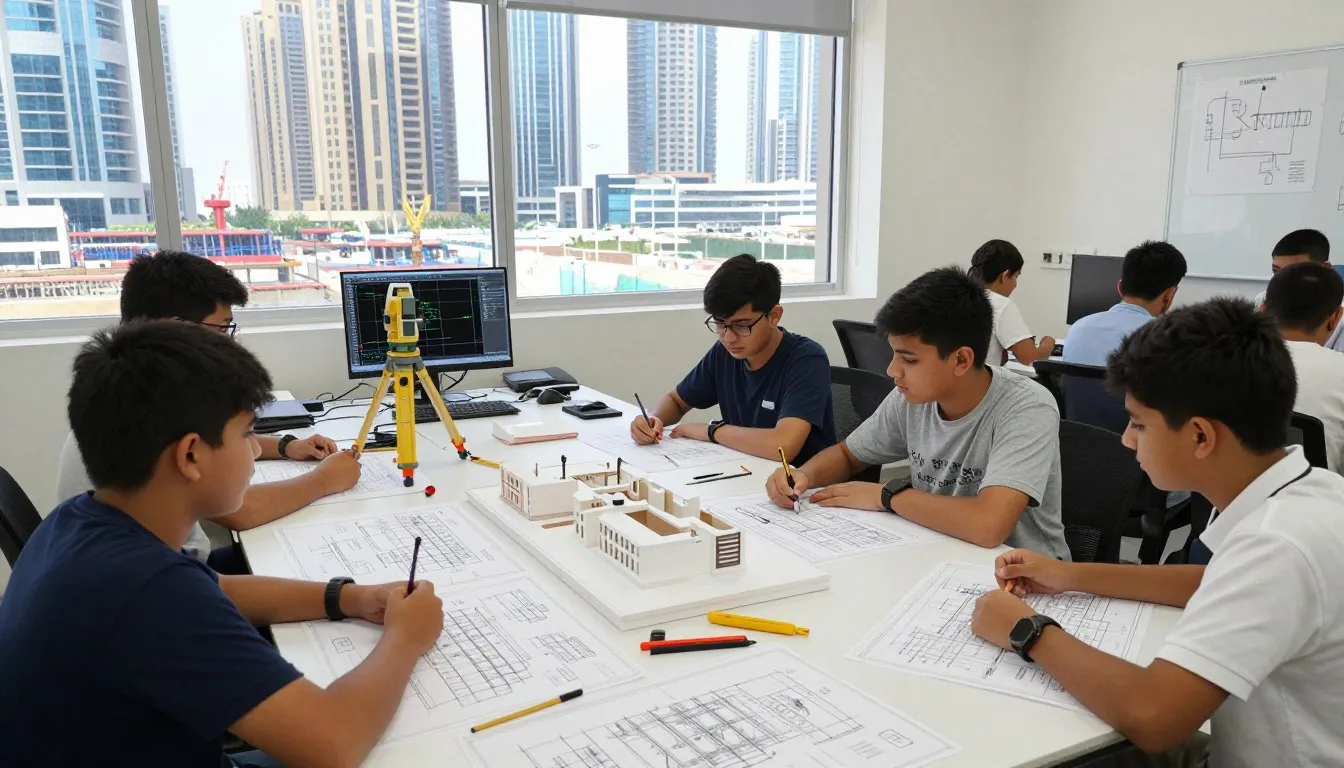
We remember the first time we saw Dubai’s skyline. It was awe-inspiring. The cranes, glass, and precise bridges showed us design meets ambition. For many, a civil engineering course in Dubai is more than studying. It’s a chance to shape cities and grow in infrastructure and urban development.
This article is for those looking to improve their skills in construction, project management, and design. Dubai’s fast growth and big projects offer great chances for engineers. They need training in modern methods and technologies.
At Bright Future Training Institute, we offer practical, career-focused education in the UAE. Our goal is to empower students with learning that connects classroom theory to real-world skills. You can contact us at Bright Future Training Institute, http://bftraining.ae, +971559234565, Suite # 404, fourth floor NBQ building Bank Street Bur Dubai, or [email protected].
In this article, we’ll explore program choices, accreditation, and how you can learn on-campus, online, or in a mix. We’ll also talk about certifications, practical skills, and career chances. Whether you’re looking for the top civil engineering program in Dubai or comparing options in the Middle East, we’re here to help.
Key Takeaways
- A civil engineering course Dubai opens pathways into high-demand infrastructure and construction roles.
- Dubai’s construction boom drives curriculum relevance and practical training opportunities.
- Bright Future Training Institute provides industry-focused programs and student support in Bur Dubai.
- We cover program types, accreditation, delivery formats, and career outcomes to guide your choice.
- This article helps you identify the best civil engineering program in dubai and compare regional degree options.
Overview of civil engineering course dubai
We give you a quick look at what a civil engineering course in Dubai offers. It’s for students and professionals who want to learn. The courses mix technical knowledge with hands-on practice. This way, graduates can tackle big projects in the UAE.
What aspiring engineers will learn
Students learn about structural analysis, geotechnical engineering, and more. They also get practical skills like site safety and using CAD software. These skills help them in real-world projects.
Courses also focus on soft skills like communication and leadership. We make sure students can solve problems and be ready for work.
Duration and typical curriculum components
Program lengths vary. Diploma programs last 6–18 months. Bachelor’s degrees take 3–4 years. Master’s programs are 1–2 years.
Curriculum includes math, core civil engineering, and lab work. It also includes software training, internships, and a final project. Short courses focus on specific topics like seismic design.
How Dubai’s construction boom shapes course content
Dubai’s fast growth changes course content. Programs focus on high-rise buildings and metro systems. They also cover seismic design for tall structures.
Training includes advanced materials and smart-city technologies. It also covers UAE-specific laws and health and safety standards. This meets local regulations.
| Program Type | Typical Length | Core Focus | Practical Components |
|---|---|---|---|
| Diploma | 6–18 months | Fundamentals, applied skills | Laboratory work, short internships, site safety |
| Bachelor’s Degree | 3–4 years | Comprehensive engineering theory | Fieldwork, extended internships, capstone project |
| Master’s Degree | 1–2 years | Advanced analysis, research, specialization | Research thesis, industry-linked projects, advanced software training |
| Short Courses & Training | Weeks to months | Specific skills: BIM, safety, surveying | Workshops, software labs, certification assessments |
Why choose Dubai for civil engineering education
We invite ambitious students to a place of rapid growth and global links. Dubai is a key entry point for careers in the Gulf. It offers access to markets and ongoing investments in transport, energy, and urban planning. Here, students learn alongside major employers and cutting-edge practices.
Strategic location and infrastructure development in the UAE
Dubai’s location between Asia, Africa, and Europe attracts cross-border projects and multinational teams. Its major transport corridors and free zones open doors to jobs with companies like DP World and Emirates Group. This makes it easy for graduates to start their careers.
Our curricula meet real-world needs for resilient design, sustainable systems, and smart-city integration. Being close to ongoing developments offers a chance for regional careers and collaboration with various stakeholders.
Industry demand and job prospects in Dubai and the Middle East
The demand for site engineers, structural engineers, project managers, and specialists in infrastructure and transportation is steady. Large construction companies, engineering consultancies, and real estate developers are always looking for skilled talent.
Accredited qualifications and professional certifications boost employability in the UAE and GCC. Students who choose programs that meet market needs can quickly start and advance in their careers.
Exposure to world-class projects and practical training opportunities
We learn alongside iconic projects that set global engineering standards. Internships, site visits, and workshops give us hands-on experience with testing, surveying, and BIM workflows.
Practical training strengthens our portfolios and speeds up skill application. This makes Dubai’s civil engineering programs stand out, providing a clear path to industry success.
| Advantage | What students gain | Relevant employers and sectors |
|---|---|---|
| Strategic regional hub | Access to cross-border projects, regional internships, and networking | DP World, engineering consultancies, transport authorities |
| High industry demand | Faster recruitment into roles like site engineer and project manager | Construction conglomerates, real estate developers, public infrastructure agencies |
| Project immersion | Hands-on site training, BIM exposure, materials and testing labs | Contractors on high-profile builds, specialist consultants, multinational firms |
| Accredited pathways | Regional recognition, smoother licensure, stronger CVs | Professional bodies, licensing authorities, multinational employers |
Types of civil engineering degree programs in the Middle East
We help students find their way in construction, infrastructure, and urban development in the UAE and beyond. The program you choose affects your technical skills, career pace, and licensing options.
Bachelor’s, Master’s, and diploma program differences
Bachelor’s degrees offer a wide base in math, mechanics, materials, and design. They prepare you for engineering licensure and entry-level jobs on big projects. Companies like AECOM and Atkins often lead these projects.
Master’s programs dive deeper into areas like structural, geotechnical, and transportation engineering. They’re great for research roles and leadership in consultancies, government, and firms like Turner Construction.
Diploma courses are shorter and focus on specific skills for technicians and ongoing learning. They’re perfect for those wanting quick employment or site roles in the UAE.
Accreditation and recognition across the region
It’s important to check if your program is accredited. The UAE’s Ministry of Education and KHDA set standards. ABET international validation can also increase your job prospects.
Professional recognition is key for getting licensed and trusted by employers. Being part of the Emirates Society of Engineers and regional councils shows you’re qualified for jobs in Dubai and other Gulf cities.
When looking at civil engineering courses in Dubai, check the degree’s validity, outcomes, and local recognition. This ensures a smooth career path.
Bridging programs and pathways for international students
International students often start with foundation years or pathway programs. These cover math, physics, and academic skills, helping bridge curriculum gaps.
Language skills are essential for visa and academic success. We support IELTS, PTE, CELPIP, OET, and TFE to help you qualify for degrees and professional registration.
Credit transfer agreements and pathways let diploma holders move to bachelor’s programs. Bright Future Training Institute helps with exam prep and pathway advice for international students in the Middle East.
Top civil engineering institutes in UAE and what to look for
We help students and professionals make informed choices. Choosing a top civil engineering institute in the UAE is important. Look for accreditation, hands-on facilities, experienced faculty, and strong industry connections.
We focus on signs that show graduates are ready for the job market. These signs include practical skills and knowledge.
Key accreditation bodies and quality indicators
We check if the UAE Ministry of Education and KHDA recognize the Dubai campuses. We also look for international validation like ABET for engineering programs. Accreditation shows the program meets high standards and prepares students well for the industry.
Quality indicators include data on graduate success, clear entry requirements, and transparent tests. It’s also important to see what employers say about graduates. Look at program reviews to check if claims about job readiness are true.
Facilities, labs, and faculty credentials
We expect to see labs for testing structures, geotechnical rigs, and equipment for materials and surveying. It’s also key to have BIM suites, CAD labs, and simulation tools. Students need real-world training.
Faculty should have advanced degrees and work experience in companies like AECOM or Parsons. Check their CVs, the number of students per piece of equipment, and lab access policies.
Industry partnerships and placement records
We look for partnerships with big contractors and consultancies. Look for internship programs and guest lectures from industry leaders like ALEC and Arabtec. These connections help students move from class to real-world projects.
Placement records should be up-to-date and detailed. We value institutes that share internship success rates, employer lists, and how quickly they place graduates. This helps find the best civil engineering program in Dubai or accredited courses in Dubai.
Best civil engineering program in Dubai: evaluation criteria
We help students find the top civil engineering programs in Dubai. We look at curriculum, hands-on training, and how well graduates do in their careers. Each aspect is important.
Curriculum relevance to modern construction challenges
Modules on sustainability and resilient design are key. They must match Dubai’s climate and rules.
Courses should also cover demolition, infrastructure management, and smart-city integration. This ensures students learn about the latest in construction.
A good curriculum fits UAE standards and new industry trends. It prepares students for the future.
Hands-on training, internships, and site visits
Internships are essential. They should be structured, recognized, and offer mentorship.
Students need to work on real projects and do lab work. This mixes theory with practical skills like surveying.
Site safety training and visits are also important. They prepare students for Dubai’s construction sites.
Graduate outcomes and employer reputation
We check how well alumni do in their careers. We look at their salaries and how quickly they get jobs.
Strong programs have endorsements from UAE contractors and consultants. This shows they are ready for the job market.
Employer reputation is key. It shows a program’s value and access to certification courses.
| Evaluation Area | What We Check | Why It Matters |
|---|---|---|
| Curriculum Depth | Modules on sustainability, smart-city tech, asset management | Prepares graduates for Dubai projects and modern construction challenges |
| Practical Training | Internship length, site visits, supervised labs, safety certification | Builds hands-on competence and employer confidence |
| Industry Links | Partnerships with contractors, consultancies, and municipalities | Creates pathways to jobs and mentorship |
| Graduate Metrics | Alumni placement rates, salary data, employer feedback | Measures real-world return on education |
| Certification Pathways | Access to civil engineering certification courses and CPD options | Supports licensure and ongoing professional growth |
| Program Reputation | Rankings, employer endorsements, student testimonials | Signals trust and long-term industry relevance |
Affordable civil engineering courses and scholarship options
We guide students and professionals to find affordable, impactful paths. We focus on short, practical courses and certifications. This way, you can gain skills without breaking the bank.
When picking a program, look at lab access, job support, and industry connections. These factors are as important as the cost.
Finding cost-effective programs without sacrificing quality
Choose accredited diploma or certificate courses with lots of hands-on learning. Focus on surveying, CAD, and materials testing. These skills are essential and can be learned quickly and affordably.
Compare the cost of tuition with the value of on-site labs, internships, and the qualifications of your instructors. This will help you make a smart choice.
Short technical certifications are great stepping stones. They often come from top civil engineering institutes in the UAE. You can use them as a starting point for more advanced qualifications.
Scholarships, grants, and employer-sponsored training in the UAE
Look into scholarships from universities, government subsidies, and grants from professional bodies like the Society of Engineers UAE. Many employers in construction and consulting offer in-house training or tuition help for the best civil engineering program in Dubai.
Reach out to HR teams at companies like Emaar, DP World, and Arabtec to find out about sponsored courses. Professional associations and some universities also offer regular scholarship opportunities for vocational and degree programs.
Payment plans and part-time study alternatives
We offer flexible options for those who need to work and study. Look into installment plans, evening classes, and weekend modules. These options allow you to keep working while earning your credentials.
Bright Future Training Institute provides flexible schedules and payment plans for various vocational and certification courses. This makes affordable civil engineering courses more accessible, without slowing down your career.
Online civil engineering classes in Dubai and hybrid delivery
We offer flexible paths for professionals to balance work and study. Our approach makes civil engineering courses in Dubai a way to grow your career. It combines theory with practical skills, allowing you to learn quickly without moving.
Advantages of online and blended learning for working professionals
We create schedules that fit your work and site commitments. This reduces travel time and helps you progress steadily. The blended model includes live webinars and recorded lectures for easy review.
This flexibility helps engineers update their skills in construction management and more. It meets the needs of employers in Dubai.
We focus on practical assessments that reflect real-world tasks. Short courses offer targeted skills, like project scheduling and quality control. These can be stacked into bigger qualifications. Employers in Dubai value candidates with both theory and practical skills from online programs.
Popular online modules and virtual lab experiences
Modules cover basics like structural analysis and construction management. They also include CAD tutorials, project scheduling, and BIM fundamentals. These are key parts of many civil engineering courses in Dubai.
Virtual labs offer simulations for testing materials and analyzing structures. It’s important to check if providers use tools like Autodesk for CAD and BIM. Also, see how they check your skills through timed assessments or projects.
How to verify accreditation for online courses
Make sure the course is recognized nationally, like by the KHDA or Ministry of Education. Check if the online syllabus matches the on-campus one. Ask for sample syllabi to compare.
See if the course is recognized by professional bodies like the UAE Society of Engineers. Check if graduates can join or get licensed. Ask for assessment rubrics, testimonials, and completion rates to judge quality.
Accredited civil engineering courses in Dubai and certifications
We help professionals and students find accredited civil engineering courses in Dubai. These courses meet industry standards and help with licensure. Choosing an accredited program shows employers you’re ready for the job.
It makes it easier to get registered and ensures you learn the latest skills. This is important for both national and international careers.
How accreditation impacts employability in the UAE
Accreditation means your skills are verified. Employers in Dubai and the UAE look for graduates from recognized programs. They want people for design, site supervision, and project management.
Having accredited credentials means you can register with local authorities. This can help you get hired faster and move up in your career.
Important civil engineering certification courses to consider
We suggest certification courses that add to your degree. Look at NEBOSH health & safety, AutoCAD and Civil 3D, Revit/BIM, and Primavera P6 for project scheduling.
Short courses like ISO 9001 quality management, materials testing, and UAE VAT training are also valuable. Bright Future Training Institute and others offer these programs.
Continuing professional development and license preparation
Professional growth needs ongoing learning. We suggest tracking CPD hours through accredited events. This meets Emirates Society of Engineers standards.
For UAE engineering licensure, take exam-focused classes and mock tests. Get advice from experienced engineers. Staying in training programs keeps you skilled and moves your career forward.
Civil engineering training programs and practical skill development
We create civil engineering training programs to bridge the gap between theory and practice. Our focus is on hands-on learning, using industry-standard tools, and completing assessed projects. Students in our civil engineering course in Dubai gain skills that employers in the UAE value.
Site safety, surveying, and materials testing workshops
Our workshops cover site safety, including permit systems, scaffolding checks, and personal protective equipment. Students learn about UAE health and safety laws and how to report incidents.
Surveying modules teach the use of total stations and GNSS receivers. Students practice leveling, control networks, and stakeout procedures. Materials testing includes soil classification, concrete slump, and compressive strength tests.
Software training: CAD, structural analysis, and BIM tools
Courses use AutoCAD and Civil 3D for drawings and corridor modeling. For structural design, we teach STAAD.Pro or ETABS and Excel-based analysis. Revit and BIM prepare learners for real-world projects.
Project scheduling and resource planning are taught with Primavera P6 and Microsoft Project. Bright Future Training Institute adds SolidWorks for component modeling and CCTV systems training.
Project-based learning and capstone projects
Capstone projects simulate real-world delivery, from concept design to site supervision. Teams handle procurement lists, risk registers, and quality plans. They meet criteria set by practicing engineers.
We require supervised capstones with external review. This shows students’ competence in integrated tasks. For working professionals, online civil engineering classes in Dubai offer support for project milestones and feedback.
| Practical Module | Key Skills | Typical Tools | Assessment |
|---|---|---|---|
| Site Safety Workshop | Permit systems, PPE, HSE reporting | Checklists, incident logs | Practical drill and written checklist |
| Surveying Lab | Leveling, GNSS setup, stakeout | Total station, GNSS receivers | Field survey deliverable and accuracy report |
| Materials Testing | Soil classification, concrete tests, NDT basics | Proctor molds, compression machine, rebound hammer | Test logbook and lab report |
| CAD & Civil 3D | Technical drawings, site modeling | AutoCAD, Civil 3D | Submission of construction drawings |
| Structural Analysis | Load modelling, member design | STAAD.Pro, ETABS, Excel | Design report with calculations |
| BIM Collaboration | Model coordination, clash detection | Revit, Navisworks | Clash resolution log and federated model |
| Scheduling & Planning | Critical path, resource levelling | Primavera P6, MS Project | Project schedule and baseline comparison |
| Capstone Project | Integrated delivery, contract management | All above tools and live data | Industry-assessed project submission |
Civil engineering diploma programs in UAE and fast-track options
We offer practical pathways for learners to quickly enter the construction sector. Civil engineering diploma programs in UAE focus on hands-on skills and site readiness. These fast-track options are affordable and help working professionals upskill without long breaks.
Who benefits from diploma versus degree pathways
Diploma routes are great for technicians, site supervisors, and skilled tradespeople aiming for rapid entry or promotion. Candidates use diplomas to gain skills in surveying, materials testing, and site management.
Bachelor’s degrees are recommended for those targeting chartered status, complex structural design roles, or senior leadership. A degree provides deeper theory, research practice, and pathways to professional licensure.
Typical modules included in diploma programs
Most programs include construction materials and methods to teach material selection and workmanship standards.
Surveying fundamentals and building drawing and CAD give learners tools for accurate site layout and design interpretation.
Site management, quality control and safety modules prepare students for day-to-day operations and regulatory compliance.
Basic structural design and practical lab sessions solidify applied calculations and hands-on testing skills.
Conversion paths from diploma to degree
Articulation agreements enable credit recognition, letting diploma graduates transfer relevant modules into bachelor’s programs. We advise confirming credit equivalence with the receiving university before enrollment.
Bridging courses cover theoretical gaps, often in advanced mathematics, structural analysis, and engineering science. Many institutions offer a top-up year to convert a diploma into a full bachelor’s credential.
Students should select accredited providers and verify that the civil engineering course Dubai or UAE degree accepts transferred credits to ensure seamless progression.
| Feature | Diploma Pathway | Bachelor’s Degree |
|---|---|---|
| Typical duration | 1–2 years, fast-track options available | 3–4 years, full academic curriculum |
| Target learners | Technicians, tradespeople, working professionals | Aspiring chartered engineers, researchers, managers |
| Core modules | Construction materials, surveying, CAD, site management | Advanced structural design, fluid mechanics, geotechnical engineering |
| Practical emphasis | High, with labs and site training | Moderate to high, plus research projects |
| Cost considerations | Often listed among affordable civil engineering courses | Higher tuition, greater long-term earning |
| Progression options | Credit transfer to bachelor’s, bridging/top-up years | Postgraduate study and professional accreditation |
| Ideal when | Rapid workforce entry or upskilling is needed | Long-term career growth and chartership are goals |
Career outcomes: jobs and salary expectations for graduates
We help graduates find clear career paths after completing a civil engineering course in Dubai. They start in entry roles on construction sites, in design offices, and materials labs. Here, they use their core skills.
As they gain experience, get certifications, and show they can deliver projects, they move up. This is how they progress.
Common roles: site engineer, structural engineer, project manager
At first, graduates might work as junior or site engineers, surveyors, or design engineers. Those with hands-on experience can become materials engineers or quantity surveyors. With time and more qualifications, they can become senior structural engineers or project managers.
These roles involve leading teams and overseeing complex projects.
Salary ranges in Dubai and progression opportunities
In Dubai, salaries vary based on qualifications, job type, and employer size. Diploma holders and junior engineers earn less than those with degrees. Mid-level structural engineers see a big jump after getting chartered or certified as PMP.
Project managers and lead engineers at big firms earn the most. This is true, even more so if they have experience working on international projects.
Tips for job searching and building a professional portfolio
To improve your job chances, take practical steps. Put together a digital portfolio with site photos, project reports, CAD drawings, and BIM models. Also, get internships or short-term jobs to gain experience and get references.
Getting certifications in BIM, NEBOSH, OSHA, and Primavera can help you stand out. Use LinkedIn to network and join local chapters of the Institution of Civil Engineers or the Society of Engineers UAE for job leads.
Training providers can help with CVs, interviews, and presentation skills. Skills like communication and leadership are also important for moving up in Dubai’s competitive job market.
| Role | Typical Entry Qualifications | Experience to Mid-Level | Common Progression | Notes on salary expectations dubai |
|---|---|---|---|---|
| Junior/Site Engineer | Diploma or Bachelor’s in Civil Engineering | 2–4 years practical site work | Site lead, QA/QC engineer | Entry range; rises with site certifications |
| Design Engineer | Bachelor’s in Civil or Structural Engineering | 3–6 years with design software proficiency | Senior structural engineer, technical lead | Higher for specialized structural roles |
| Quantity Surveyor | Bachelor’s in QS or Civil Engineering | 2–5 years in estimating and contracts | Cost manager, commercial manager | Performance bonuses common in large projects |
| Materials/Testing Engineer | Diploma or Bachelor’s with lab experience | 2–5 years in materials labs and standards | Laboratory manager, consultant | Specialist roles command premium rates |
| Project Manager | Bachelor’s plus project experience, PMP helpful | 5–10 years managing multi-discipline teams | Program manager, director of projects | One of the highest-paid civil roles in Dubai |
How Bright Future Training Institute supports aspiring civil engineers
We help students get ready for careers in civil engineering. Our courses are practical and meet Dubai’s construction needs. At Bright Future Training Institute, we offer flexible learning to fit your schedule.
Our campus is in Bur Dubai, at Suite # 404, fourth floor NBQ building, Bank Street. You can visit us during office hours or call +971559234565. For emails, send to [email protected] and check our website for course details.
We have a wide range of courses, including HVAC, SolidWorks, and solar training. You can also learn about IT and site systems, like CCTV Camera and Surveillance System. Plus, we teach software skills that civil engineers use every day.
Our courses are accredited and include programs for international students. We offer IELTS, PTE, CELPIP, OET, and TFE Exam Preparation. We also teach UAE VAT Training and soft skills like presentation and leadership.
We make learning affordable. Our courses have flexible schedules and payment plans. We help you choose the right course based on your goals and budget.
Start by contacting us online or by phone. We’ll guide you through course options and schedules. After you enroll, you’ll get support for your career path.
For more information, email [email protected] or call +971559234565. We’re here to help you succeed in Dubai’s construction industry.
Conclusion
Dubai’s economy is driven by construction, creating a big need for skilled workers. A civil engineering course in Dubai is a great way to start a career. Look for programs that mix theory with practical skills and software knowledge.
When picking a civil engineering program in Dubai, think about the hands-on experience, the teachers’ qualifications, and what graduates do after they finish. Programs with internships, lab work, and connections with employers help students get jobs faster in the UAE and Middle East.
At Bright Future Training Institute, we focus on giving students the skills they need to succeed. We offer flexible learning options and support to help students do their best. If you’re interested in learning more, visit our website at http://bftraining.ae, call +971559234565, or email us at [email protected] to talk about your options.
FAQ
What civil engineering course options are available in Dubai for aspiring engineers?
Dubai has many civil engineering courses. You can choose from diploma programs (6–18 months), bachelor’s degrees (3–4 years), and master’s programs (1–2 years). There are also short certification courses and professional training modules.
These courses are offered online, on-campus, or in a hybrid format. They cover topics like structural analysis, geotechnical engineering, and construction management. You’ll also learn about materials testing, surveying, and using BIM and CAD tools.
Soft skills like communication and leadership are also taught. This prepares you for a career in civil engineering.
How do we choose the best civil engineering program in Dubai?
When choosing a program, look at accreditation. Check if it’s recognized by KHDA, the UAE Ministry of Education, or ABET. Also, consider the curriculum and if it matches modern construction challenges.
Look for programs with hands-on training and lab access. Check the internship and placement records. The credentials of the faculty and industry partnerships are also important.
Graduate outcomes and employer reputation are key. Look for transparent placement statistics.
Are there accredited civil engineering courses and certifications in Dubai that improve employability?
Yes, there are. Accredited courses and recognized professional certifications can boost your employability. Look for NEBOSH (health & safety), AutoCAD/Civil 3D, Revit/BIM, and Primavera P6 certifications.
ISO 9001 quality management and materials testing credentials are also valuable. Accreditation helps with licensure and membership in professional bodies like the Emirates Society of Engineers.
What practical skills and training will we gain from civil engineering training programs?
You’ll learn practical skills like site safety protocols and surveying. You’ll also learn about soil and concrete testing, and non-destructive testing basics.
Skills in using STAAD.Pro/ETABS for structural analysis and AutoCAD/Civil 3D drafting are taught. You’ll also learn about Revit/BIM workflows, Primavera/MS Project scheduling, and capstone project management.
Programs focus on supervised lab sessions, site visits, and project-based assessments. This ensures you gain hands-on competence.
Can working professionals take online civil engineering classes in Dubai?
Yes, working professionals can take online classes. Online and hybrid classes offer flexibility, allowing you to balance work and study.
Popular online modules include structural analysis basics, construction management, and CAD tutorials. BIM fundamentals are also covered. Make sure to verify national accreditation for online courses.
Ensure virtual labs and assessments provide the same learning outcomes as on-campus courses.
What are affordable options and scholarship opportunities for civil engineering students in the UAE?
There are affordable options like accredited diploma and certificate courses. Short technical certifications and part-time or blended delivery are also available.
Funding sources include institutional scholarships, government grants, and employer-sponsored training. Installment payment plans are also offered. Contact course providers and employers for sponsorship and check available scholarships.
How long do typical civil engineering programs take to complete?
Program durations vary. Short certificates and diplomas take 6–18 months. Bachelor’s degrees are 3–4 years, and master’s programs are 1–2 years.
Many institutes offer accelerated or top-up pathways and part-time schedules for working learners.
How does Dubai’s construction environment influence course content?
Dubai’s focus on high-rise buildings and mega-infrastructure drives course content. You’ll learn about advanced structural design and seismic considerations for tall buildings.
High-performance materials, infrastructure asset management, and smart-city technologies are also covered. Industry-relevant modules like construction law and UAE health & safety standards are included.
What accreditation should we check before enrolling in a civil engineering program in Dubai?
Verify institutional accreditation with the UAE Ministry of Education and local oversight like KHDA for Dubai. Check for international accreditation like ABET for engineering programs.
Also, confirm recognition by professional bodies like the Emirates Society of Engineers. Ensure the program meets licensure or CPD requirements.
How do diploma programs compare to degree programs and who should choose them?
Diplomas are shorter and more focused. They’re suited for technicians, tradespeople, and those seeking rapid entry into site-based roles. Degrees offer more theory and practice for professional engineering licensure and leadership roles.
Diplomas can often be credited toward a bachelor’s top-up or used as a bridge into degree study through articulation agreements.
What career outcomes and salary expectations can civil engineering graduates expect in Dubai?
Graduates can expect roles like junior/site engineer, surveyor, design engineer, and materials engineer. Salaries vary by qualification, experience, and employer.
Degree-qualified and certified professionals generally command higher compensation. Progression depends on certifications, international experience, and proven project delivery. Consult current recruitment surveys for exact figures.
How can we validate the quality of labs, faculty and industry partnerships at an institute?
Check for facilities like structural and materials testing labs, surveying equipment, and BIM/CAD suites. Look at the faculty’s CVs for industry experience.
Ask about student-to-equipment ratios, formal industry tie-ups, internship pipelines, and guest lecturers from leading firms. Documented placement records are also important. Institutes with active employer networks typically offer stronger practical exposure.
What continuing professional development and licensing support should courses provide?
Good programs offer CPD workshops, exam preparation for UAE engineering licensure, and guidance for Emirates Society of Engineers membership. They should provide licensing exam prep, mock tests, and workshops aligned with professional registration requirements.
What specific support and courses does Bright Future Training Institute provide for aspiring civil engineers?
Bright Future Training Institute offers a range of technical, software, and professional courses. They support civil engineering careers with practical technical programs, software training, and industry-relevant short courses.
They also offer language and exam preparation, and complementary modules like UAE VAT training and soft skills. Contact us at http://bftraining.ae, +971559234565 or [email protected] for tailored guidance, flexible scheduling, and enrollment details.
How do we verify accreditation and course recognition for online or hybrid programs?
Request formal accreditation documentation from the provider showing KHDA or Ministry of Education recognition. Ask for sample syllabi, assessment rubrics, and graduate outcomes.
Ensure online learning meets the same learning outcomes as on-campus equivalents. Confirm whether professional bodies recognize online completion for licensure or CPD credit.
What practical workshops and software trainings are most valuable for immediate employability?
Practical workshops include site safety, surveying techniques, and soil and concrete testing. Non-destructive testing basics are also taught.
Software trainings that boost employability include AutoCAD/Civil 3D, Revit/BIM, STAAD.Pro or ETABS, Primavera P6, and advanced Excel for engineering analysis. Combined practical and software competence significantly improves job readiness.