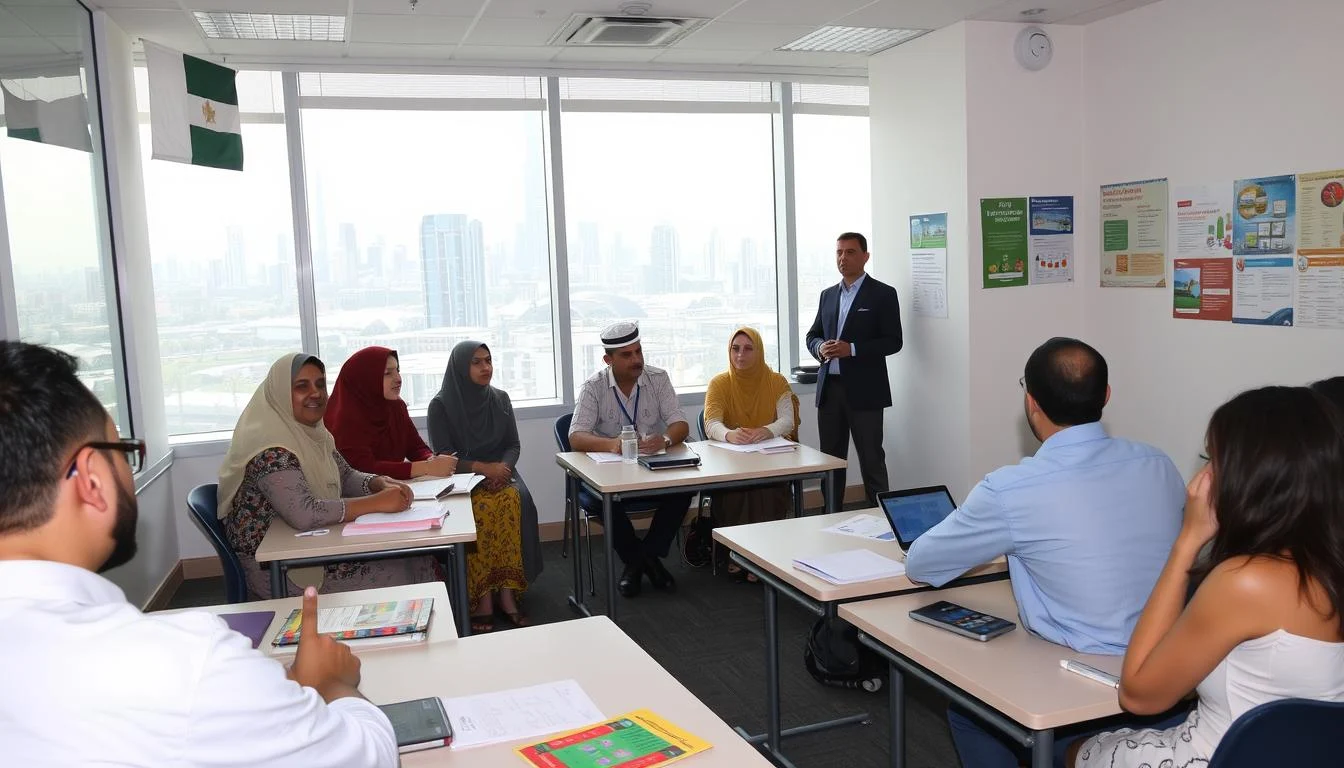
A good IELTS coaching centre in Dubai teaches all four test skills, gives regular written feedback on Writing and Speaking, runs timed practice tests and explains how to improve, not only what to practise. Check the trainers, class format, feedback routine and practice material before you enrol, and ask for a free demo class first.
Key takeaways
- Coaching is worth choosing when it gives personal feedback, especially on Writing and Speaking, which are hard to mark yourself.
- Match the module to your goal: Academic for university study, General Training for work or migration purposes. Confirm which one your institution asks for.
- Ask to see how mock tests are marked and how feedback is delivered before you commit.
- Bright Future Training Institute in Bur Dubai offers IELTS preparation in the classroom and as online live sessions, with a free demo class before enrolling.
- Fees, test dates and exam rules belong to the exam bodies and the institute, so always confirm current details at source.
What does an IELTS coaching centre actually do?
An IELTS coaching centre helps you prepare for a test that measures English in four skills: Listening, Reading, Writing and Speaking. The exam itself is run by the official IELTS partners, and a coaching centre is a separate training provider. It does not sit the exam for you and it does not control marking.
What a centre can control is the quality of your preparation. A strong course does four things. It explains how each task is built, it gives you structured practice, it marks your work against the published band descriptors, and it shows you which habits are holding your score back.
Many candidates in Dubai already speak English well at work. They still lose marks because they are unfamiliar with the task formats, run out of time, or write in a style the examiner does not reward. Coaching is mainly about closing the gap between everyday English and exam English.
Coaching, self-study and online apps: how they differ
Self-study works for disciplined candidates who already score close to their target. Apps and videos are useful for vocabulary and Listening practice, but they rarely mark a full Writing task with comments you can act on. Coaching adds a person who reads your work, hears you speak and tells you what to change.
| Route | What it does well | Where it falls short |
|---|---|---|
| Self-study with books | Flexible and easy to start | No one marks your Writing or Speaking |
| Apps and online videos | Quick practice, good for Listening and vocabulary | Limited personal feedback |
| Group coaching | Structured plan, trainer feedback, peer practice | The pace is set for the group |
| One-to-one tuition | Fully personal focus | Needs more planning and a suitable tutor |
For a deeper look at the value of structured classes, see the Bright Future guide to benefits of taking IELTS preparation classes.
How do you know if a coaching centre in Dubai is a good one?
Start with what the centre can show you before you commit. A good centre is happy to answer practical questions, let you try a demo class, and explain its method plainly. A weak one relies on slogans and pressure.
Check the trainers
Ask who will teach you and what they teach. Look for trainers who know the current test format, can explain the marking criteria in simple language, and have experience with candidates from your background. A trainer who has worked with Arabic, Urdu, Hindi, Tagalog or Malayalam speakers will usually spot the typical errors of those groups faster.
You can also ask how the trainers keep up to date with the test. Format details, rules and booking processes can change, so a centre should send you to the official IELTS website for current information instead of guessing.
Ask how feedback works
Feedback is the single most valuable thing you are choosing coaching for. Ask these questions directly:
- Who marks Writing tasks, and how soon do you get them back?
- Are comments written against the band descriptors, or just a score?
- Is Speaking practised in a mock interview format, with live feedback?
- Do you get a chance to rewrite a task after feedback?
If the answer to all four is vague, keep looking.
Look at the practice material
Good practice material matches the real test in format and difficulty. Ask whether you will sit full mock tests under timed conditions, and how often. Ask how the results are reviewed. A mock test that is handed back with a number and nothing else teaches very little.
Be careful with big promises
Treat any centre that promises a particular band score as a warning sign. No training provider controls how an examiner marks your paper. Honest centres talk about preparation, practice and improvement, not results. Be equally careful with claims of "best" or "number one" that come with no evidence you can check.
Which module should you prepare for?
IELTS comes in more than one version, and choosing the wrong one wastes preparation time. The two main versions are Academic and General Training. IELTS for UKVI is a separate version used for certain UK visa routes, and the official IELTS website explains which test applies to which purpose.
| Question | Academic | General Training |
|---|---|---|
| Who usually takes it | Candidates applying for university or professional registration | Candidates applying for work experience, training or migration |
| Listening | Same format | Same format |
| Speaking | Same format | Same format |
| Reading | Passages on academic topics | Texts from everyday and workplace situations |
| Writing | Describing a chart, graph or process, plus an essay | A letter, plus an essay |
Ask the university, employer or immigration authority which version it accepts before you book classes. A good adviser will ask you this question first. You can read more in the Bright Future guide to the difference between General and Academic IELTS.
Bright Future Training Institute lists the IELTS Training Dubai course on its website. If you are unsure which module suits you, an adviser can help you decide.
What should a complete IELTS coaching plan include?
A complete plan covers more than four lessons labelled Listening, Reading, Writing and Speaking. It follows a sensible order and connects the skills.
Diagnostic first
A centre should start by finding out where you are now. A short diagnostic task in each skill shows your strengths and gaps, and it gives the trainer something real to build on. Without that step, everyone in the class gets the same plan whether they need it or not.
Skill by skill
The table below shows what each skill tests and the kind of support coaching typically provides.
| Skill | What it tests | Typical coaching support |
|---|---|---|
| Listening | Understanding spoken English in different accents and contexts | Practice with varied audio, note-taking and answer-checking habits |
| Reading | Finding and understanding information in written texts | Skimming, scanning and handling different question types |
| Writing | Organising ideas clearly and using accurate language | Task planning, model answers and personal feedback |
| Speaking | Communicating naturally in a face-to-face conversation | Mock interviews, fluency practice and feedback on pronunciation |
Strategy and timing
IELTS rewards candidates who manage time well. A coaching plan should include timed practice so that you learn how long to spend on each part. It should also teach you what to do when you get stuck, because a single hard question should never cost you an easy one later.
Language building
Task strategy only goes so far. If your vocabulary range or grammar accuracy is limiting your score, the centre should help you build both through reading, speaking drills and corrected writing. This part takes steady effort, and a trainer who points out your repeated errors saves you a lot of time.
For help on the Writing side, the Bright Future guide to IELTS Writing Task 1 and Task 2 explains the two tasks in detail.
Classroom or online IELTS coaching: which should you choose?
Both formats can work. The right choice depends on your routine, your learning style and how much face-to-face practice you need.
Bright Future Training Institute teaches IELTS in the classroom at the NBQ Building on Bank Street in Bur Dubai and as online live sessions. That gives candidates in Dubai and across the UAE a choice.
| Factor | Classroom | Online live sessions |
|---|---|---|
| Speaking practice | In person, with immediate reaction from the trainer and classmates | Live on screen, with the trainer and group |
| Travel | You travel to Bur Dubai | None, so it suits busy schedules |
| Focus | Fewer home distractions | Needs a quiet space and a good connection |
| Interaction | Natural group discussion | Chat, group work and screen sharing |
| Best for | Candidates who like routine and face-to-face support | Working professionals and candidates outside Dubai |
If you are undecided, a free demo class is an easy way to test the format before you enrol. Candidates who want to compare options can also read the Bright Future guide to the IELTS course in Dubai.
How to reach the coaching centre in Bur Dubai
Convenience matters because regular attendance affects results more than almost any other factor. Bright Future Training Institute is at Suite 404, Fourth Floor, NBQ Building, Bank Street, Bur Dubai, close to BurJuman Metro Station. That makes it reachable by Metro for many candidates living or working across Dubai.
The institute is open daily, 9:00 AM to 5:00 PM. Course advisers answer questions by phone and on WhatsApp at +971 54 373 3394, and by email at [email protected]. If you cannot visit in person, an adviser can explain the online live sessions by phone or message.
Questions to ask before you enrol
A short list of questions makes comparing centres much easier. Take it with you when you call or visit.
About the course
- Which module does this course prepare me for?
- How will you assess my level at the start?
- Are mock tests included, and how are they marked?
- How do I get Speaking practice, and with whom?
About support
- Can I see a demo class or speak to the trainer first?
- What happens if I miss a session?
- Is there support between classes, for example with homework questions?
- What study material will I receive?
About the practical side
- What are the current fees and what do they cover? Ask an adviser, because fees are not published here.
- Which payment options are accepted? Bright Future Training Institute accepts Visa, Mastercard, Tabby and Tamara.
- What is the class format: classroom, online live sessions, or both?
- Which documents or details do I need to enrol?
Keep notes from each call so you can compare answers side by side. The centre that answers clearly and does not rush you is usually the better partner.
Common problems that coaching can fix
Understanding the typical problems helps you judge whether a centre addresses them.
Strong speaker, weaker Writing score
Many fluent speakers are surprised by Writing. The test rewards clear structure, a relevant answer to the exact question and accurate language, not only good ideas. A coach who marks several tasks and points out recurring patterns can change this quickly.
Good reading skills, but problems with time
Some candidates understand the texts but cannot finish the section. Timed practice and question-type strategies help here, and so does learning when to leave a hard question and return to it.
Nervous in the Speaking test
Speaking is a conversation with an examiner, and nerves can make short answers even shorter. Repeated mock interviews build comfort, and feedback shows you how to extend answers naturally.
Listening answers that go wrong in small ways
Spelling slips, plural forms and missed words can cost marks even when you understood the audio. Coaching trains the habit of checking answers carefully while you listen.
You can find detailed tips for each skill in the Bright Future posts on IELTS Reading tips and the IELTS Speaking test.
What to prepare before your first class
A little preparation helps you get more from your first session.
| Preparation | Why it helps |
|---|---|
| Your target band score and your deadline | Lets the adviser plan around your real goal |
| Which module your institution accepts | Prevents preparing for the wrong version |
| A sample of your recent English writing, if you have one | Gives the trainer something to assess |
| Your weekly availability | Helps choose between classroom and online live sessions |
| Any previous IELTS score report | Shows which skills need most attention |
Be honest about your level. Trainers can help most when they see the true starting point.
How to confirm the official exam details
Coaching centres do not set exam fees, dates or rules. The IELTS test is run by its official partners, and those details can change. Always confirm current fees, test dates, identification requirements and booking rules on the official IELTS website and with your chosen test centre before you plan around them.
The same applies to score requirements. Universities, employers and immigration authorities set their own, and they may change them. Check directly with the organisation that will receive your result.
Final thoughts: choose a centre you can trust
The best IELTS coaching centre for you is the one that suits your goal, your schedule and your learning style, and that gives you honest, personal feedback. Visit or call two or three centres, ask the questions above and compare the answers calmly.
If you would like to see how Bright Future Training Institute approaches IELTS preparation, talk to a course adviser or book a free demo class through the contact page, message +971 54 373 3394 on WhatsApp or write to [email protected]. You can also browse the wider exam preparation courses to see what else is available.