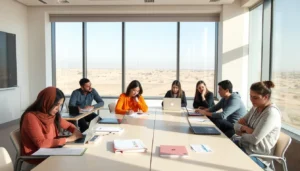
An IELTS course in Dubai is a structured preparation programme that trains you for the four IELTS skills: Listening, Reading, Writing and Speaking. A good course explains the test format, teaches exam technique, gives you timed practice and returns feedback on your writing and speaking, so you can sit the official test with a clear plan.
Key takeaways
- An IELTS course prepares you for the test; the official exam is booked and run separately by the exam organisers.
- Choose Academic or General Training first, because the choice shapes what you practise in Reading and Writing.
- The features that matter most are timed practice, written feedback and speaking practice with a trainer.
- Classroom and online live sessions both work; pick the format that fits your week and your learning style.
- Ask a course adviser about current fees and intakes before you enrol, and confirm exam rules on the official IELTS website.
What does an IELTS course in Dubai actually include?
Most people searching for an IELTS course want to know what they will do in class, week by week. The details differ between providers, but a well-built course follows the shape of the test itself.
Expect work on all four skills. Listening practice trains you to follow recordings and answer while you listen. Reading practice builds speed and accuracy with long texts. Writing practice covers the two task types, and Speaking practice prepares you for a face-to-face interview with an examiner.
At Bright Future Training Institute, IELTS training covers Listening, Reading, Writing and Speaking, with classroom or online preparation. You can read more about the programme on the IELTS Training Dubai course page.
The four skills and what each one tests
| Skill | What the test checks | What a course should give you |
|---|---|---|
| Listening | Understanding spoken English in different situations and accents | Audio practice, note-taking habits, spelling and answer-transfer technique |
| Reading | Understanding ideas, detail and opinions in written texts | Skimming and scanning drills, question-type strategies, vocabulary work |
| Writing | Organising ideas clearly and accurately in two tasks | Model answers, planning methods, corrected practice essays and reports |
| Speaking | Communicating naturally in a short interview | Mock interviews, pronunciation feedback, ideas for common topics |
Beyond the four skills
A strong course also teaches you how the exam is marked, how to manage your time and how to review your own mistakes. These habits often improve results more than extra vocabulary lists do.
How is IELTS scored, and why does that matter for choosing a course?
According to the official IELTS website, results are reported on a 0 to 9 band scale. Listening and Reading each have 40 questions worth one mark apiece, and the raw marks are converted to a band. Your overall band is the average of the four skill scores, rounded to the nearest half band.
Writing and Speaking are marked by trained examiners against published criteria. This is where a course helps most, because these skills cannot be self-checked easily.
- Writing criteria: task achievement (Task 1) or task response (Task 2), coherence and cohesion, lexical resource, and grammatical range and accuracy.
- Speaking criteria: fluency and coherence, lexical resource, grammatical range and accuracy, and pronunciation.
If your course does not teach you these criteria, you will be guessing why a practice answer scored the way it did. Ask any provider how it marks practice writing and whether the trainer explains the criteria in plain language.
Always confirm current exam rules, fees and test dates on the official IELTS website, because these belong to the exam organisers and can change.
Academic or General Training: which version does your course need?
IELTS comes in two versions. According to the official IELTS website, Listening and Speaking are the same in both, while Reading and Writing differ. That means your course must match your version, at least for those two skills.
| Version | Usually chosen for | What differs |
|---|---|---|
| IELTS Academic | Higher education or professional registration | Reading and Writing use academic-style texts and tasks |
| IELTS General Training | Work, training programmes or migration purposes | Reading and Writing use everyday and workplace-style texts and tasks |
Check with your university, employer or the authority asking for your result before you choose, because they decide which version they accept. Our guide to the differences between General and Academic IELTS explains the split in more detail.
How do you choose the right IELTS course?
Comparing courses is easier when you use a checklist. These questions separate a genuine preparation programme from a generic English class.
Does the course match your version and your goal?
Ask whether the class is built for Academic, General Training or both. A mixed group can work for Listening and Speaking, but Reading and Writing need targeted practice for your version.
Is there timed practice and feedback you can use?
Mock tests are only useful if you receive feedback afterwards. Ask how often you practise under test conditions and how the trainer returns comments on Writing and Speaking.
Can you speak with a trainer, not just watch a screen?
Speaking improves through conversation. Look for live interaction, whether in the classroom or in online live sessions, rather than recorded lessons alone.
Is the information honest?
Be careful with any provider that names a result in advance. A band depends on your own English, your practice and the day of the test, so no course can honestly settle it for you. A trustworthy provider explains what the course does and does not control.
Classroom or online live sessions: which format suits you?
Bright Future Training Institute runs classes in the classroom at the NBQ Building, Bank Street, Bur Dubai, close to BurJuman Metro Station, and as online live sessions. Both formats prepare you for the same exam, so the better choice is the one you can attend consistently.
| Consideration | Classroom | Online live sessions |
|---|---|---|
| Interaction | Face-to-face with trainer and classmates | Live, through a screen |
| Travel | You travel to Bur Dubai | Study from home or work |
| Speaking practice | In-person partner and trainer practice | Live conversation with the trainer and group |
| Best for | Learners who like a routine away from home | Learners across the UAE with busy or distant commutes |
If you are still deciding on the format, read our guide to the best online IELTS course for what to look for in a live online class.
What should you do before you enrol?
A little preparation makes the first class far more useful. Work through this short list.
- Decide which IELTS version you need and who will receive your result.
- Take a sample practice test, so you and the trainer know your starting point.
- Note which skill feels weakest; most learners find Writing or Speaking the hardest to self-correct.
- Choose a weekly study pattern that you can honestly keep.
- Ask about intakes, class format and current fees.
- Find out whether you can attend a demo class first.
Students can book a free demo class before enrolling, which is an easy way to see the teaching style for yourself.
What does a typical IELTS lesson look like?
Course formats vary, but a lesson usually mixes explanation, practice and review. Knowing the pattern helps you judge whether a provider is teaching or only supervising.
Explain, practise, review
A trainer first introduces a question type or a writing task, showing what examiners look for. You then practise on your own or in pairs, and the trainer reviews the answers with the group. The review stage is the valuable part, because it shows why an answer earned or lost marks.
Skill-focused sessions
Some sessions focus on a single skill. A Listening session might train you to predict answers while the recording plays. A Reading session might concentrate on matching headings, true/false/not given questions or completing summaries. A Writing session might compare a weak paragraph with a stronger one. A Speaking session usually puts you in short mock interviews with a trainer or partner.
Test-day habits
Good courses also rehearse the practical side of the exam: arriving prepared, following instructions carefully, writing answers clearly and moving on when a question takes too long. These small habits protect marks that language ability alone would not.
Which skill is hardest, and how does a course help?
Learners often say one skill feels harder than the others. The answer depends on your background, but the patterns below are common, and each has a practical fix.
Listening: following the recording
The difficulty is that you hear the recording once. A course trains you to read the questions first, underline key words and listen for paraphrases, because the speaker rarely repeats the exact words printed on the page.
Reading: managing long texts
Reading texts are long, and the question sets reward focus. Skimming and scanning drills teach you to find the relevant paragraph quickly instead of reading every word. Vocabulary work then helps you recognise synonyms.
Writing: organisation and accuracy
Writing is where self-study stalls most often, because you cannot always see your own errors. Trainer feedback on structure, task response and grammar is what turns practice essays into progress. This is also why a course with corrected writing is worth more than one with unmarked model answers.
Speaking: confidence and fluency
Speaking improves with repetition. A course gives you a safe place to answer questions aloud, hear corrections on pronunciation and learn to extend your answers without memorising scripts. Examiners notice rehearsed speeches, so natural fluency is the better goal.
Which IELTS courses does the institute offer?
IELTS preparation at Bright Future Training Institute is organised by purpose, so you can match the course page to your situation. The main page is IELTS Training Dubai. The institute also lists related IELTS pages, including Academic preparation, General Training, IELTS for UKVI and Life Skills preparation, so ask an adviser which suits the requirement you have been given.
The word "requirement" matters here. Universities, employers and authorities set the version of IELTS they accept, and only they can tell you. A course adviser can explain how the course relates to your version, but you should confirm the exact test your organisation wants before booking anything.
How long should you leave before the official test?
There is no single answer, and it is better not to borrow a figure from another learner. Your starting level, your target version and the time you can give each week all change the plan. A course adviser can look at your situation and suggest a realistic approach after you try a sample test.
What matters more than the calendar is the cycle: learn a skill, practise it, receive feedback, then test yourself again. If a plan leaves no room for that cycle, it is too tight. Our guide on IELTS preparation tips for beginners helps you set up that cycle.
How do you plan around the official test booking?
An IELTS course prepares you; it does not replace booking the test. The official test is arranged with the exam organisers, who set the fees, dates and rules. Follow this order to avoid stress.
- Confirm which IELTS version your university, employer or authority accepts.
- Check the official IELTS website for current fees, test dates and rules.
- Start your course with enough time to practise, receive feedback and repeat mock tests.
- Book the official test once you feel ready and your trainer agrees you are prepared.
Avoid booking a date first and then searching for a course that fits. Rushed preparation tends to leave Writing and Speaking weak, and those are the skills that need feedback over time.
How should you study between classes?
Class time is only part of the work. Steady practice between sessions is where progress builds.
Build a simple routine
Short daily sessions are usually easier to keep than occasional long ones. Alternate skills so none is neglected: listen on one day, write on another, and practise speaking aloud as often as you can.
Review your mistakes
Keep a notebook of errors in spelling, grammar and question types. Reviewing it before each mock test turns every error into a lesson.
Use official practice material
Use practice material from the exam organisers and recognised publishers, and ask your trainer which materials suit your level. Our IELTS preparation tips for beginners give a gentle starting plan if you are new to the test.
Common questions to ask any IELTS provider
Before you pay, ask each provider the same questions and compare the answers. Clear, specific replies are a good sign; vague replies deserve follow-up.
- Which IELTS version does this class prepare me for?
- Will I receive corrected feedback on Writing, and how soon?
- How do you practise Speaking, and with whom?
- Are mock tests included, and are they marked?
- What happens if I miss a session?
- Can I try a demo class first?
- What are the current fees and what do they cover?
Write the answers down so you can compare them side by side. Do not choose on price alone, and do not rely on claims you cannot verify. If a provider quotes unusual results or names a band in advance, treat it as a warning sign.
IELTS course or coaching: is there a difference?
People use the two words interchangeably. In practice, a course usually means a planned programme with a clear structure, while coaching often describes closer, more personal support around your weak areas. Many learners benefit from both: a structured course for the full syllabus and extra trainer attention where they need it. Our post on IELTS coaching in Dubai looks at what to expect from coaching.
Who benefits from an IELTS course?
A course is not only for beginners. Different learners come with different needs.
- Students applying for further study who need to understand the exam format.
- Working professionals who need an English result for a role, registration or move.
- Job seekers and families in the UAE planning their next step.
- Repeat test takers who want a clearer diagnosis of what held their score back.
The institute's description lists students, school leavers and their parents, working professionals and job seekers among its learners. A course adviser can help you judge which path fits you.
How do you reach Bright Future Training Institute in Bur Dubai?
The institute is at Suite 404, Fourth Floor, NBQ Building, Bank Street, Bur Dubai, Dubai, United Arab Emirates, close to BurJuman Metro Station. It is open daily, 9:00 AM to 5:00 PM. Certificates are approved by KHDA and recognised across the UAE, and the institute is an affiliate partner of the British Council.
Payment options include Visa, Mastercard, Tabby and Tamara. Because no fees are published online, ask a course adviser for current fees and available intakes.
You can also browse related options in the exam preparation category.
Next step: talk to a course adviser
If you are ready to choose an IELTS course, speak to a course adviser, ask your questions and book a free demo class before enrolling. Reach the team through the contact page, by phone or WhatsApp on +971 54 373 3394, or by email at [email protected].