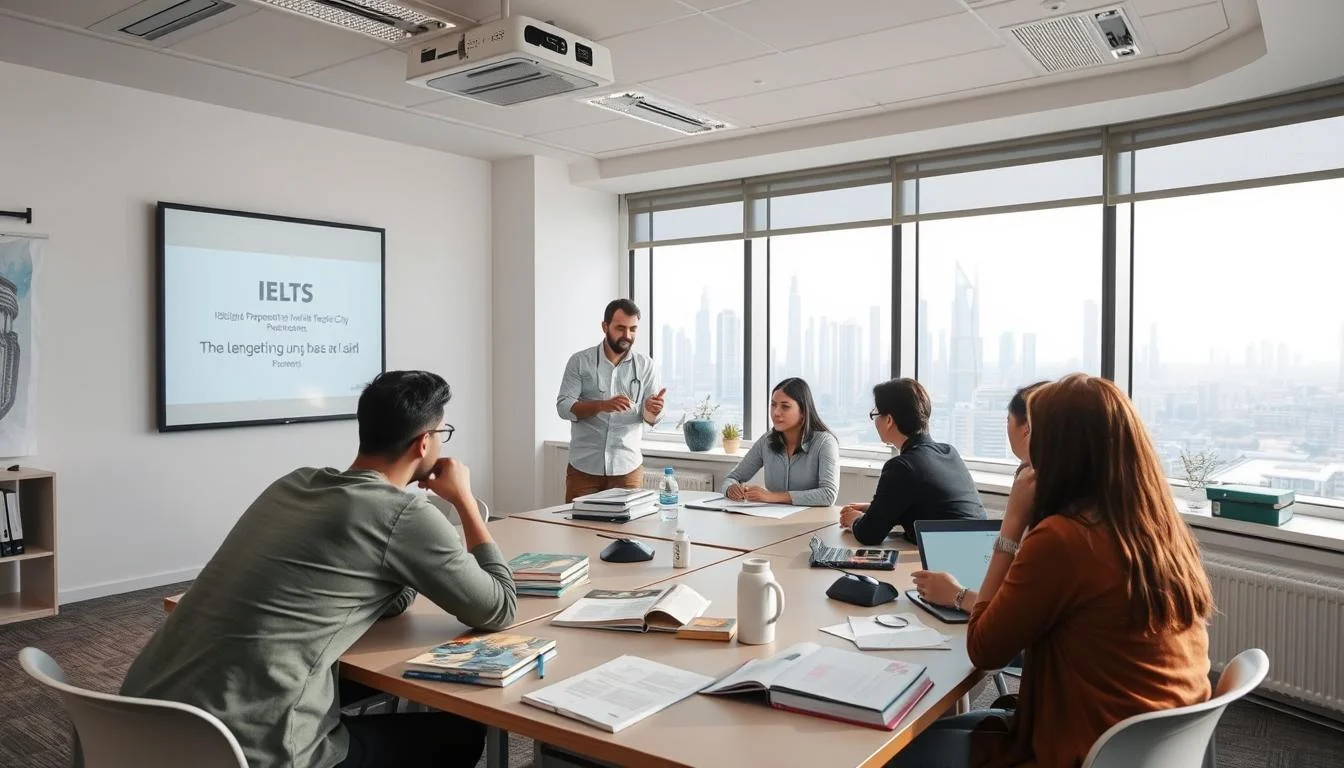
IELTS preparation for people who live or work in Dubai Media City is available at Bright Future Training Institute, which teaches in the classroom at the NBQ Building, Bank Street, Bur Dubai, close to BurJuman Metro Station, and in online live sessions. The courses cover Listening, Reading, Writing and Speaking, so you can choose the format that suits your daily routine.
Key takeaways
- Our centre is in Bur Dubai, not inside Dubai Media City, so the real choice is between travelling to the classroom and joining online live sessions.
- IELTS has four parts: Listening, Reading, Writing and Speaking. Preparation should train all four, not only the one you find hardest.
- Academic and General Training share Listening and Speaking but differ in Reading and Writing, so pick the right version before you start studying.
- Exam fees, test dates and exam rules belong to the exam bodies. Confirm them on the official IELTS website before you book.
- Course fees are not published. A course adviser will give you current fees and answer questions before you enrol.
- You can book a free demo class to see the teaching style first.
Where can you do IELTS preparation if you work or live in Dubai Media City?
Dubai Media City is a business and media district, and many professionals there have long workdays, client calls and deadlines. IELTS preparation has to fit around that. Most people in the area are looking for one of three things: a class they can reach after work, a weekend option, or a way to study without crossing the city at all.
Bright Future Training Institute does not have a classroom inside Dubai Media City. Our one address is Suite 404, Fourth Floor, NBQ Building, Bank Street, Bur Dubai, close to BurJuman Metro Station. We would rather say that plainly than let you find out on the day. What we offer is a choice of two formats, both led by trainers and both covering the full exam.
Classroom classes in Bur Dubai
Classroom preparation suits people who focus better away from home and the office. You sit with a trainer and other learners, practise speaking out loud with real people, and get feedback in the room. If you are comfortable with the journey, the classroom is a good option, particularly for Speaking, where live conversation is the whole point.
Because the centre is near BurJuman Metro Station, you can reach it by metro rather than driving and parking. Check your own route on a journey planner before you commit, since your starting point in Dubai Media City, your working hours and the traffic at your usual time will all affect the trip.
Online live sessions
Online live sessions are taught in real time, not as recordings you watch alone. For many people working in Dubai Media City this is the more practical choice, because there is no travel and you can join from home or a quiet room at the office. You still hear your trainer, ask questions as they come up and take part in practice tasks.
The two formats are described in more detail in the comparison below. Ask a course adviser which one your target score, schedule and learning style point to, because that depends on you and not only on location.
Classroom or online live: which format suits you?
Neither format is better in every situation. The right one depends on how you learn, how much time you lose to travelling, and which of the four skills worries you most. The table sets out the differences using only what we can say with certainty.
| Question | Classroom in Bur Dubai | Online live sessions |
|---|---|---|
| Where do you attend? | NBQ Building, Bank Street, Bur Dubai | From home, the office or any quiet place |
| Travel needed? | Yes, to Bur Dubai | No travel |
| Taught by a trainer in real time? | Yes | Yes |
| Covers all four skills? | Yes | Yes |
| Best for | People who study better away from home and want face-to-face speaking practice | People who want to avoid the journey from Dubai Media City |
| What you need | A route to the centre | A reliable internet connection, a device and a quiet space |
Two practical points are worth adding. First, online study needs a good microphone and headphones if you want to practise Listening and Speaking properly, so test your equipment before the first session. Second, if you choose the classroom and your schedule changes later, ask the adviser what is possible. Do not assume; ask before you enrol, and ask for the answer to be clear.
You can also book a free demo class before enrolling. If you are torn between formats, a demo is the simplest way to decide, because you will see how a session feels and whether you follow the trainer easily.
What does IELTS preparation actually cover?
Good preparation is not a pile of practice papers. It teaches you how the test works, finds where you lose marks, and trains those weak points until they hold under exam conditions. According to the official IELTS website, the test has four sections: Listening, Reading, Writing and Speaking. Our IELTS training covers all four, in the classroom or online.
What each part of the test asks of you
Each skill rewards different habits, so a plan that treats them as one subject usually leaves a gap. The table below summarises what each part is mainly checking and where learners commonly need practice.
| Skill | What it mainly tests | Where learners often need practice |
|---|---|---|
| Listening | Following recorded speech and picking out specific information | Staying focused when you miss a word, and spotting the answer as the audio moves on |
| Reading | Understanding written texts and finding information in them | Working through long passages without losing the thread |
| Writing | Organising ideas clearly and writing accurately in English | Planning before you write, and keeping grammar accurate under pressure |
| Speaking | Talking naturally with an examiner | Speaking at a steady pace, extending short answers and sounding relaxed |
This summary is general. For the exact format, number of questions, timings and marking criteria, use the official IELTS website, because the exam body sets and updates those details.
Skills that busy professionals often neglect
People who use English at work every day often assume IELTS will be easy. Workplace English and exam English are not the same thing. At work you can be informal, repeat yourself and rely on context. In the test you are judged on range, accuracy and organisation, and you have to show them in a set format.
That is why preparation helps even confident speakers. A trainer can show you how your answers look from the examiner's side, and that is hard to see on your own. If you want a deeper look at one area, our guides on IELTS speaking fluency and how to prepare for the IELTS Listening test are good starting points.
Academic or General Training: which IELTS do you need?
Choosing the wrong version is a costly mistake because you may study the wrong material. The official IELTS website explains that Listening and Speaking are the same in both versions, while Reading and Writing differ. Academic is intended for people applying for undergraduate or postgraduate study, or for professional registration. General Training is usually chosen for work, training or migration purposes.
You should not guess which one you need. Ask the university, employer, professional body or immigration authority that requested your result, and get the answer in writing if you can. Some requests also name a specific version, such as one for visa applications, and the rules differ between organisations.
Our course pages explain the options in more detail. You can read about the IELTS training course in Dubai or compare the two versions in our article on the differences between General and Academic IELTS. If your requirements are unclear, a course adviser can help you work out which questions to ask, although the final decision should come from the organisation requesting the result.
How do you plan IELTS study around a busy Dubai Media City schedule?
Consistency matters more than long, occasional sessions. A learner who practises regularly and reviews mistakes will usually make more steady progress than one who crams before the test. The plan below is a general approach, not a promise of a score.
Start with an honest baseline
Before choosing a course, find out where you stand. Take a practice test under quiet, timed conditions and note which part felt hardest. Do not judge yourself on one bad section. Look at patterns: do you lose marks through running out of time, misreading questions, or making grammar slips?
A trainer can do this more accurately because they know what the examiner looks for. Ask your adviser how your starting level is assessed and how your progress is reviewed as the course goes on.
Match your study blocks to your working week
Look at your calendar and find the slots you can protect. For some people that is an evening, for others it is a weekend or a break in the working day. What matters is that the slot is realistic and that you can keep to it. Ask the adviser which class options are currently available, because we do not publish a fixed timetable in this article.
Between sessions, spread your practice across all four skills. Short, regular tasks work better than one long, tiring block. Our guide to IELTS preparation tips for beginners gives a simple way to start if you have never prepared before.
Practise under exam conditions
Practice only helps if it resembles the real test. Sit at a desk, switch off notifications and work without pausing the audio or looking things up. Then review your errors afterwards. The aim is not to feel comfortable but to find out where you are still weak, so you can fix it before the real test.
Plan for the booking separately
Booking the test is a different process from taking a course. Test dates, fees, available centres and what to bring are decided by the exam bodies and can change. Check the official IELTS website for current information and book only when you are confident about your timeline. If you plan to use the result for an application, check that deadline first and work backwards.
What should you ask before enrolling in an IELTS course?
A short list of questions will tell you more than any brochure. Take it to your first conversation with a course adviser, whichever institute you are considering.
| What to check | Why it matters |
|---|---|
| Which IELTS version the course prepares you for | Academic and General Training differ in Reading and Writing |
| Whether the course covers all four skills | A gap in one skill can limit your overall result |
| Classroom, online live, or both | The format has to fit your schedule and the way you learn |
| How feedback on Writing and Speaking is given | These two skills need personal feedback to improve |
| How your progress is checked | You should know whether you are improving before the exam |
| Current course fees and payment options | Fees are confirmed by an adviser, and payment options include Visa, Mastercard, Tabby and Tamara |
| Whether you can try a demo class first | A demo shows you the teaching style before you commit |
Notice that nothing in this list asks for a promised result. No honest provider can offer one, because your outcome depends on your starting level, your effort and the exam itself. Be cautious of any course that does.
Why does Bright Future Training Institute suit IELTS candidates?
We can only describe what we are sure of, so here is a short and factual answer.
- A KHDA-approved institute. Bright Future Training Institute is KHDA-approved, and certificates are approved by KHDA and recognised across the UAE.
- An affiliate partner of the British Council. This is a partnership fact, not a promise about your result.
- Two ways to study. You can attend in the classroom in Bur Dubai or join online live sessions.
- Adviser support. Course advisers answer questions by phone and on WhatsApp at +971 54 373 3394, and by email at [email protected].
- A demo before you commit. You can book a free demo class before enrolling.
- Several payment options. These include Visa, Mastercard, Tabby and Tamara.
If you are comparing different exam routes, you may also find our article on the benefits of taking IELTS preparation classes useful. For learners who are weighing IELTS against another English test, our PTE classes for Dubai Media City article looks at the same location question for that exam. You can also browse all exam preparation courses to see what else is offered.
How can you tell whether your preparation is working?
Progress in IELTS is easier to judge when you track it. Keep a simple notebook or document with one page per skill. After each practice task, write down what went wrong and why, not only the result. Over time the same few errors will appear again and again, and those are the ones to fix first.
For Listening and Reading, note whether you lose marks through misunderstanding, spelling, or running out of time. Each cause needs a different cure. For Writing, ask a trainer to point out your two or three most frequent errors rather than correcting everything, because fixing a few habits is more realistic than rewriting your whole style at once. For Speaking, record yourself answering a question, listen back, and notice pauses, repeated words and answers that stop too early.
Share this record with your trainer or course adviser. It turns a general conversation into a specific one, and it shows you whether the format, pace and level of the course suit you. If you feel stuck after a reasonable period of steady practice, say so early. A good trainer would rather adjust the plan than watch you repeat the same mistakes.
Finally, look after the basics. Sleep properly before test day, plan your journey to the test venue in advance, and check what identification and items the exam body requires. These details are set by the exam bodies, so read them on the official IELTS website and do not rely on advice from friends, which may be out of date.
How do you reach Bright Future Training Institute?
The centre is at Suite 404, Fourth Floor, NBQ Building, Bank Street, Bur Dubai, Dubai, United Arab Emirates, close to BurJuman Metro Station. The institute is open daily, 9:00 AM to 5:00 PM. If you plan to visit after work, call or message first to confirm what is available, because staff and class availability can change.
If you would rather not travel, say so when you speak to the adviser and ask about the online live option. Many learners in Dubai Media City start with a phone call or a WhatsApp message and then decide whether to visit.
Conclusion: choose the format first, then the course
For IELTS preparation in Dubai Media City, the first decision is not the institute but the format. If you want a classroom, you travel to Bur Dubai. If you want to stay where you are, you join online live sessions. Either way, look for training that covers Listening, Reading, Writing and Speaking, that matches the IELTS version you need, and that gives you personal feedback.
Confirm exam fees, dates and rules on the official IELTS website, and ask a course adviser for current course fees. When you are ready, talk to a course adviser or book a free demo class through our contact page, message or call +971 54 373 3394 on WhatsApp or phone, or email [email protected].