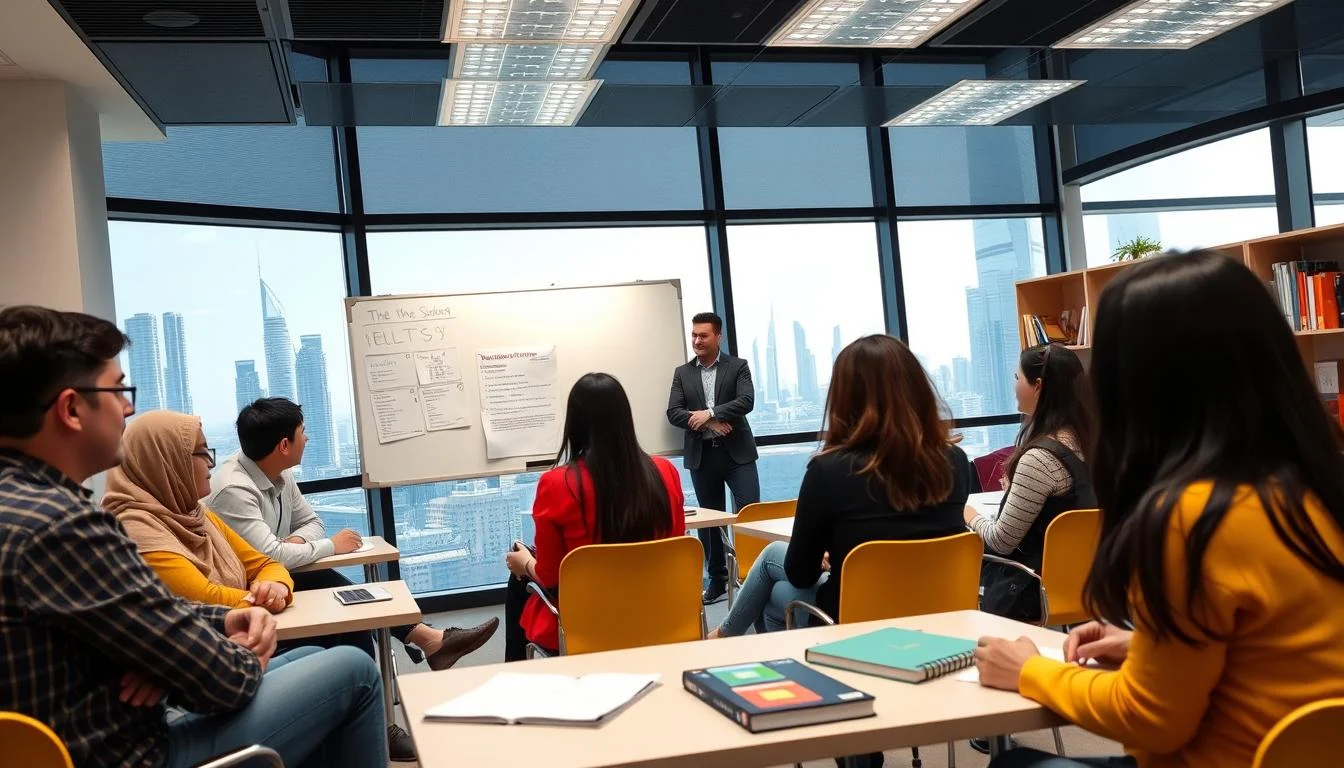
IELTS speaking training is structured practice for the face-to-face Speaking test, where a trainer builds your fluency, vocabulary, grammar and pronunciation through timed practice and feedback. In Dubai, Bright Future Training Institute in Bur Dubai prepares candidates for IELTS in the classroom or as online live sessions, with Speaking covered alongside the other three skills.
Key takeaways
- The Speaking test is a recorded, face-to-face interview with a certificated examiner, in three parts, and it is the same for IELTS Academic and General Training.
- Examiners mark four things: fluency and coherence, lexical resource, grammatical range and accuracy, and pronunciation.
- Good training turns those four criteria into habits you can repeat under pressure, not into memorised answers.
- You can train in the classroom in Bur Dubai or in online live sessions, and you can book a free demo class before enrolling.
- Confirm current exam rules, fees and dates on the official IELTS website, because the exam bodies set them, not training centres.
What does IELTS speaking training actually involve?
Speaking is the one IELTS skill where you cannot work alone with a book. You have to produce spoken English, in real time, for a person who is scoring you. Training therefore centres on spoken practice with a trainer who listens, notes patterns and tells you what to change.
A speaking-focused plan usually has four strands that run side by side.
- Format training: you learn what happens in each of the three parts, what the examiner is looking for and how to use the time you are given.
- Skill training: you work on fluency, vocabulary, grammar and pronunciation one at a time, then bring them together.
- Practice interviews: you answer questions out loud in test-like conditions and receive feedback straight afterwards.
- Review and repair: you repeat weak answers, fix recurring errors and track what has improved.
At Bright Future Training Institute, IELTS training covers Listening, Reading, Writing and Speaking, with classroom or online preparation. The speaking strand sits inside that wider IELTS preparation. You can read about the full course on the IELTS Training Dubai course page.
How is training different from simply practising English?
General English practice improves your language over a long period. Exam training is narrower. It teaches you to show your language to an examiner within a fixed format and against fixed marking criteria.
Many fluent speakers lose marks because they never learned the format. They answer Part 1 questions with one short sentence, run out of ideas in the long turn, or give opinions without reasons in the discussion. Training closes that gap by showing you how a complete answer sounds in each part.
If your everyday English is the main problem rather than exam technique, a general speaking course may suit you better first. Our guide to the English speaking course in Dubai explains that route.
How does the IELTS Speaking test work?
According to the official IELTS website, the Speaking test is a face-to-face interview between you and an examiner, and it is recorded. The format is the same for IELTS Academic and IELTS General Training, so one training plan serves both.
| Part | What happens | What it tests |
|---|---|---|
| Part 1: Introduction and interview | The examiner introduces themselves, checks your identity and asks general questions about familiar topics such as home, family, work, studies or interests | Giving opinions and information on everyday topics |
| Part 2: Long turn | You receive a task card, get one minute to prepare with pencil and paper, then speak for about two minutes. The examiner may ask one or two follow-up questions | Speaking at length and organising ideas logically |
| Part 3: Discussion | The examiner asks you to discuss issues linked to the Part 2 topic in a more general and abstract way | Explaining opinions, analysing and speculating |
Because the format is fixed, you can prepare for each part deliberately. The questions change, but the type of thinking each part demands does not.
For a closer look at the questions themselves, read our separate guide to the IELTS Speaking test. Always check the current exam format, rules and booking details on the official IELTS website before you plan your test.
What do examiners mark in the Speaking test?
Examiners score four criteria. Training is most useful when each criterion has its own exercises, because each one fails in a different way.
| Criterion | What it covers | A common weakness | A training response |
|---|---|---|---|
| Fluency and coherence | How smoothly you speak and how clearly your ideas connect | Long pauses while searching for words, or jumping between ideas | Timed answers with linking phrases and an answer shape you can reuse |
| Lexical resource | The range and accuracy of your vocabulary | Repeating the same simple words, or forcing in idioms that do not fit | Topic vocabulary built from your own life, with paraphrasing drills |
| Grammatical range and accuracy | Variety of sentence structures and how correct they are | Staying with short sentences, or losing control when sentences get longer | Practice with past, present and future reference, comparisons and conditionals |
| Pronunciation | How easy you are to understand: sounds, stress, rhythm and intonation | Flat stress, swallowed word endings, or speaking too fast | Recording yourself, listening back and repeating with a trainer's guidance |
Why a trainer matters more for pronunciation and fluency
You can study vocabulary from a list. You cannot easily hear your own stress and rhythm. A trainer notices that you drop the endings of words, or that every sentence ends on the same tone, and gives you a specific fix.
The same applies to fluency. Hesitation has different causes: some people search for a word, some for an idea, some worry about grammar. A trainer works out which one it is, because the remedy differs.
What should training cover, part by part?
Strong speaking training does not treat the test as one block. It builds a separate skill for each part, then joins them.
Part 1: sounding natural on familiar topics
Part 1 questions are about you. Training here focuses on answers that are short but complete: a direct answer, a reason and a small detail. Candidates who stop after one sentence leave the examiner little to score.
Useful work includes:
- Building an answer pattern you can adapt to any familiar topic.
- Preparing the ideas, not scripts, for work, study, hometown, daily routine and hobbies.
- Practising a natural, relaxed tone so you do not sound recited.
Part 2: organising a long turn
The long turn is the part many candidates fear, because nobody interrupts you. You need to plan in the preparation time and then keep going. Training teaches you to use that time for a quick outline rather than full sentences, to cover every point on the card and to tell a story with a clear beginning, middle and end.
Practice exercises include timed talks on random topics, switching between description, explanation and personal reflection, and learning to recover when you lose your thread. A trainer can also show you how to extend a point with a reason or example instead of stopping early.
Part 3: explaining and discussing ideas
The discussion asks for opinions, comparisons and speculation. This is where grammatical range and vocabulary show most clearly. Training builds sentence frames for giving a view, weighing two sides and talking about causes and future possibilities, while still sounding like yourself.
A good trainer will also push you with follow-up questions of the kind an examiner might ask, so you learn to think and speak at the same time.
How should you use feedback in training?
Practice without feedback repeats mistakes. Feedback without repetition is quickly forgotten. The useful cycle is short: answer, listen to the feedback, answer again.
Ask your trainer to focus feedback on a few points at a time, such as one grammar habit, one pronunciation habit and one structural habit. Trying to fix everything at once usually fixes nothing.
Keep a simple record after each session:
- The one thing you did well.
- The main things to fix before next time.
- A topic you struggled with and want to retry.
Over several sessions, this record shows real progress and tells you where to spend your own study time.
Is classroom or online live training better for speaking?
Both formats work for Speaking, because both involve talking to a trainer and other candidates. Bright Future Training Institute runs IELTS preparation in the classroom at the NBQ Building, Bank Street, Bur Dubai, close to BurJuman Metro Station, and as online live sessions.
| Question | Classroom | Online live session |
|---|---|---|
| Where do you attend? | At the institute in Bur Dubai | From home or work through a live link |
| Best for | Candidates who like face-to-face energy and live eye contact | Candidates who need to avoid travel or live outside central Dubai |
| What to prepare | A route to Bur Dubai and BurJuman Metro Station | A quiet room, a stable connection and working audio |
| How speaking is practised | Directly with the trainer and classmates in the room | Live with the trainer and classmates on screen |
The Speaking test itself is face-to-face with an examiner, so a classroom can feel closer to test day. If you choose online, practise speaking to a real person rather than only watching videos, and keep your audio clear so your trainer can judge your pronunciation properly.
If you are comparing locations, our guide to IELTS classes near me explains how to decide between travelling to Bur Dubai and studying online.
How can you practise between sessions?
Training sessions give you direction. Your own daily practice gives you speed. A few short habits do more than one long weekly effort.
- Record yourself: answer one Part 2 style topic aloud, listen back and note filler words, pauses and unclear sounds.
- Think in English: describe your day, your commute or your work tasks silently in English while you walk or travel.
- Read and retell: read a short article, close it, then explain it aloud in your own words.
- Practise with a partner: ask a friend or colleague to play examiner and ask follow-up questions.
- Learn words in chunks: note phrases with their prepositions and typical partner words, not just single words.
For more fluency habits, see our guide to improving IELTS speaking fluency.
What to avoid in your own practice
Memorised answers are the most common trap. Examiners listen for natural language, and a recited script usually sounds flat and does not respond to the question asked. Prepare ideas and vocabulary, not paragraphs.
Another trap is stuffing answers with rare idioms. Language that is accurate and natural scores better than language that is impressive but misused. Your goal is clear communication.
What should you prepare before you enrol?
A little planning helps you get more from the first session and helps the adviser recommend the right route.
| Prepare | Why it helps |
|---|---|
| Your reason for taking IELTS | Study, work, migration and visa routes may need different IELTS versions, so the adviser can point you to the right course |
| Your test version | Academic or General Training; the Speaking test is the same, but the other sections differ |
| Your target band and any deadline | Check the requirement with the university, employer or authority that asked for IELTS |
| A rough idea of your current level | Helps the trainer decide where to begin |
| Your preferred format | Classroom in Bur Dubai or online live sessions |
| Your availability | Lets the adviser suggest a suitable batch |
Official exam fees, test dates and rules belong to the exam bodies, so confirm them on the official IELTS website. For course fees, ask a course adviser for current details.
How do you choose the right speaking trainer or centre?
Look for evidence of the things that matter for Speaking rather than general promises.
- Speaking time for you: you should talk a lot in sessions, not mostly listen.
- Specific feedback: comments such as "you drop word endings" help far more than "speak better".
- Test-like practice: timed Part 2 talks and follow-up questions.
- Honest advice: a good adviser will tell you if you need more general English before exam training.
- Clear information: the centre should explain its format, delivery and approvals plainly.
Bright Future Training Institute is a KHDA-approved training institute, and its certificates are approved by KHDA and recognised across the UAE. It is also an affiliate partner of the British Council. Students can book a free demo class before enrolling, which is a practical way to judge a trainer's style first.
Where is the institute and when can you reach it?
The institute is at Suite 404, Fourth Floor, NBQ Building, Bank Street, Bur Dubai, Dubai, United Arab Emirates, close to BurJuman Metro Station. It is open daily, 9:00 AM to 5:00 PM. Payment options include Visa, Mastercard, Tabby and Tamara.
Which other IELTS and exam-preparation courses are available?
If you want to prepare for all four IELTS skills together, the IELTS Training Dubai course is the place to start. If you are still deciding between exams, browse the exam preparation category to see what else is offered, including other English language tests.
Speaking improves most when it is part of a balanced plan. Listening, reading and writing support your vocabulary and grammar, and a stronger vocabulary makes speaking easier.
Conclusion
IELTS speaking training works when it is specific: know the three parts, understand the four marking criteria, practise aloud with feedback and repeat until the habits become natural. It does not replace your own daily practice, and no training can promise a particular score.
If you would like to see how the sessions work, talk to a course adviser or book a free demo class through the contact page. You can also call or message on WhatsApp at +971 54 373 3394, or email [email protected].