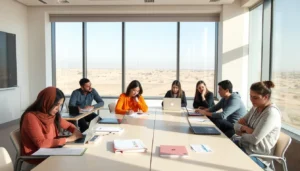
If you live or work in Business Bay, IELTS training is available at Bright Future Training Institute on Bank Street in Bur Dubai, close to BurJuman Metro Station. You can attend in the classroom or join online live sessions, so the course fits around work whichever side of Dubai you are on.
Key takeaways
- Bright Future Training Institute is a KHDA-approved institute in Bur Dubai, and its IELTS training is offered in the classroom or as online live sessions.
- Business Bay residents and professionals can travel to the classroom by Metro or road, or skip the journey and study online.
- IELTS training covers Listening, Reading, Writing and Speaking.
- Choose Academic or General Training according to your purpose, and confirm what your university, employer or immigration authority asks for.
- Exam fees, dates and rules come from the exam bodies, so confirm them on the official IELTS website.
- A free demo class is available before you enrol.
Where can you take IELTS training if you are in Business Bay?
Many people searching for IELTS training in Business Bay are professionals who work in the towers near the canal or residents who want a course close to home. Bright Future Training Institute does not run a classroom in Business Bay. Its single address is Suite 404, Fourth Floor, NBQ Building, Bank Street, Bur Dubai.
That is not as limiting as it sounds. The institute offers two ways to study, and each suits a different kind of week:
- Classroom classes at the NBQ Building, close to BurJuman Metro Station, for learners who concentrate better away from home or the office.
- Online live sessions with a trainer, for learners who would rather save the journey and study from a Business Bay apartment or desk.
The institute is open daily, 9:00 AM to 5:00 PM, and a course adviser can talk you through both formats before you decide. The sections below explain how to choose between them, what the course covers and how to prepare.
How do you get from Business Bay to the classroom in Bur Dubai?
The classroom is on Bank Street, close to BurJuman Metro Station. If you commute by Metro, plan the route with the official RTA journey planner, since lines, interchanges and timings are managed by the transport authority. If you drive or take a taxi, enter the building name, NBQ Building, Bank Street, Bur Dubai, in your map app.
A few practical tips for a first visit:
- Check the route the day before, so that you know where you are heading.
- Bring your ID and any previous IELTS results, if you have them.
- Write down your questions about the Academic and General Training tests so that the adviser can answer them in one visit.
- If the journey is your main concern, ask about online live sessions instead.
You can also view the location on the map at the end of this article.
Classroom or online live sessions: which suits a Business Bay schedule?
Both formats prepare you for the same four skills. The difference is mainly how you like to learn and where your day takes you.
| Question | Classroom in Bur Dubai | Online live sessions |
|---|---|---|
| Where do you study? | NBQ Building, Bank Street, Bur Dubai | From home, the office or anywhere with a stable connection |
| Travel needed | Yes, by Metro or road | None |
| Interaction | Face to face with the trainer and classmates | Live with the trainer on screen |
| Best for | Learners who like a dedicated study space | Learners with busy days or long commutes |
| Free demo class | Available before enrolling | Available before enrolling |
Neither format is better in every case. A learner who works long hours near Business Bay may prefer online sessions in busy weeks. Someone who is distracted at home may prefer the classroom. Speak to an adviser about how the course is organised in each format, since schedules are confirmed directly by the institute.
Which learners usually choose the classroom?
Learners who want to leave their usual environment, meet classmates and speak English in person often choose the classroom. It suits people who find it hard to switch off at home, and students who want a trainer beside them while they plan a Writing answer.
Which learners usually choose online live sessions?
Professionals with unpredictable days, parents managing school runs and anyone who wants to avoid the commute often prefer online sessions. You still study live with a trainer, so you can ask questions and receive feedback as the session happens.
What does IELTS training at Bright Future cover?
IELTS training covers the four skills the exam tests: Listening, Reading, Writing and Speaking. Preparation is available in the classroom or online. The table below shows what each skill asks of you and where learners usually need practice.
| Skill | What the exam asks you to do | Where training helps |
|---|---|---|
| Listening | Follow recorded conversations and talks and answer questions | Predicting answers, noting spelling and following changes of idea |
| Reading | Read passages and answer a range of question types | Skimming and scanning, matching headings and managing time |
| Writing | Produce written responses to set tasks | Planning, structure, grammar and clear paragraphs, with trainer feedback |
| Speaking | Speak face to face with an examiner | Fluency, pronunciation and answering with developed ideas |
Training is most useful when it gives you feedback. Reading and Listening can be practised alone with past papers, but Writing and Speaking improve faster when someone points out habits you cannot see yourself. For a closer look at the speaking part, see the guide on IELTS speaking training in Dubai.
Why do many learners struggle with Writing and Speaking?
These two skills are productive: you have to create language rather than recognise it. Common problems include answers that are too short, repeated vocabulary, long sentences that lose their grammar and ideas that are not developed. A trainer can name the pattern, give you a model and ask you to try again. That cycle of attempt, comment and rewrite is what separates focused training from simply doing more practice tests.
Why do Listening and Reading feel easier to improve alone?
Both have clear answer keys, so you can mark your own work. Even so, a trainer helps you see why you missed an answer. Was it a spelling slip, a distractor, a misread question or an unknown word? Knowing the reason tells you what to practise next.
Academic or General Training: which IELTS test should you choose?
The IELTS organisation offers two versions of the test. Listening and Speaking are the same in both. Reading and Writing differ. According to the official IELTS website, the Academic test is intended for people applying for undergraduate or postgraduate study or professional registration, while General Training is intended for those who wish to migrate to an English-speaking country or to train or study below degree level.
How do you decide?
Start with the organisation asking for your result. A university, a professional body, an employer or an immigration authority will state which version it accepts. Always read that requirement yourself rather than relying on a friend's experience, because rules change and differ between institutions.
Why does the choice matter for training?
The two tests use different Reading material and different Writing tasks, so your practice should match. A learner preparing for Academic spends time on data description and formal essays. A General Training learner practises letters and everyday texts. For a fuller comparison, read the differences between General and Academic IELTS.
What should you ask before you enrol in an IELTS course?
Because no two learners start from the same place, ask questions before you commit. These cover most of what Business Bay learners want to know:
- Which format, classroom or online live sessions, fits my working week?
- Which test, Academic or General Training, do I need for my goal?
- How will my level be assessed at the start?
- How often will I receive feedback on Writing and Speaking?
- Can I attend a free demo class first?
- What are the current fees and the payment options?
Payment options include Visa, Mastercard, Tabby and Tamara. For current fees, ask a course adviser, since fees are not published in this article.
How can you prepare alongside work in Business Bay?
Most learners balance training with a full-time job, so the plan matters as much as the course. These habits help whichever format you choose.
Build a routine around your day
Short, regular sessions beat occasional long ones. Link practice to something you already do: listen to English podcasts on the commute, or read an English article at lunch. Keep a simple notebook of new vocabulary and mistakes your trainer has corrected.
Practise all four skills, not just your favourite
It is natural to spend time on the skill you enjoy. Most learners improve their overall result faster by giving extra time to the skill that is currently weakest. Your trainer can tell you which that is.
Use feedback, not just practice tests
A practice test shows a result, but feedback shows the reason. After each Writing task, compare your draft with the trainer's comments and rewrite the weakest paragraph. For Reading advice, the guide to IELTS reading training is a useful companion.
Plan the test around your preparation, not the other way round
Choose a test date after you and your trainer agree you are ready. Test dates, availability and fees are set by the exam bodies, so check them on the official IELTS website or with the test provider you book through.
How does studying in Bur Dubai compare with studying closer to home?
Learners often ask whether it is worth leaving Business Bay for a course. The answer depends on what you value.
| Factor | Course in Bur Dubai | Course very close to home or work |
|---|---|---|
| Journey | Needs planning, though Metro access is close | Shorter, if one exists |
| Focus | Dedicated study environment | Convenient, but easier to skip or rush |
| Flexibility | Classroom or online live sessions | Depends on the provider |
| Support | Course advisers by phone, WhatsApp and email | Depends on the provider |
If travel is the only concern, remember that online live sessions remove it completely. If you are still comparing options across Dubai, the posts on IELTS training in Downtown Dubai and IELTS classes near me cover those areas and class formats.
What happens on test day, and what should you remember?
On test day, bring the identification you used when you booked and follow the instructions from the test provider. Arrive early, read the rules sent to you and avoid last-minute cramming. Listening, Reading and Writing are normally taken together, while the Speaking test is a face-to-face conversation with an examiner arranged by the exam body.
Exam rules, including what you may bring, change from time to time. Confirm them on the official IELTS website before the day. No course can promise a particular band score, because results depend on your starting level, practice and performance on the day.
Which IELTS course page should you read next?
The institute describes the full course on the IELTS training Dubai course page. Browse related exam courses in the exam preparation category. Use these pages for course details, then ask an adviser the questions that matter to your situation.
How do you take the next step?
If you are in Business Bay and thinking about IELTS, the simplest next step is a conversation. Tell a course adviser which test you need, how your week looks and whether you prefer the classroom or online live sessions. You can then book a free demo class before you enrol.
Request course details, message or call +971 54 373 3394 on WhatsApp or phone, or email [email protected]. Advisers answer questions daily between 9:00 AM and 5:00 PM.