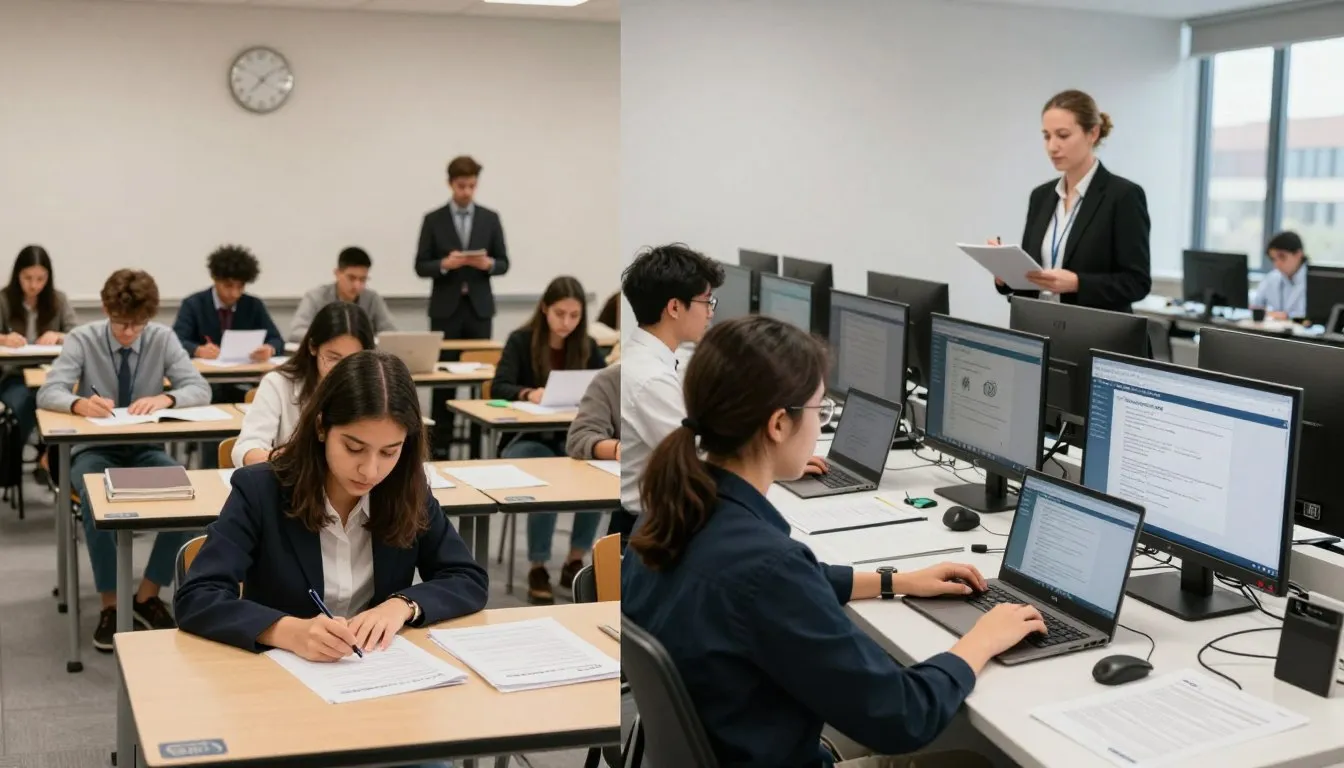
We remember the quiet mix of hope and nerves when a student from Dubai or Abu Dhabi tells us they are ready to apply overseas. Choosing between ielts vs pte feels like a fork in the road. Both paths lead to study abroad dreams, but each requires different preparation and strategy.
At Bright Future Training Institute, we believe informed choices are empowering. This article answers the central question—ielts or pte—and offers a clear, practical guide. It’s tailored to UAE applicants who aim to excel in university admission, visa applications, or professional licensing.
Read on to understand formats, scoring, validity, registration, and study plans. See how our targeted training programs can enhance your chances. Whether you are weighing ielts vs pte which is better for your goals, or deciding between ielts or pte for study abroad, we map test features to real outcomes. This way, you can choose with confidence.
Key Takeaways
- IELTS and PTE both support global study and visa goals, but differ in format and scoring.
- Choosing ielts vs pte depends on your comfort with paper-based speaking or fully computer-based tests.
- Acceptance varies by institution and country; check target universities before deciding.
- Preparation strategy should reflect test structure—timed sections for PTE, band-focused practice for IELTS.
- Bright Future Training Institute offers tailored courses to bridge gaps and improve score predictability for UAE test-takers.
Introduction to IELTS and PTE for UAE Test Takers
We start by giving a clear overview of both exams for UAE candidates. The International English Language Testing System (IELTS) and the Pearson Test of English Academic (PTE Academic) are key for getting into university, visa applications, and professional registration. In the UAE, acceptance depends on the university, employer, or consulate. Many big institutions accept IELTS, while PTE Academic is becoming more recognized, mainly for those going to Australia.
Knowing the differences between IELTS and PTE helps candidates pick the right test. We explain the format, scoring, how to register, the cost, and how long the results last. This way, you can choose based on your goals, schedule, and the institutions you’re aiming for.
Bright Future Training Institute offers support to boost your readiness. Our programs include diagnostic tests, focused coaching, mock exams, and feedback. We help you improve weak areas and build confidence for the exam.
Getting started is easy. Bright Future Training Institute is at Suite #404, fourth floor NBQ building, Bank Street, Bur Dubai. Call +971559234565 or email [email protected] for more information. Our website is http://bftraining.ae. We aim to create a supportive environment where you can excel, whether you choose IELTS or PTE.
Here’s a quick comparison to show how each test is used in the UAE.
| Exam | Primary Uses | Common Acceptance in UAE | Typical Strengths for Candidates |
|---|---|---|---|
| IELTS (Academic & General Training) | University admission, UK/Australia/Canada visas, professional registration | Widely accepted by UAE universities, employers, and many consulates | Well-suited for learners comfortable with face-to-face speaking and paper-based formats |
| PTE Academic | University admission, visa applications, fast scoring turnaround | Increasing acceptance, strong for Australian visa and many global institutions | Good fit for computer-savvy candidates who prefer automated scoring and quick results |
| How to choose | Match format and scoring to learning style and deadlines | Confirm requirements with target institutions before booking | Consider test availability, cost, and whether quick results or specific format matters |
ielts vs pte
We offer a clear comparison to help UAE applicants choose the right path for international study and career goals. This comparison looks at delivery, scoring, task types, timing, and report turnaround. This way, you can pick a test that fits your schedule and skills.
Direct side-by-side comparison of features
| Feature | IELTS | PTE Academic |
|---|---|---|
| Delivery mode | Paper-based and computer-delivered options available at approved centers | Fully computer-based with all skills assessed on the same device |
| Scoring approach | Band scores from 0–9, reported in half bands for each skill | Automated scoring on a 10–90 scale with item-level machine grading |
| Test sections | Listening, Reading, Writing, Speaking; formats vary by Academic vs General | Listening, Reading, Writing, Speaking in integrated, multi-skill tasks |
| Task types | Dialogue and monologue speaking tasks, extended essays, discrete reading items | Integrated items such as speak-while-recording, summarize spoken text, reorder paragraphs |
| Length and timing | About 2 hours 45 minutes for Academic; varies by delivery mode | Approximately 2 hours, fully scheduled on computer |
| Result turnaround | Up to 13 days for paper, faster for computer-delivered results | Often within 2–5 business days due to electronic processing |
| Speaking assessment | Face-to-face examiner in many centers; human interaction influences scores | Recorded responses assessed by automated scoring algorithms |
| Retake and reporting | Multiple test dates; official Test Report Form with central verification | Frequent dates, fast electronic score delivery, digital reports for institutions |
Key differences test-takers should know
The main difference is in scoring. PTE uses automated scoring, rewarding precise and complete responses. IELTS combines human examiners and standardized criteria, allowing for natural interaction in speaking and writing.
PTE focuses on integrated tasks that test skills under time pressure. IELTS has separate tasks, giving more room for detailed answers in essays and speaking.
Turnaround times are also a factor. PTE’s quick results are great for those with tight deadlines. IELTS is trusted by many institutions for its established formats and examiner-led speaking tests.
Which test aligns with common study abroad goals from the UAE
Choose based on your target country, program, and timeline. PTE is good for those needing quick results and a computer-based test. IELTS might suit those who value traditional recognition and human-assessed speaking.
For example, many Australian universities and the Department of Home Affairs accept both tests. Some list PTE as an equivalent. UK universities widely accept IELTS, but PTE acceptance is growing. Always check specific program requirements before booking a test.
When deciding between IELTS and PTE, consider your application deadlines, comfort with computer-based speaking, and scoring style. For study abroad, match program score thresholds to your practice tests. Then, choose the format that best showcases your strengths.
Exam formats compared: IELTS exam format versus PTE exam format
We explain the main parts of both tests to help UAE students plan better. This comparison shows the differences in timing, tasks, and how the tests are given. It helps learners pick the best test for their goals.
Sections and timing for IELTS (Academic and General Training)
IELTS has four skills tested together on the same day or spread out for computer tests. Listening is 30 minutes with four parts, plus 10 minutes for paper-based tests. Reading takes 60 minutes and has different content for Academic and General Training.
Writing is also 60 minutes with two tasks. Task 1 for Academic asks for data interpretation, while General Training needs a letter. Speaking is 11–14 minutes, either face-to-face or recorded in some tests. Band scoring is the same for both Academic and General Training.
Sections and timing for PTE Academic
PTE Academic is a single, fully computer-delivered test that lasts about two hours. It combines Listening, Reading, Speaking, and Writing into one test. Tasks include read-aloud, repeat sentence, describe image, essay, multiple-choice, and fill-in-the-blanks.
Items follow a set sequence and use an automated scoring engine. Responses require speaking into a microphone, typing essays, and selecting answers on screen.
How test structure impacts preparation strategies
PTE tasks require practice that mixes speaking with reading and listening. Candidates need to improve typing, note-taking, and quick skill transitions. Timed, multi-skill exercises mimic the PTE environment.
We focus on keyboard fluency and microphone practice in our sessions.
IELTS preparation focuses on sustained writing and live speaking. Academic candidates should practice report-style writing and analyzing graphs. General Training learners should practice letter tone and purpose.
Face-to-face speaking practice builds interaction skills and reduces test day anxiety.
Below is a compact comparison to guide targeted mock tests and study plans.
| Feature | IELTS Academic / General Training | PTE Academic |
|---|---|---|
| Delivery | Paper-based or computer-based; Speaking face-to-face or recorded | Fully computer-delivered; speaking recorded via microphone |
| Total time | Listening ~30 min (+10 min transfer), Reading 60 min, Writing 60 min, Speaking 11–14 min | Approximately 120 minutes continuous session |
| Task types | Separate focused tasks: listening passages, reading passages, distinct writing tasks, live speaking interview | Integrated tasks: read-aloud, repeat sentence, describe image, essay, MCQs, fill-in-the-blanks |
| Timing pressure | Discrete blocks allow pacing per skill; longer writing sessions | Faster transitions; requires multi-skill responses under strict timing |
| Scoring method | Human-scored bands across skills; Academic and General Training equivalence maintained | Automated scoring with algorithmic item weighting and skill-level reports |
| Preparation focus | Handwriting or keyboard practice, sustained essays, live speaking drills | Typing speed, integrated practice, microphone technique, rapid note-taking |
| Implications for test choice | Preferable for those who perform better in live interaction and separate skill blocks | Preferable for candidates comfortable with digital delivery and integrated tasks |
When deciding between IELTS and PTE, think about your study habits and strengths. Our training highlights the differences between IELTS and PTE. We also tailor mocks to reflect the timing and task types of each test.
Scoring systems and how they affect your application ielts vs pte scoring
We look at the scoring systems that UAE admissions teams and visa officers often see. Knowing how IELTS and PTE turn performance into scores helps applicants decide. It also helps them plan to improve their scores.
IELTS band scores explained
IELTS scores range from 0 to 9 for each skill: Listening, Reading, Writing, and Speaking. The overall band score is the average of these four. A score of 6.0 means you’re competent, 7.0 is good, and 8.0 is very good.
Many places require a minimum overall band and specific sub-band scores. This is for each skill.
PTE scoring scale and item-level feedback
PTE Academic scores range from 10 to 90. These scores show how well you communicate and your skills in grammar, speaking, and vocabulary. PTE also gives detailed feedback on your strengths and weaknesses.
This feedback helps you focus on improving specific skills. It makes your practice more effective, whether it’s for speaking or grammar.
How each scoring system maps to university or visa requirements
Many schools have charts that show how IELTS bands and PTE scores are equivalent. But these charts can vary, so it’s important to check the exact requirements. For example, an IELTS 7.0 might be similar to a PTE score of 65–75.
Universities might ask for both an overall score and specific sub-scores. It’s key to meet both requirements.
PTE’s automated feedback can make practice more efficient. IELTS, with its human-marked tasks, might be seen as more holistic by some. It’s best to check with your chosen university or immigration authority. They can tell you which scoring system is better for your application.
| Feature | IELTS (0–9) | PTE (10–90) |
|---|---|---|
| Score reporting | Four skill bands + rounded overall band | Global score + communicative and enabling skill profile |
| Typical band/score examples | 6.0 Competent, 7.0 Good, 8.0 Very Good | 60–70 aligns with strong academic readiness; 80+ for near-native performance |
| Feedback granularity | Holistic examiner comments for Writing and Speaking | Item-level diagnostic feedback for targeted practice |
| Use in admissions/visas | Widely accepted; sub-band rules common | Growing acceptance; check for required PTE equivalents to IELTS |
| Practical advantage | Perceived holistic judgment on productive skills | Faster, data-driven improvement loops through detailed profiles |
Difficulty analysis: ielts vs pte difficulty for different skill sets
We analyze listening, reading, writing, and speaking to help UAE test takers choose the right exam. This approach highlights common challenges and practical strategies. Use these insights to tailor your practice to your learning style.
Listening challenges and tip-based comparisons
IELTS listening tests longer recordings with various accents. It requires note-taking and predicting distractors. PTE listening, on the other hand, is faster, with tasks that appear quickly.
For both tests, active note-taking and practicing with different accents are key. Timed sections and mock tests help build stamina and accuracy.
Reading difficulty: time management and question types
IELTS reading tests longer passages that need careful skimming and scanning. PTE reading includes quicker tasks like re-ordering paragraphs and short comprehension tests.
Set time goals for each question, practice spotting keywords, and use speed-reading drills. Brief pauses between tasks help maintain focus and reduce errors.
Writing and speaking: subjective vs automated scoring considerations
IELTS writing is graded by examiners who look at cohesion, task response, and lexical range. PTE writing uses automated scoring for clear structure, precise grammar, and timed responses.
IELTS speaking tests your ability to communicate live. PTE records your spoken replies and scores them based on pronunciation, fluency, and content.
To prepare for IELTS, focus on sustained answers and coherent ideas. For PTE, concentrate on concise structure, accurate grammar, and consistent pronunciation. Tailor your practice to the scoring method for the best results.
Which is easier: ielts vs pte which is easier for different learners
We help UAE candidates choose between ielts and pte by looking at who does better in each. The right test depends on your typing speed, comfort with computers, and how you answer questions. We show how different learning styles match up with each test and how to practice to overcome any challenges.
Factors that make one test easier depending on learning style
Those who type fast and like tasks that mix different skills might prefer PTE. It’s designed for quick answers and is scored by computers.
Students who do well in conversations and can think of answers quickly might like IELTS better. It’s given in person, which suits those who are good at talking naturally.
Test anxiety can affect your choice. If you worry about new technology, PTE might be harder. But if you get nervous in live talks, IELTS could be more stressful.
Examples: native-like speakers, academic English learners, test-anxious candidates
People who speak English like a native often do well in IELTS speaking. Their natural way of speaking fits the format.
Those who like structured essays and clear arguments might prefer PTE. It rewards focused writing and tasks that mix listening and writing.
If you get really nervous during tests, pick the format you’re more comfortable with. If a headset and screen help you relax, PTE might be better. But if you do better in person, IELTS could be more familiar.
Practice pathways to level the playing field
Start with a diagnostic test to find out your strengths and weaknesses. Then, focus on improving your weak areas with specific drills. Keep practicing timed sections until you can do them accurately under pressure.
Mock tests in real conditions help you feel less surprised on the actual test day. For PTE, look at feedback on each item to improve your timing and answers. For IELTS, match your writing and speaking to what the examiners look for.
Bright Future Training Institute offers sessions that mix PTE simulations with IELTS mock interviews. This approach helps learners use their strengths in both tests and reduces the difficulty gap through focused practice.
| Learner Trait | Why It Helps | Suggested Focus |
|---|---|---|
| Fast typist, tech comfortable | Computer tasks and quick responses suit PTE timing | Timed typing drills, integrated listening-writing practice |
| Natural conversational speaker | Live speaking sections reward spontaneity and interaction | Mock interviews, fluency drills, pronunciation tuning |
| Strong academic writer | Structured essays and clear organization match PTE scoring | Essay planning templates, coherence and cohesion exercises |
| High test anxiety | Comfort with delivery mode reduces performance drops | Simulated test days, relaxation techniques, stepwise exposure |
| Slow reader but accurate | Paper formats can allow scanning strategies; computer allows highlighting | Timed reading sets, skimming and scanning drills, digital annotation practice |
Choosing a test for study abroad: ielts or pte for study abroad
We help UAE students pick the right test for studying abroad. The choice affects your admission, visa, and study plan. We’ll guide you on whether ielts or pte is best for your goals.
University and country acceptance: UK, Australia, Canada, USA, and others
In the UK, IELTS is often preferred, but PTE is also accepted. Australia accepts both tests for university entry and visas. In Canada, both tests are common, but check each program’s requirements.
In the USA, IELTS and TOEFL are popular, with PTE gaining acceptance. For undergrads, expect IELTS 6.0–7.0 or PTE 59–76. Postgrads need IELTS 6.5–7.5 or PTE 58–79.
Visa and immigration considerations for UAE applicants
Visa rules vary by country and test. Australia accepts both tests for many visas. Canada’s Study Permit follows the university’s decision.
In the UK, student visas list acceptable tests and scores. UAE applicants should check visa rules early to avoid delays.
How program requirements influence test choice
Programs may require specific scores or sub-scores. For example, medicine or nursing might need certain bands. Check university websites and contact admissions for specific requirements.
Our team at Bright Future Training Institute can help you understand these rules. We’ll set a score target that meets your needs.
Here’s a quick guide to help you choose between ielts and pte. Match your goals to the test that fits best.
| Destination | Common Acceptance | Typical Minimums | Visa Notes |
|---|---|---|---|
| United Kingdom | IELTS widely accepted; many universities accept PTE Academic | IELTS 6.0–7.5, PTE 59–79 depending on program | Check UKVI-approved test list for visa-compliant test versions |
| Australia | Both IELTS and PTE commonly accepted by universities and immigration | IELTS 6.0–7.5, PTE 50–79 for study; higher for skilled visas | Department of Home Affairs publishes score mapping for visa categories |
| Canada | Most institutions accept either IELTS or PTE; confirm per program | IELTS 6.0–7.0, PTE 59–76 typical for admissions | Study permit relies on university offer; program acceptance is key |
| United States | IELTS and TOEFL common; PTE acceptance growing | IELTS 6.5–7.5 or equivalent PTE 58–79 for many programs | Universities set requirements; check each institution’s admissions page |
| Other countries | Acceptance varies; many European and Asian universities accept both | Ranges vary by country and institution; confirm before applying | Embassy or immigration office guidance may list accepted tests |
When deciding between ielts and pte, think about score validity and your goals. We help you understand acceptance trends and set realistic targets for studying abroad.
Test validity and recognition: ielts vs pte validity
We help UAE applicants understand score validity and recognition. This knowledge lets them plan their applications confidently. Knowing how long scores are valid and who accepts which test is key. It helps avoid surprises during admissions or visa processing.
How long scores are valid and what that means for applicants
Both IELTS and PTE scores are valid for two years. Institutions or immigration authorities might reject older scores. We suggest taking tests close to application deadlines to avoid expired scores.
Recognition by institutions, employers, and immigration departments
Universities like the University of Melbourne and University of Toronto accept both IELTS and PTE. But, policies can vary by program. It’s wise to check specific requirements before choosing a test.
When to retake and score validity strategies
Plan to have a buffer attempt before deadlines for a retake. Use diagnostics from Bright Future Training Institute to focus on weak skills. Keep records of course completion and tutor feedback to show improvement.
| Item | IELTS | PTE |
|---|---|---|
| Standard score validity | 2 years | 2 years |
| Common acceptance | Widespread among UK, Australia, Canada, and many UAE employers | Growing acceptance at universities in Australia, Canada, UK; strong in tech-forward institutions |
| Scoring transparency | Band scores by skill with overall band; familiar to admissions panels | Automated scoring with item-level feedback; clear task-level detail |
| Best timing strategy | Test within 3–6 months of application; allow time for one retake | Test within 3–6 months of application; schedule retake quickly if needed |
| When to present supplementary evidence | If score is near expiry, present course certificates and practice logs | If score is near expiry, present targeted PTE practice reports and course outcomes |
| Implication for choice | Consider if specific universities prefer IELTS; check professional body rules | Consider if institutions value quick automated reporting and item-level feedback |
When choosing between IELTS and PTE, consider timelines and preparation. Comparing scores helps match test strengths to admission rules. For those wondering which is easier, try trial tests and diagnostic coaching to make an informed choice.
Registration, test centers, and availability in the UAE
We help UAE candidates with registration and booking for both exams. We provide clear, step-by-step support. Choosing between ielts vs pte depends on understanding how to register, the ID needed, and payment options. We guide students on whether ielts or pte fits their schedule and needs better.
How to register for IELTS and PTE in the UAE
To register for IELTS, go online through the British Council or IDP, or call local test centers. You need to create an account, choose your test type, upload your ID, and pay by card or bank transfer. For PTE, make a Pearson account, pick a test date, verify your ID, and pay online. Always have your passport or Emirates ID ready during registration and on test day.
Test centre locations and online/remote options
Both exams have many centers in Dubai, Abu Dhabi, and Sharjah. IELTS offers both paper and computer tests at approved centers. PTE is mainly computer-based at Pearson venues. Remote proctoring is available for PTE and some IELTS sessions, depending on policy and technology. Check official schedules and contact Bright Future Training Institute for the latest center lists and remote-test advice.
Booking tips and typical wait times
Book early to get your preferred dates, more so before university intake seasons. Expect shorter waits in off-peak months and longer waits in spring and summer. Cancellation and refund policies vary by provider, so confirm them when you pay. We can help with scheduling to meet application deadlines and strategies for peak periods.
| Item | IELTS (British Council / IDP) | PTE (Pearson) |
|---|---|---|
| Registration method | Online account via British Council or IDP; phone at local centres | Pearson online account; select centre and date, pay online |
| ID required | Passport or Emirates ID for UAE bookings | Passport or Emirates ID; must match registration |
| Delivery mode | Paper-based or computer-delivered options at centres | Computer-based at authorised test centres; remote proctoring in some cases |
| Common UAE test cities | Dubai, Abu Dhabi, Sharjah | Dubai, Abu Dhabi, Sharjah |
| Typical booking lead time | Weeks to months depending on season; peaks before intakes | Often available within weeks; longer waits in peak periods |
| Payment methods | Card, bank transfer, local payment options via centres | Online card payment; regional payment options where supported |
| Support and updates | British Council / IDP customer service; centre notifications | Pearson customer service; automated booking confirmations |
| How we help | Booking assistance, ID checks, test-day coaching | Account setup help, scheduling, pre-test simulations |
Knowing the ielts vs pte format helps choose the right center and book. We match test availability to your target date and advise on whether ielts or pte suits your needs. Contact Bright Future Training Institute for personalized scheduling support and the latest center information.
Cost comparison and value for money ielts vs pte comparison
We compare fees and value for UAE applicants. This helps you understand the costs against the benefits. Remember, test prices change, so always check the official sites before booking. Small extras can greatly affect the total cost.
Test fees in the UAE and additional costs
IELTS and PTE Academic registration fees vary by date and location. Travel, parking, and sometimes overnight stays add to the cost. You’ll also spend on practice guides, mock tests, and apps for prep.
Rescheduling or cancellation fees can apply if plans change. PTE results come out faster, which can save you money if you need a quick retake.
Value: score reliability, retake policies, and preparation costs
Value goes beyond just the price. PTE scores are available in 48 hours, which can save you time and money. IELTS offers both paper and computer tests, widely recognized worldwide.
Retake policies differ. PTE lets you retake quickly, while IELTS has scheduled dates and fees for re-marks. IELTS also charges a service fee for re-marks. Prep costs, like classroom courses or private tutoring, impact your score and job opportunities.
Discounts, package offers, and institutional partnerships
Bright Future Training Institute offers packages that include diagnostic tests and mock exams. These bundles can make your prep more affordable and include priority scheduling for mock tests.
It’s wise to ask about group discounts, corporate partnerships, and flexible payment plans. These can make a big difference in your choice between IELTS or PTE.
| Cost Component | Typical Impact on Candidate | Considerations for UAE Test Takers |
|---|---|---|
| Registration Fee | Direct outlay; first-line comparison | Check British Council, IDP for IELTS; Pearson for PTE for latest fees |
| Travel & Logistics | Adds to total cost; may require overnight stays | Use centers in Dubai, Abu Dhabi to minimize travel time |
| Preparation Courses | Major portion of investment; raises passing odds | Classroom training often helps faster progress than self-study |
| Mock Tests & Materials | Refines exam readiness; reduces retake risk | Look for official practice materials for accurate simulation |
| Reschedule/Review Fees | Unplanned costs if dates change or score review needed | PTE’s quick results can lower review urgency; IELTS offers paid re-marks |
| Bundled Packages | Can reduce overall spend per successful attempt | Ask training providers about mock tests, diagnostic sessions, and retake planning |
Preparation approaches: best study methods for IELTS or PTE
In the UAE, we help learners prepare for IELTS or PTE. We focus on clear planning, reliable materials, and timed practice. A mix of self-study and instructor-led sessions is recommended for flexibility and feedback.
Self-study vs classroom training advantages
Self-study is flexible and affordable. It allows learners to study at their own pace and focus on weak areas. Mobile apps make daily practice easy, perfect for busy professionals in Dubai and Abu Dhabi.
Classroom training offers a structured plan and expert advice. It includes focused feedback on Speaking and Writing, and group activities for Listening and Reading. Adding solo practice to classroom sessions boosts progress.
Recommended practice materials and test simulations
Start with official resources: British Council and IDP for IELTS, and PTE Academic guides for PTE. These materials reflect real test formats and scoring. Add reputable books and online platforms for more practice.
Timed mock exams are key. For PTE, review feedback to improve. For IELTS, use band descriptors to align with examiner expectations. Aim for weekly full-length simulations and mini-tests for skill improvement.
Timeframes for effective preparation based on target score
Start with a diagnostic test to set a baseline. For small score gains, plan 4–8 weeks of study. For bigger improvements, allow 8–12+ weeks with more intense practice.
Plan weekly study sessions for all skills, with timed practice days. Schedule full mocks every one to two weeks. This helps learners choose between IELTS and PTE based on their strengths.
We offer tailored programs at Bright Future Training Institute. They include diagnostics, practice materials, and classroom coaching. This approach helps learners decide between IELTS and PTE and understand the differences.
How technology affects test experience: computer-based vs paper-based
We look at how digital tests change exam day and study prep in the UAE. Knowing the differences helps learners pick the right format for their goals. This guide covers interface, scoring, and time management for both tests.
PTE computer-delivered implications
PTE is fully computer-based, so typing speed and accurate keyboard use are key for writing tasks. Speaking responses are recorded through a headset, which means clear enunciation and steady pacing improve automated scoring. The test’s consistent electronic administration delivers faster results, helping candidates meet application deadlines sooner.
IELTS paper and computer options
IELTS offers both paper-based and computer-delivered options for most parts, but speaking can be face-to-face in many centers. Computer IELTS lets candidates type essays and get results quicker than paper. Paper IELTS requires handwriting for writing tasks and may include time to transfer answers after listening sections, affecting time allocation and neatness.
Test-day tech and time tips
Arrive early and check that your ID exactly matches registration details. For computer exams, test headset checks and on-screen navigation familiarization reduce surprises. Practice typing timed essays and using on-screen tools to highlight or flag questions.
For paper exams, build neat, legible handwriting through timed handwriting drills and practice transferring notes efficiently during listening sections. Bring backup arrangements for commuting and ensure any required batteries or login credentials are ready when applicable.
We run mock day simulations that mirror both computer and paper workflows. These sessions aim to reduce tech-related anxiety, sharpen time management, and let candidates assess ielts vs pte exam format impacts on their performance. Test-takers gain clarity on ielts vs pte which is easier for their style and on ielts vs pte difficulty across digital and paper settings.
Common mistakes and how to avoid them in both exams
We point out common mistakes UAE students make and how to fix them. We provide clear examples and drills to help students improve quickly. Bright Future Training’s mock tests and feedback from instructors are key to tracking progress.
Listening
- Poor time management: skipping question rehearsals leads to missed answers. Practice timed sections to build stamina.
- Misunderstanding instructions: not noting word limits or answer formats causes mark loss. Train on instruction-awareness drills before every practice session.
- Accent variety: unfamiliar accents reduce comprehension. Include Australian, British, and North American audio in listening practice to widen exposure.
Reading
- Slow reading speed: spending too long on detail questions harms score. Use interval sprints to increase pace while preserving accuracy.
- Keyword trap errors: answering based on single words instead of full meaning. Teach paraphrase recognition and scanning-skimming combos.
- Transfer mistakes on paper tests: careless copying of answers leads to avoidable losses. Simulate paper transfers under timed conditions to build habit.
Writing
- Weak paraphrasing: repeating the prompt lowers task response quality. Drill paraphrase templates and synonym switching for clarity.
- Grammar and range limits: simple errors reduce band and automated scores. Use targeted grammar cycles and progressive error logs for correction.
- Poor structure: unclear paragraphs and missing cohesion hurt examiner evaluations. Teach band-focused checklists with model outlines for each task.
Speaking
- Hesitation and disfluency: long pauses and fillers affect PTE automated scoring and IELTS band descriptors. Practice shadowing and timed speaking prompts to build fluency.
- Pronunciation inaccuracies: mispronounced key words lower machine and human scores. Include focused pronunciation drills and phoneme work in daily routines.
- Limited lexical resource: repeating simple words reduces perceived range. Expand topic-based word banks and phrase frames for natural use.
Scoring methods amplify some errors more than others. PTE’s automated system flags mispronunciation, word-choice mismatches, and disfluencies quickly. Small, repeated slips can drop an overall PTE score more than a single lapse on a paper task.
IELTS speaking and writing are judged against examiner band descriptors that stress coherence, task response, and lexical resource. Recurrent issues with cohesion or task focus show up across criteria and cut multiple band areas at once.
We recommend corrective exercises tied to measurable feedback. Use shadowing and pronunciation drills for speaking, timed writing with band-focused checklists for essays, and reading speed intervals for comprehension.
Implement iterative feedback loops: take BF Training mock tests, review PTE item reports, and schedule instructor reviews each week. Track errors, repeat targeted drills, and reassess every two weeks to ensure steady gains.
The ielts vs pte comparison matters when choosing drills. For example, PTE candidates should prioritise clarity of speech and precise word matches. IELTS candidates must focus on coherence and range of vocabulary.
When we advise students on ielts vs pte difficulty, we tailor practice to the way each exam penalizes mistakes. That approach clarifies which drills move scores fastest for different learners.
Students often ask ielts vs pte which is easier. Our correction pathway removes guesswork by mapping common pitfalls to specific exercises and by measuring improvement with real test-style feedback.
Choosing based on target score and career or academic goals
We help UAE applicants set clear, realistic targets. These targets match program entry rules and visa thresholds. Start by listing minimum scores for your chosen universities or immigration pathways.
Reverse-engineer a study plan from that number. Leave time for one or two retakes if needed. Scheduling tests with buffer weeks reduces pressure and improves final outcomes.
How to set realistic score targets for programs or visas
We recommend checking official university pages and immigration guidance for precise score bands. For example, many UK and Australian universities state specific bands while US colleges may accept a range. Use those requirements to define a target band.
Add a cushion of 0.5 band for IELTS or 10–15 PTE points. This allows for test-day variation.
We break targets into short milestones: current level, three-month improvement goal, and exam-ready score. This helps allocate practice time across listening, reading, writing, and speaking in a focused way.
Mapping test choice to academic fields and professional licensing
We advise verifying professional regulator rules early. Nursing boards, engineering councils, and medical licensing bodies in the UK, Australia, and the UAE sometimes require minimum sub-scores or specify accepted tests. Some regulators list IELTS explicitly; others accept PTE.
Choose the test that meets both overall and sub-score needs for your field.
We guide candidates toward the test that aligns with professional recognition. For instance, applicants aiming for nursing registration may prefer the test recognized by their regulator. Applicants in tech or business fields often focus on fastest turnaround and consistent item-level feedback to support credentialing.
Case studies: successful choices for study abroad from the UAE
We supported a Dubai-based engineering graduate who needed specific sub-scores for an Australian licensing board. She selected IELTS to match the regulator’s stated preferences and focused on targeted speaking practice. Her preparation plan emphasized band-focused feedback and achieved the required scores in a single attempt.
We also worked with a UAE-based project manager who required rapid results for a Canadian employer offer. He chose PTE for its fast reporting and computer-delivered format, where his typing and quick response skills gave him an edge. With simulated tests and timed drills, he met his employer’s requirement within six weeks.
We encourage applicants to weigh ielts or pte for study abroad based on deadlines, sub-score needs, and comfort with computer versus face-to-face speaking. When deciding ielts vs pte which is better for a particular career, factor in professional body recognition and personal test strengths. Review ielts vs pte scoring details early so your preparation maps directly to the scores your program or license demands.
Bright Future Training Institute services and tailored programs
We help learners choose between ielts vs pte and build confidence for exams. Our method includes diagnostic tests, focused skills work, and regular progress checks. This way, students understand their strengths and areas for improvement.
IELTS Training Program and PTE Exam Preparation Dubai details
Our IELTS Program offers group classes, one-on-one coaching, and weekend bootcamps. Each session starts with a diagnostic test to set a baseline. We track progress weekly to see how students improve in Speaking, Listening, Reading, and Writing.
For PTE Exam Preparation Dubai, we provide computer-based practice. Mock exams are timed and offer feedback from both automated systems and tutors. We aim to increase scores and ensure students are ready for the exam.
Related language and professional courses that strengthen test readiness
- Language courses: English, Arabic, French Speaking Courses to improve fluency and pronunciation.
- Soft skills modules: Letter Writing, Presentation Skills, Public Speaking, Leadership, Communication Styles, Emotional Intelligence to enhance clarity and coherence on test tasks.
- Professional and technical courses: Accounting and Finance, Solar Training, Mechanical Courses, IT Program to support academic goals.
- Technical training: Solar Training, Mechanical Courses, IT Program to align language gains with career outcomes.
Contact information, location, and how to enroll
To enroll, we start with a diagnostic test. Then, we advise on course selection and scheduling. Payment options include card, bank transfer, or in-person payment at our center. Students receive a personalized study plan after payment confirmation.
Bright Future Training Institute is at Suite #404, fourth floor NBQ Building, Bank Street, Bur Dubai. Call +971559234565 or email [email protected] for a free consultation. Visit our website at http://bftraining.ae for course calendars and detailed syllabi.
If you’re unsure between ielts or pte, book a consultation. We’ll recommend the best pathway based on your goals and current level. Our programs are designed to help candidates excel and make the path to success clear and achievable.
Conclusion
Choosing between ielts and pte depends on several key factors. These include your preference for test format, how you feel about scoring, and your goals for study abroad. You should also think about your strengths and how quickly you need your scores.
Our comparison highlights that both tests have their own strengths. PTE is great for those who need fast results and prefer computer-based tests. On the other hand, IELTS is known for its traditional band structure and wide recognition. Choose the test that best aligns with your goals.
UAE students can take a diagnostic test at Bright Future Training Institute. This will help figure out which test is right for you. You can join our IELTS Training Program or PTE Exam Preparation Dubai. Contact us at http://bftraining.ae, +971559234565, or [email protected]. We are in Suite #404, fourth floor NBQ building Bank Street Bur Dubai.
We aim to help students succeed through evidence-based coaching and focused practice. With the right preparation, you can achieve your academic and career dreams. We offer compassionate guidance to support you every step of the way.
FAQ
What is the main difference between IELTS and PTE?
The main difference is how they are delivered and scored. PTE Academic is fully computer-based with scores from 10 to 90. It gives results quickly. IELTS offers both paper and computer tests. It uses a 0–9 band scale and has human assessors for some parts.
Which test is more widely accepted for study abroad from the UAE — IELTS or PTE?
Both tests are widely accepted, but it depends on the country and school. The UK often lists IELTS. Australia and many Australian schools accept both. Canada and some US schools also accept both, but some prefer IELTS or TOEFL.
Which test is easier: IELTS or PTE?
It depends on your strengths. PTE might be easier for fast typers and those comfortable with computer tasks. IELTS might suit those who prefer speaking face-to-face. Try a diagnostic test to see which suits you better.
How do IELTS and PTE scoring systems compare?
IELTS scores range from 0 to 9, based on four skills. PTE gives a single score from 10 to 90 and also rates enabling skills. Institutions may provide conversion tables, but exact scores can vary.
How long are IELTS and PTE scores valid?
Both scores are valid for two years. But, institutions or immigration might not accept older scores. Plan your test date with application deadlines in mind.
How quickly do results come back for each test?
PTE results are usually ready in a few days, often 2–5 business days. IELTS results vary: computer-delivered tests take 3–5 days, while paper tests can take up to 13 days. Check current times when booking.
Can I take IELTS or PTE in the UAE, and how do I register?
Yes, you can take both tests in the UAE. Register for IELTS through British Council, IDP, or local centers. For PTE, use Pearson’s website. Choose your city, create an account, pick a date and center, and pay online. You’ll need ID. Bright Future Training Institute can help with booking and prep.
Does PTE or IELTS suit visa applications better?
Visa acceptance varies by country and type. Australia and many Australian schools accept both. The UK often prefers IELTS, but many UK schools also accept PTE. Always check the specific visa requirements.
How should I prepare differently for IELTS versus PTE?
PTE focuses on computer tasks, typing, and clear speech. Practice item-level skills and use PTE feedback. IELTS prep emphasizes writing, speaking, and paper-based skills. A mix of self-study and classroom coaching works best.
What are common mistakes test-takers make on both exams?
Common errors include poor time management, misreading instructions, weak writing, and careless answers. On PTE, unclear speech can be penalized. On IELTS, failing to meet task criteria harms scores. Practice and mock tests help avoid these mistakes.
How many times can I retake IELTS or PTE, and are there waiting periods?
You can retake both tests as many times as you want, but availability and visa rules may limit scheduling. There’s no universal cooling-off period. Plan your retakes and use feedback to improve before retaking.
Which test offers better feedback to improve faster?
PTE provides detailed reports on skills like grammar and pronunciation. IELTS feedback is less detailed but can also guide improvement. Both tests offer ways to improve with targeted practice.
Which one costs more in the UAE and what other expenses should I expect?
Test fees vary; check official sites for current prices. Budget for registration, prep courses, materials, travel, and possible re-mark fees. Faster PTE results can save costs if you need to retake.
How do I choose between IELTS and PTE for a specific university program?
Check the program’s admissions page for accepted tests and score requirements. Choose the test that fits your strengths and schedule. If unsure, consult Bright Future Training Institute for guidance.
Does Bright Future Training Institute offer help choosing and preparing for IELTS or PTE?
Yes. We offer diagnostic testing, tailored programs, mock exams, and feedback. Contact us at Bright Future Training Institute, Suite #404, fourth floor NBQ Building, Bank Street Bur Dubai; http://bftraining.ae; phone +971559234565; email [email protected] for enrollment and a free consultation.