
In the United Arab Emirates - a federation transforming itself into a global epicenter of technological innovation - the Cisco Certified Network Associate (CCNA) certification presents a fascinating paradox. It is simultaneously a time-tested foundation and a contested credential in an era dominated by cloud computing. This exhaustive guide moves beyond simplistic binary answers to provide a multidimensional analysis of the CCNA’s value proposition within the unique socio-economic and technological fabric of the UAE.
We will dissect market demand with granularity, calculate tangible ROI, evaluate the certification against emerging tech trends, and provide tailored, strategic pathways for professionals at every career stage. This is not just an article; it is a strategic career-planning document for the aspiring IT professional in Dubai, Abu Dhabi, Sharjah, and beyond.
Section 1: The Compelling Case FOR CCNA in the UAE - A Data-Driven Perspective
1.1 Market Demand Analysis: Where the Jobs Actually Are
The UAE’s IT job market is stratified. The CCNA’s strength lies in its penetration across multiple layers.
-
Telecommunications Backbone: The physical and logical infrastructure of Etisalat by e& and du is predominantly Cisco-powered. Roles in Network Operations Centers (NOCs), field engineering, and core network planning explicitly list CCNA as a minimum requirement, often as a non-negotiable filter.
-
Enterprise Infrastructure: Walk into the server room of any major bank (Emirates NBD, FAB), airline (Emirates, Etihad), or energy company (ADNOC, DEWA). You will find Catalyst switches, ISR routers, and ASA firewalls. Maintaining these requires CCNA-level knowledge.
-
System Integrators (SIs) and Managed Service Providers (MSPs): Companies like Logicom, Mindgate, Emirates Computers, and Alpha Data are the engine of UAE IT. They deploy and manage networks for thousands of SMEs and large clients. For their technical staff, CCNA is the baseline certification for hiring and promotions.
-
Government & Smart City Projects: Entities like Smart Dubai, Digital Abu Dhabi, and the Telecommunications and Digital Government Regulatory Authority (TDRA) are executing vast digitalization projects. While these initiatives embrace cloud, their foundational connectivity-fibre networks, municipal Wi-Fi, IoT gateways-relies on robust networking principles validated by the CCNA.
Verdict: The CCNA is not about landing a job at a pure-play “cloud-native” startup (though it helps). It is about securing a position in the organizations that form the critical, physical infrastructure of the nation. These roles are numerous, stable, and well-compensated.
1.2 Salary Impact: A Detailed Breakdown
Let’s move beyond averages to specific brackets. Salaries vary significantly by emirate, company size, and years of experience paired with the certification.
-
Entry-Level (0-2 years experience, with CCNA):
-
Dubai/Abu Dhabi: AED 8,000 - AED 12,000 per month. Common titles: Network Support Engineer, NOC Engineer, Junior Network Administrator.
-
Without CCNA: Candidates often start in helpdesk roles at AED 5,000 - AED 7,000. The CCNA provides a direct lift into more technical, higher-paying tracks.
-
-
Mid-Level (3-6 years experience, CCNA + some specialization):
-
Role: Network Engineer, IT Infrastructure Specialist.
-
Salary Range: AED 15,000 - AED 25,000. At this stage, the CCNA is expected. Value is added through experience, project management skills, and perhaps a cloud associate-level cert (e.g., AWS SAA).
-
-
Senior-Level (7+ years, CCNP/CCIE or deep specialization):
-
Role: Senior Network Architect, Network Operations Manager, IT Infrastructure Manager.
-
Salary Range: AED 28,000 - AED 45,000+. The CCNA is the historical foundation for these careers. These professionals design the networks that others operate.
-
Key Insight: The CCNA’s greatest financial impact is at the career entry point, where it can increase starting salaries by 30-50% compared to uncertified peers. Its secondary value is as a gatekeeper credential for progression; you cannot pursue CCNP without it.
1.3 The Syllabus Deep Dive: CCNA 200-301 and UAE Relevance
The modern CCNA is a comprehensive curriculum. Here’s how each domain translates to UAE workplace competence:
-
Network Fundamentals (IP Addressing, Subnetting, OSI Model):
- UAE Application: Allocating efficient IP address schemes for a new branch office in JAFZA (Jebel Ali Free Zone) or designing the VLAN structure for a new hotel on the Palm.
-
Network Access (Ethernet, VLANs, STP):
- UAE Application: Configuring switchports for VoIP phones and workstations in a Dubai corporate tower, or troubleshooting a spanning-tree loop that brings down a warehouse network in Sharjah.
-
IP Connectivity (Static Routing, OSPF):
- UAE Application: Establishing resilient connectivity between a head office in Abu Dhabi and a remote site in Al Ain using OSPF, or configuring a default route to an ISP gateway.
-
IP Services (DNS, DHCP, NTP, QoS):
- UAE Application: Setting up an internal DNS/DHCP server for a compound in Arabian Ranches, or implementing QoS to prioritize video-conferencing traffic for a legal firm in DIFC.
-
Security Fundamentals (ACLs, Security Port Concepts):
- UAE Application: Applying basic access-lists to protect a SCADA network in an industrial plant, or enabling port-security to prevent unauthorized device connections-a critical skill under UAE cybersecurity laws.
-
Automation & Programmability (APIs, JSON, REST):
- UAE Application: Writing a simple Python script to automate the backup of 100 switch configurations across a retail chain, or using Ansible to push consistent VLAN configurations. This is no longer “future” skills; it’s present-day demand.
1.4 The “Known Quantity” Advantage in Hiring
In a job market flooded with candidates from diverse global backgrounds, UAE hiring managers use certifications as standardized benchmarks. A CCNA on a CV from a candidate with a non-traditional background or from a university they don’t recognize acts as a credibility equalizer. It tells the hiring manager at, say, Mubadala Investment Company or DP World, “This candidate possesses a verified, global standard of knowledge.”
Section 2: The Realistic Challenges & Cons - A Candid Assessment
2.1 The Total Investment: A Full Cost Accounting
| Cost Component | Details & UAE-Specific Notes | Approximate Price (AED) |
|---|---|---|
| Exam Voucher | CCNA 200-301 exam at Pearson VUE centers in Dubai/Abu Dhabi. | 1,100 - 1,300 |
| Official Training | Instructor-led course from a reputable center like BFTraining. Critical for hands-on labs and structured learning. | 3,500 - 7,000 |
| Self-Study Materials | Official Cert Guide Library, video subscriptions (CBT Nuggets, INE), practice exam engines (Boson). | 1,000 - 2,500 |
| Lab Environment | Physical gear is expensive. Most rely on software: Cisco Packet Tracer (free) is sufficient for CCNA; GNS3/EVE-NG offer more realism. | 0 - 500 |
| Opportunity Cost | 200-300 hours of study over 4-6 months. Time not spent on other income-generating or upskilling activities. | (Variable) |
| Recertification | Every 3 years. Can be done via CE credits (e.g., taking Cisco online courses) or passing a higher exam. | 0 - 1,300 |
Total Monetary Investment (Excluding Opportunity Cost): AED 5,600 - 11,300+
2.2 The Experience Gap: “Paper CCNA” vs. “Practical Engineer”
This is the most significant criticism. The UAE market is acutely aware of the “paper certified” professional. The certification proves you can pass a test, not that you can:
-
Troubleshoot a flaky BGP session with an ISP.
-
Lead a midnight maintenance window to upgrade core switch IOS.
-
Document a network topology to ISO standards for a government audit.
Mitigation Strategy: This is why choosing a lab-intensive training program is non-negotiable. Your goal should be to build a portfolio of home lab projects that you can discuss in interviews. The certification gets you the interview; your practical demonstrable skills get you the job.
2.3 The Technological Pivot: Networking in a Cloud-First World
The core challenge is not that networking is dead; it’s that the locus of control is shifting. The skills for a “Cloud Network Engineer” differ:
-
Traditional (CCNA Focus): CLI on physical Cisco devices, VLANs on switches, OSPF/BGP on routers.
-
Cloud-Native (Additional Learning): GUI/API on cloud consoles, Virtual Networks (VPC/VNet), Security Groups/NSGs, SD-WAN services, Infrastructure-as-Code (Terraform).
The critical insight: Cloud networks are abstracted, not eliminated. They still use IP addresses, subnets, routing tables, and ACLs. A professional with a CCNA foundation who then learns Azure Networking will understand it faster and more deeply than someone without that foundation.
2.4 The Specialization Question
The CCNA is a broad, associate-level certification. It makes you a generalist. High-paying, niche roles in the UAE often demand deeper specialization:
-
Cybersecurity: Requires certs like Certified Ethical Hacker (CEH) or Cisco’s CCNA Security (now part of CCNP Security).
-
Unified Communications: Requires Cisco Collaboration track knowledge.
-
Data Center: Requires Cisco Data Center technologies (Nexus, ACI).
The CCNA is the prerequisite for all these Cisco specialization tracks. It is the trunk of the tree from which these branches grow.
Section 3: Strategic Alternatives & The Hybrid-Future Engineer
The question is not “CCNA or something else?” but “CCNA then what?” and “What, instead of CCNA, for my specific goal?”
3.1 The Decision Matrix: Choosing Your Path
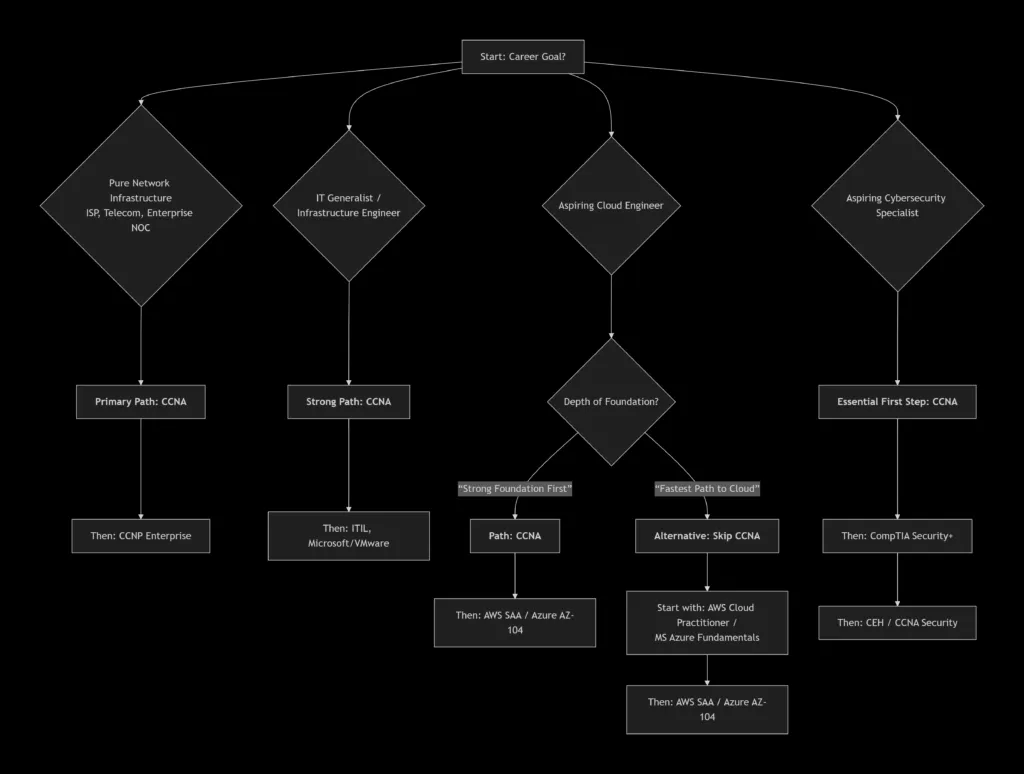
3.2 Detailed Alternative Analysis
-
CompTIA Network+:
-
Pro: Vendor-neutral, excellent for broad concepts, easier than CCNA, good for non-technical managers.
-
Con: Less depth, not as compelling to employers of hardcore network engineers in the UAE. Often viewed as a “step below” CCNA.
-
Verdict: Good for helpdesk pros moving to desktop support. For dedicated network roles in the UAE, CCNA is preferred.
-
-
Juniper JNCIA-Junos:
-
Pro: Relevant if targeting specific employers using Juniper (some ISPs, data centers).
-
Con: Cisco’s market share in the UAE enterprise is overwhelming. A CCNA offers far more opportunities.
-
Verdict: A supplementary cert after CCNA for career versatility, not a primary substitute.
-
-
Cloud-Centric Path (AWS/Azure Associate):
-
Pro: Direct alignment with the highest-growth sector. Can lead to jobs faster for some.
-
Con: Without networking fundamentals, you risk being a “button-clicker” with limited troubleshooting depth and career ceiling.
-
Verdict: The Hybrid Path (CCNA -> Cloud Cert) creates the most robust and future-proof profile.
-
3.3 The “Future-Proof” Hybrid Profile: The CCNA+
The most valuable professional in the 2024 UAE market is not a network engineer or a cloud engineer, but a hybrid infrastructure engineer. Build this profile:
-
Layer 1: Absolute Foundation. CCNA Certification. This is your non-negotiable base.
-
Layer 2: Cloud Competence. AWS Solutions Architect Associate (SAA-C03) or Microsoft Azure Administrator (AZ-104). Choose based on the UAE market: Azure is huge with government and large enterprise, AWS is dominant with SMEs and tech companies.
-
Layer 3: Automation & Code. Basic Python for Network Automation, followed by Terraform (Infrastructure-as-Code). This is what separates you from the past
-
Layer 4: Specialization (Optional). Security+, ITIL 4 Foundation (for process), or a deeper dive into SD-WAN or Zero Trust Networking.
This profile allows you to work on legacy infrastructure while designing and deploying the future. You become the bridge that UAE companies desperately need.
Section 4: The UAE-Specific Action Plan & Final Verdict
Phase 1: Pre-Commitment (Weeks 1-2)
-
Self-Assessment: Honestly evaluate your learning style, available time, and finances
-
Market Scan: Spend 5 hours on LinkedIn, Bayt.com, and Indeed.ae. Search for “Network Engineer,” “NOC,” “IT Infrastructure.” See how many list CCNA. Read the job descriptions.
-
Talk to Professionals: Use LinkedIn to politely message network professionals in Dubai. Ask: “How critical was the CCNA for your role?”
Phase 2: Execution & Training (Months 1-6)
-
Select Your Training Partner: This is crucial. Your institute must provide:
-
KHDA/ADEC Recognition: For certificate attestation value.
-
Hands-On Labs with Real Equipment: Not just simulations.
-
Instructors with UAE Industry Experience: They can contextualize learning.
-
Career Support: CV workshops, interview prep, potential internship links.
-
-
Immerse and Lab Relentlessly: Theory is 30%. Labs are 70%. Break things and fix them.
-
Build a “Project Portfolio”: Document 3-5 lab projects on a personal blog or GitHub. For example: “Designed a redundant network for a 3-branch mock company with OSPF and VLANs.”
Phase 3: Post-CCNA Strategy (Month 6+)
-
Update Your CV & LinkedIn: Highlight the certification and your project portfolio
-
Start Applying & Interviewing: Target the companies listed in Section 1.1.
-
Immediately Begin Your Next Learning Cycle: Enroll in an AWS Cloud Practitioner or Microsoft Azure Fundamentals course within one month of passing the CCNA. Momentum is key.
Final, Nuanced Verdict
Is the Cisco CCNA certification worth it in the UAE in 2024?
For the vast majority of IT professionals seeking to build a long-term, resilient, and high-earning career in the UAE’s technology sector: Yes, it is not only worth it but remains a strategically sound, and in many cases essential, investment.
However, it must be understood not as a final destination, but as the single most important foundational step in a continuous learning journey. It is the master key that unlocks doors to stable, infrastructure-centric roles today and provides the essential grounding for the cloud and automation roles of tomorrow.
The CCNA alone is a powerful tool. The CCNA as the foundation of a hybrid skill set is an unstoppable career advantage in the ambitious digital landscape of the United Arab Emirates.
Begin your foundation. Master the network. Then, command the future.
Ready to execute this strategy? The first step is world-class training. BFTraining’s CCNA program in Dubai is engineered for the UAE market, blending foundational mastery with insights into cloud integration and automation. We prepare you not just for an exam, but for a career.