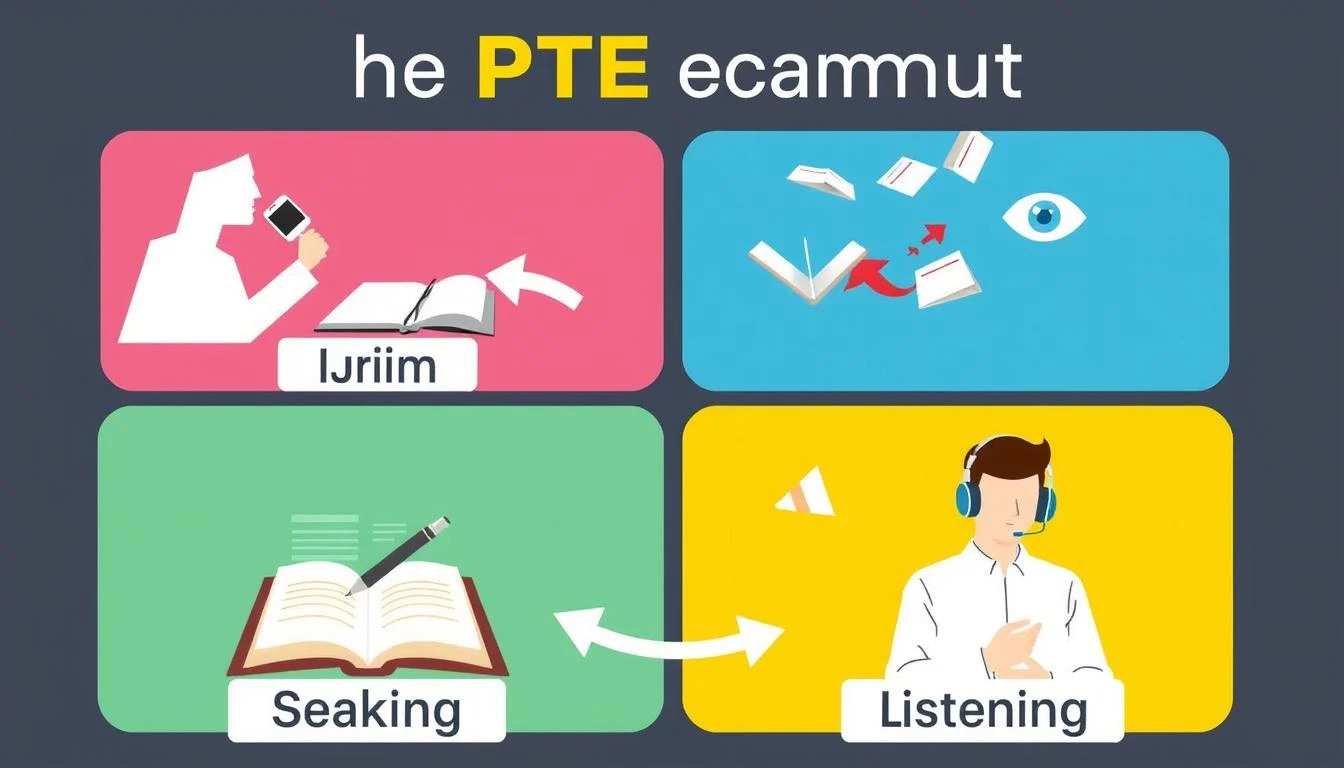
The PTE Academic exam format is a single computer-based test with three parts: Speaking and Writing, Reading, and Listening. These parts assess four skills, and many tasks score more than one skill at once. Pearson sets the exact task list, timings and rules, so confirm current details on the official Pearson PTE website before you book.
Key takeaways
- The test is taken on a computer, with a headset and microphone for the speaking tasks.
- Speaking and Writing come first as one combined part, followed by Reading and then Listening.
- Several tasks are integrated: one answer can contribute to two skills, such as listening and speaking.
- Speaking responses are recorded once, and some audio plays only once, so the format rewards calm, first-time accuracy.
- Knowing which task builds which skill lets you plan practice far better than repeating full mock tests.
- Official exam fees, dates and rules belong to Pearson, so check them on the official exam website.
What does the PTE Academic exam format look like?
PTE Academic is delivered on a computer and marked largely by automated scoring. You do not sit in front of an examiner, and you do not speak to a person. You speak into a microphone, type your written answers and click or drag your way through the objective tasks.
The test is split into three parts that run one after another:
- Speaking and Writing, taken together as the first part.
- Reading, with a mix of selection and gap-filling tasks.
- Listening, with audio and video clips that play automatically.
Within each part you meet a series of task types, each with its own instructions and timing. The instructions appear on screen before every task, and the test moves forward on its own. That is a real difference from a paper exam: you cannot linger on one section and borrow time from another.
The institute's own PTE exam preparation course is built around this computer-based structure, so learners practise in the same way they will test.
The four skills behind the three parts
The three parts do not map neatly onto the four skills. Speaking and Writing sit together in one part, and Reading and Listening tasks also draw on writing. This overlap is the main reason the format feels unfamiliar to people who have only taken paper-based tests.
| Part | Main skills assessed | How you respond |
|---|---|---|
| Speaking and Writing | Speaking, writing, plus listening and reading in integrated tasks | Microphone and keyboard |
| Reading | Reading, with some writing in gap-fill tasks | Mouse selection, drag and drop, drop-down menus |
| Listening | Listening, with writing, reading and spelling in integrated tasks | Keyboard and mouse |
What happens in the Speaking and Writing part?
This is usually the most demanding part, because you switch quickly between spoken and written work. It opens with a personal introduction that is not scored, which gives you a moment to settle your voice and check the microphone.
Speaking tasks
Spoken tasks include reading a text aloud, repeating a sentence you have heard, describing an image, retelling a lecture, answering a short question, summarising a group discussion and responding to a situation. Several of these begin with audio, so they test listening as much as speaking.
Speaking responses are scored on content, pronunciation and oral fluency. Content is about whether you said what the task asked. Pronunciation is about whether your speech can be understood clearly. Oral fluency is about smooth, steady delivery without long gaps or constant restarts.
Three format rules affect how you practise:
- The microphone opens after a tone or countdown, so speaking early records nothing.
- You can record each spoken response only once.
- Audio for sentence repetition and short-question tasks cannot be replayed.
Writing tasks
The written tasks are summarising a passage in a single sentence and writing an essay. Summaries are judged on content, form, grammar and vocabulary. Essays are judged on a wider set of traits, including development and coherence, language range, grammar, vocabulary and spelling. Each task has a word range, and going outside it can lower the mark, so read the on-screen instructions and the official page for the current limits.
The key habit here is to answer exactly what the prompt asks. A fluent answer to a different question scores poorly on content.
What the Speaking and Writing tasks test
| Task | Skills assessed | What the marker looks at |
|---|---|---|
| Read Aloud | Speaking | Content, pronunciation, oral fluency |
| Repeat Sentence | Listening and speaking | Content, pronunciation, oral fluency |
| Describe Image | Speaking | Content, pronunciation, oral fluency |
| Retell Lecture | Listening and speaking | Content, pronunciation, oral fluency |
| Answer Short Question | Listening | Right or wrong answer |
| Summarize Group Discussion | Listening and speaking | Content, pronunciation, oral fluency |
| Respond to a Situation | Speaking | Content, pronunciation, oral fluency |
| Summarize Written Text | Reading and writing | Content, form, grammar, vocabulary |
| Write Essay | Writing | Development, structure, language range, grammar, vocabulary, spelling |
Task names and the exact list can change when Pearson updates the test, so use this table as a map of skills rather than a fixed checklist.
How is the Reading part organised?
The Reading part uses objective formats. Instead of typing long answers, you select options, fill gaps from a menu or a word bank, and rearrange text. The tasks cover:
- Fill in the Blanks (drop-down): choose the correct word for each gap in a passage.
- Multiple Choice, Multiple Answers: select every correct option; wrong selections can cost marks.
- Reorder Paragraph: put jumbled text boxes into a logical order.
- Fill in the Blanks (drag and drop): drag words into gaps, with some words left unused.
- Multiple Choice, Single Answer: choose the one correct option.
Most of these tasks give partial credit, so a partly correct answer still earns something. Reorder Paragraph rewards spotting links between sentences, and the gap-fill tasks reward a good sense of collocation and grammar. Reading tasks do not have a separate timer on each item, which means you control your own pacing inside the part. Practise with the whole part in mind, not one question at a time.
For a focused look at this part, see the institute's guide to PTE Reading training.
How is the Listening part organised?
Listening clips play automatically and you hear each one once. You can take notes while you listen. The task types include:
- Summarize Spoken Text: listen to a short talk and write a summary.
- Multiple Choice, Multiple Answers and Single Answer: answer questions about a recording.
- Fill in the Blanks (type in): type the missing words into a transcript.
- Highlight Correct Summary: choose the paragraph that best summarises the audio.
- Select Missing Word: pick the word or phrase that completes a recording ending in a beep.
- Highlight Incorrect Words: click the words in a transcript that differ from what you heard.
- Write from Dictation: type the sentence you hear exactly.
Several of these tasks combine listening with reading or writing, so spelling and typing accuracy matter. Write from Dictation is a good example: a short sentence is played once, and you are marked on the words you type correctly, spelled correctly. Wrong guesses in Highlight Incorrect Words lose marks, so accuracy beats speed.
How does one answer score more than one skill?
This is the part most guides skip. In PTE, the result you see is not four separate exams stitched together. Because tasks are integrated, a single response can feed into more than one skill score.
Consider Repeat Sentence. You listen, hold the sentence in memory and speak it back. That one response is evidence of your listening and your speaking. Write from Dictation works the same way for listening and writing. Summarize Spoken Text uses listening and writing together.
The practical effect is that weakness in one area can pull down others. If your spelling is unreliable, it can affect both Listening and Writing results. If you struggle to hold information from audio, it can affect Listening and Speaking at once. Your score report shows communicative skills (speaking, writing, reading, listening) and enabling skills such as grammar, spelling, vocabulary, pronunciation, oral fluency and written discourse, which helps you see where marks are being lost.
Why does the computer-based format change how you prepare?
Format knowledge is practical, not just background. Here is how the structure should shape your preparation.
Practise speaking with the recording rules in mind
Because you can record only once, practise answering in one clean attempt. Record yourself, play it back and note hesitations, but do not restart mid-answer the way you might in conversation. In the real test, a restart eats your time and breaks fluency. The institute's PTE speaking training guide explains how to build that habit.
Train for single-play audio
Many learners are used to replaying audio. In PTE you cannot. Practise with recordings played once, and build the habit of taking brief notes as you listen. This is especially important for Summarize Spoken Text and Repeat Sentence.
Get comfortable with headset, keyboard and screen
A fair share of lost marks come from handling the interface rather than from English ability. Practise typing accurately, using drag and drop smoothly and speaking naturally into a microphone.
Practise whole parts, not only single tasks
Short drills build skills, but a whole-part run builds stamina. The test moves on its own, so rehearse full parts without pausing, then review mistakes afterwards.
What should you prepare before you start studying?
Use this checklist to make early preparation efficient. It contains no fixed timelines, because the right pace depends on your starting level and your goal.
| Step | What to do | Why it matters |
|---|---|---|
| Check your purpose | Confirm which score and test version your university, employer or authority asks for | Requirements are set by those bodies, not by the institute |
| Read the official format pages | Review the current task list and rules on the Pearson PTE website | Task lists and rules can change |
| Take a diagnostic attempt | Try a sample part under test conditions | Shows your starting point across all four skills |
| Match weak tasks to skills | Link each weak task to the skill it assesses | Directs practice to the real cause |
| Set up practice equipment | Use a headset, microphone and keyboard | Mirrors test day |
| Ask for expert feedback | Have a trainer review your speaking and writing | Automated scoring rewards patterns that a trainer can spot |
For more courses in this area, browse the exam preparation category. For wider preparation tactics once you understand the format, read the institute's PTE Academic exam tips.
Is PTE Academic the only PTE format?
No. Pearson also offers PTE Core, which is aimed at different purposes. The two tests share the same general computer-based approach, but their intended use differs, and the exact content is set by Pearson. The institute lists a dedicated PTE Core page for learners who need that version.
If you are unsure which version suits you, ask the organisation that requires the result. Do not choose a test version based on what a friend took, because the accepted version depends on the purpose and on the receiving body.
Many readers are also deciding between PTE and IELTS. The institute has a separate comparison, IELTS vs PTE, which looks at format differences in more detail.
How can you prepare in Dubai?
Bright Future Training Institute is a KHDA-approved training institute at the NBQ Building, Bank Street, Bur Dubai, close to BurJuman Metro Station. It offers exam preparation in the classroom and as online live sessions, so you can choose the format that fits your work or study week.
A trainer-led class can help in ways that self-study cannot. A trainer listens to your speaking and points out what automated feedback does not explain. A trainer also checks your written tasks against the traits that markers use. For learners who work during the day, online live sessions remove the commute while keeping the live interaction.
The institute is open daily, 9:00 AM to 5:00 PM, and students can book a free demo class before enrolling. Course advisers can explain the available options, tell you current fees and help you decide between classroom and online preparation. Certificates are approved by KHDA and recognised across the UAE.
What to ask a course adviser
- Which PTE version does my purpose require, and how should I prepare for it?
- How will my speaking and writing be reviewed?
- Can I join a free demo class first?
- Which payment options are available? Options include Visa, Mastercard, Tabby and Tamara.
What should you remember about the PTE exam format?
The format is straightforward once you see it as a map of skills. Three parts, many task types, a computer interface and integrated scoring are the whole story. The most useful steps are to learn what each task assesses, practise under test conditions and confirm every official rule with Pearson.
No training course can promise a score, because results depend on your own English, your practice and your performance on the day. What good preparation can do is remove surprises about the format, so your attention goes to the English itself.
If you would like help building a plan, talk to a course adviser at Bright Future Training Institute, request details of the PTE course or book a free demo class. You can also reach the team on WhatsApp or phone at +971 54 373 3394 or by email at [email protected].