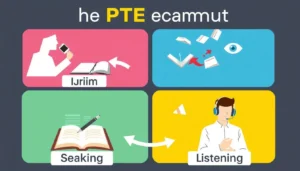
The PTE Academic exam structure has three parts: Speaking and Writing, Reading, and Listening. All four language skills are tested on a computer in one sitting, and an automated system scores the answers on a scale of 10 to 90. Knowing which tasks sit in each part makes preparation far more focused.
Key takeaways
- The test is delivered in three parts, and the first part tests speaking and writing together.
- Many tasks are integrated, so one answer can show evidence of more than one skill.
- Each part uses its own set of task types, and the listening audio plays only once.
- Scores run from 10 to 90 and are produced by an automated scoring system, with some responses reviewed by a human expert.
- Timings, question numbers, fees and dates are set by Pearson, so always confirm them on the official Pearson PTE website.
What is the PTE Academic exam structure?
PTE Academic is an English language test from Pearson. It is taken on a computer at a test centre, and the questions are grouped into three parts that always appear in the same order. Part 1 covers Speaking and Writing, Part 2 covers Reading, and Part 3 covers Listening.
The structure is different from tests that give each skill its own separate paper. In PTE Academic, a task often mixes skills. A candidate may listen to a short lecture and then speak about it, or read a passage and write a one-sentence summary. This is why the test is described as integrated.
For a student in the UAE, the practical meaning is simple. Preparation cannot treat the four skills as sealed boxes. Listening practice helps speaking tasks, and reading practice helps writing tasks. A good study plan follows the three parts of the real test and then looks at the individual task types inside each one.
This guide is a general overview of the structure. It does not list timings, question numbers or fees, because Pearson can change them. Use it to understand the shape of the test, then check the current details on the official Pearson PTE website before you book.
How is the PTE Academic exam divided?
The table below shows the three parts in the order a candidate meets them, with the skills each one is built to measure.
| Part | Name | Main skills measured | Answer format |
|---|---|---|---|
| Part 1 | Speaking and Writing | Speaking, writing, plus listening and reading in integrated tasks | Spoken recordings and typed answers |
| Part 2 | Reading | Reading, with grammar and vocabulary in context | Clicking, dragging and reordering |
| Part 3 | Listening | Listening, with some writing and reading | Typing, selecting and clicking |
The fixed order is one reason mock practice matters. A candidate who has only ever practised single tasks may feel the rhythm of a full sitting for the first time on test day, which is the wrong moment to discover it.
What happens in Part 1: Speaking and Writing?
Part 1 is the longest and the most varied. It opens with a personal introduction, which is a practice-style recording. According to Pearson, this introduction does not count towards the score, so it is a safe moment to settle into the microphone and the screen.
After that, the speaking and writing tasks follow. They fall into two groups.
Which speaking tasks are in Part 1?
The spoken tasks test how clearly and naturally a candidate can communicate. The main ones are:
- Read Aloud: reading a short text out loud. This is mainly a test of pronunciation and oral fluency.
- Repeat Sentence: repeating a sentence that was heard. This draws on listening and speaking together.
- Describe Image: describing a picture, chart or graph in detail and in an organised way.
- Retell Lecture: listening to a short lecture and retelling it in the candidate's own words.
- Answer Short Question: replying to a spoken question with a word or a few words.
- Summarize Group Discussion: summarising a conversation between several speakers.
- Respond to a Situation: giving a spoken reply to an everyday situation, using a suitable level of formality.
Speaking tasks are generally judged on content, pronunciation and oral fluency. A candidate does not need a particular accent. Clear, steady speech with relevant content is what the system is looking for. For tips on this area, the guide to PTE speaking tips is a useful companion.
Which writing tasks are in Part 1?
There are two written tasks in this part:
- Summarize Written Text: reading a passage and writing a single-sentence summary. It tests reading and writing together.
- Write Essay: writing an argumentative essay on a given topic. It is scored on a wider set of criteria, including development, structure, grammar and vocabulary.
Because the essay and the summary both depend on grammar, spelling and organisation, they reward candidates who write calmly and proofread. Memorised templates tend to sit awkwardly with a new topic, so it is better to learn how a clear paragraph is built than to copy a fixed script.
What happens in Part 2: Reading?
Part 2 contains five types of questions, and all of them assess reading. They are presented as short passages with a task attached.
| Question type | What the candidate does | What it tests |
|---|---|---|
| Fill in the Blanks (Dropdown) | Chooses the best word from a list for each gap in a passage | Grammar, vocabulary and context |
| Multiple Choice, Multiple Answers | Selects every correct option about a passage; wrong selections can lose points | Understanding of content and tone |
| Reorder Paragraph | Puts shuffled text boxes back into a logical order | Organisation and cohesion |
| Fill in the Blanks (Drag and Drop) | Drags words from a box into gaps; some words are extra | Grammar and context |
| Multiple Choice, Single Answer | Reads a passage and picks the one correct answer | Overall comprehension |
The most important feature of this part is the way the tasks reward understanding rather than speed-reading alone. Reorder Paragraph, for example, cannot be solved by spotting a keyword. It asks the candidate to see how an argument moves from one sentence to the next.
Practice for this part works best when it includes both skimming and careful reading. Skimming helps with the multiple-choice items, while slow, precise reading helps with the gap-filling and reordering tasks. The page on PTE reading training goes into this area in more depth.
What happens in Part 3: Listening?
Part 3 has eight types of questions, and the audio plays once for each. That single hearing is the feature that surprises many first-time candidates. There is no second chance to catch a detail, so note-taking and attention matter from the first second.
| Question type | What the candidate does | Skills involved |
|---|---|---|
| Summarize Spoken Text | Writes a short summary of a recording | Listening and writing |
| Multiple Choice, Multiple Answers | Selects all correct options about a recording | Listening |
| Fill in the Blanks (Type In) | Types the missing words in a transcript with gaps | Listening and writing |
| Highlight Correct Summary | Chooses the paragraph that best summarises the recording | Listening and reading |
| Multiple Choice, Single Answer | Selects one correct option | Listening |
| Select Missing Word | Chooses the option that completes the recording, where the end is replaced by a beep | Listening |
| Highlight Incorrect Words | Clicks the words in a transcript that differ from what the speaker said | Listening and reading |
| Write from Dictation | Types a short sentence exactly as heard | Listening and writing |
Accents and speaking styles vary between recordings, so a candidate who has only listened to one type of English can feel caught out. Mixed listening practice, including lectures, discussions and short announcements, is a better preparation than repeating the same audio source. A closer look is available in the guide to PTE listening training.
How does the scoring work in the PTE Academic exam?
PTE Academic is scored on a scale of 10 to 90. According to Pearson, the scores are linked to the Global Scale of English. The candidate receives an overall score and also a profile that shows performance across the language skills.
The test is marked by an automated scoring system, so a candidate does not speak to a human examiner. Multiple-choice answers are marked right or wrong. More complex responses, such as essays, are judged on several criteria at once. Pearson also states that some responses are reviewed by a human expert before the automated score is final.
Why do integrated tasks matter for the score?
Because one task can show evidence of more than one skill, a weak area can pull down more than one result. A candidate who struggles to follow the audio in Retell Lecture may find that both listening and speaking suffer. The reverse is also true. Improving one core ability, such as listening for the main idea, can lift several parts of the profile together.
This is the most useful way to read the structure. Instead of asking which skill to practise first, ask which skills feed the most tasks. Listening and vocabulary tend to appear everywhere in the test, so they are usually a sound place to invest effort.
Does a score secure admission or a visa?
No. A PTE score is only one document in an application. Universities, employers and immigration departments set their own requirements, and those requirements change. No institute can promise a score or a result. Always check the required score with the university, employer or authority that will receive it, and confirm the exam rules on the official Pearson PTE website.
How can candidates prepare for each part?
Preparation works best when it follows the structure of the test. A balanced plan has four stages.
- Find a starting point. Attempt a short practice set from each of the three parts. The aim is to see which task types feel natural and which feel slow or stressful.
- Learn the task types one by one. Read what each task asks for, then practise it alone until the instruction no longer needs to be re-read.
- Combine tasks into full parts. Once the individual tasks feel comfortable, practise whole parts in the real order, without pausing the recording or checking the answers.
- Review the pattern of mistakes. Look for repeated errors, such as dropping word endings in speech or missing the last detail in a recording. Fix the pattern rather than a single answer.
What should a candidate prepare before enrolling in a course?
Some preparation before the first class helps a course adviser give better guidance. The table below lists what is worth gathering.
| Item to prepare | Why it helps |
|---|---|
| The score required by the university, employer or authority | Sets the target for the study plan |
| A recent English test result, if one exists | Shows the starting level |
| The planned test date, if known | Helps the adviser plan the study schedule |
| A note of the weakest skill | Allows early attention on that area |
| Preferred study format: classroom or online live sessions | Fits the course to the candidate's routine |
How should the structure shape a study routine?
A steady, short routine usually works better than occasional long sessions. A practical week could give each skill a regular slot: spoken recordings, a writing task, a reading set and a listening set. Keep notes on common errors and revisit them. Candidates who work or study full time often do best with a simple, repeatable pattern rather than a complicated plan.
Another useful habit is to read the instruction for every task type slowly during practice, even when it feels familiar. Many lost marks come from answering a slightly different question from the one asked, for example describing an image in general terms when the task wants key features and relationships. Treat the instruction as part of the task, and check it against the scoring criteria described above. Candidates who build this habit early tend to feel calmer when a full part is running on a real screen.
Mock practice should also reflect the real structure. That means working through a whole part in order, in a quiet space, using headphones and a microphone. It also means getting used to a screen-based test, where the only tools available are the ones the software provides.
What common misunderstandings affect candidates?
A few misunderstandings come up often in conversations with students.
- "Speaking is a separate test." In PTE Academic, speaking sits in the same part as writing, so there is no separate speaking appointment.
- "A perfect accent is needed." The system looks for clear, fluent, relevant speech. It is not a test of accent.
- "Templates solve everything." Templates can give a structure, but the content still has to answer the actual prompt.
- "Listening can be repeated." The audio plays once, so listening practice should be done the same way.
- "All sources are current." Online summaries of the test format vary and some are out of date. The official Pearson PTE website is the place to confirm the current structure.
How does PTE compare with other English tests?
Many candidates ask whether PTE or IELTS suits them better. The honest answer is that it depends on where the score will be used, how the candidate prefers to answer, and which organisation will receive it. Some people like the computer-based format and automated marking of PTE. Others prefer a different style of test. The comparison is covered in IELTS vs PTE, and a course adviser can help weigh the options against a specific goal.
Whichever test is chosen, check that the receiving institution accepts it. Acceptance is decided by the institution, not by the training centre.
How can Bright Future Training Institute help with PTE preparation?
Bright Future Training Institute is a KHDA-approved training institute at the NBQ Building, Bank Street, Bur Dubai, close to BurJuman Metro Station. Classes run in the classroom and as online live sessions, so candidates elsewhere in Dubai and across the UAE can join. The institute is also an affiliate partner of the British Council.
The PTE exam preparation course is built around the three-part structure described above, with expert trainers and practice for each task type. More options in the same area are listed in the exam preparation category. Candidates who want focused work on a single skill can also read about PTE writing training, and the PTE exam format explained guide gives a second view of the layout.
Payment options include Visa, Mastercard, Tabby and Tamara. The institute does not publish course fees, so ask a course adviser for the current details. Certificates are approved by KHDA and recognised across the UAE. No course can promise a particular score, so the aim of training is to build skill and confidence, not to promise a result.
Ready to plan your PTE preparation?
The best next step is a short conversation. A course adviser can look at your goal, your current level and your preferred format, and suggest a sensible plan. Students can also book a free demo class before enrolling, which is a low-pressure way to see the teaching style.
Request course details or reach the course advisers on WhatsApp or phone at +971 54 373 3394, or by email at [email protected]. The institute is open daily, 9:00 AM to 5:00 PM.