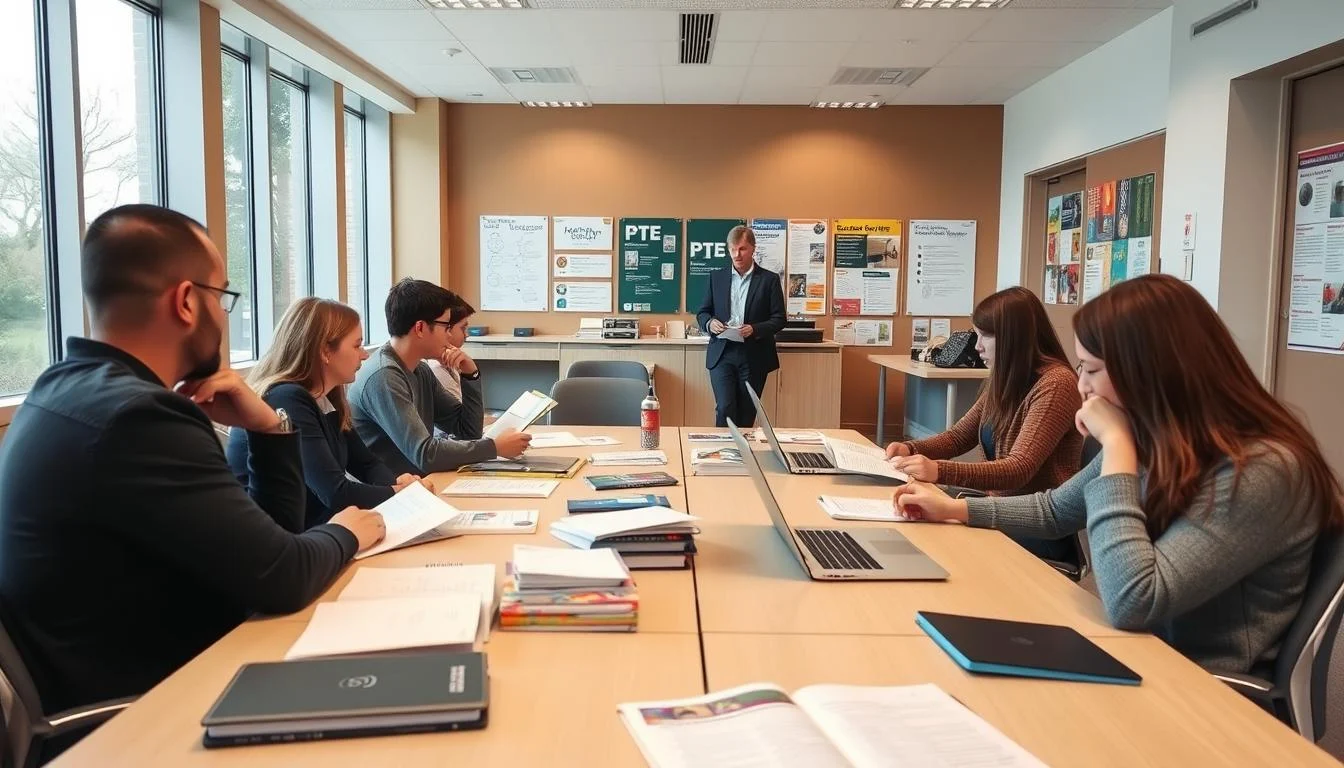
PTE Academic Reading is the second part of the test and contains five question types: two fill-in-the-blanks tasks, two multiple-choice tasks and Reorder Paragraphs. The best preparation is to learn how each task is scored, practise it under timed conditions and have a trainer explain your errors. Bright Future Training Institute teaches this in Bur Dubai and online.
Key takeaways
- The Reading part has five question types, and each one rewards a different habit.
- Several tasks give partial credit, so a half-right answer is worth attempting.
- Multiple-answer questions can cost you points for wrong choices, so guessing needs care.
- A written error log shows more about your reading than a raw practice score.
- Classroom and online live sessions both work; the right choice depends on your routine.
- Exam rules, fees and dates belong to the exam body, so confirm them on the official Pearson PTE website.
What does the PTE Reading section test?
The PTE Academic is split into three parts: Speaking and Writing, Reading, and Listening. Reading is the middle part. It checks whether you can understand academic-style English texts, follow how ideas connect, and work out the meaning of words from their context.
The section is made of short texts followed by tasks. None of the tasks asks for a long written answer. You click, drag, reorder or select. That sounds simple, but the texts are dense and the tasks are timed, so the real challenge is reading accurately at speed.
A reader who only studies vocabulary lists often struggles here. The tasks test grammar, collocation (which words naturally go together) and paragraph logic as much as word meaning. That is why a structured approach to PTE reading training helps more than reading random articles.
The five question types at a glance
The official Pearson PTE website lists five question types in the Reading part. The table below summarises them in plain language. Text lengths are the upper limits Pearson gives for each type, so always check the official page for the current description.
| Question type | What you do | Scoring idea |
|---|---|---|
| Reading and Writing: Fill in the Blanks | Choose the right word from a dropdown list for each gap in a text of up to 200 words | Partial credit for the gaps you fill correctly |
| Multiple Choice, Multiple Answers | Read a text of up to 350 words and select every correct option | Credit for correct options, points lost for incorrect ones |
| Reorder Paragraphs | Put text boxes, shown in random order, into the original sequence | Partial credit for boxes placed correctly |
| Reading: Fill in the Blanks | Drag words from a box into the gaps of a text of up to 80 words; extra words are supplied | Partial credit for each correct gap |
| Multiple Choice, Single Answer | Read a text of up to 110 words and choose the one correct answer | Correct or incorrect, with no partial credit |
Notice how different the tasks are. One rewards grammar and word choice, another rewards careful elimination, and another rewards an eye for how a text is built. A good study plan treats them separately instead of calling everything "reading practice".
Why does Reading and Writing Fill in the Blanks also involve writing?
The dropdown fill-in-the-blanks task is described by Pearson as assessing writing as well as reading. You are not writing sentences, but you must choose words that fit the grammar and meaning of the sentence. A wrong word form, such as the wrong tense or the wrong preposition, can cost you even when you understood the text.
For test takers, the practical lesson is that grammar knowledge supports your Reading score. Spend part of your preparation on the patterns that appear again and again: verb forms, articles, prepositions and linking words.
How is PTE Reading scored?
Scoring in PTE is computer-based, and the Reading section uses a mix of full and partial credit. According to the official Pearson description, multi-item questions receive partial credit for partly correct answers, while single-answer questions are marked simply right or wrong.
Three consequences follow from this.
- Do not leave multi-item tasks blank. A partly correct Reorder Paragraphs answer or a fill-in-the-blanks answer with some correct gaps still earns something.
- Treat multiple-answer questions with caution. Because incorrect options can lose points, selecting every option that might be right is risky. Choose only the options you can support from the text.
- Treat single-answer questions as all or nothing. Spend your thinking time on eliminating wrong options rather than hunting for one perfect sentence.
Pearson also explains how Reading contributes to the overall result and to the communicative skill scores. Those details can change, so read the current scoring page on the official PTE website rather than relying on a blog, including this one. Your course adviser can also point you to the right pages.
What about the score you need?
The score you need depends on the university, employer or immigration authority that asked for the test. Each organisation sets its own requirement and can change it. Ask the organisation directly, and confirm the current rules on the official exam website. A trainer cannot promise a particular score, and neither can this article.
How should you approach each question type?
A sound method is to give each task its own routine. Practise the routine until it feels automatic, then time yourself.
Reading and Writing: Fill in the Blanks
Read the whole text once before you touch any dropdown. Work out the topic and the tone. Then go gap by gap.
- Look at the words just before and after the gap. Does the gap need a noun, a verb, an adjective or a linking word?
- Check grammar signals: singular or plural, tense, and whether a preposition is expected.
- Eliminate options that are the wrong part of speech before you think about meaning.
- Return to the sentence and read it through in your head with your choice in place.
Many errors here come from choosing a word that has the right meaning but the wrong form. Slow, systematic checking beats a fast gut feeling.
Multiple Choice, Multiple Answers
These questions come with the longest text, so reading strategy matters most. Read the question first, so you know what to look for. Then read the passage and mark the places that relate to each option.
Select an option only when you can point to the evidence in the text. Watch for options that are partly true but add a detail the passage never states. Those are the usual traps. Because wrong choices can reduce your result, accuracy is worth more than coverage.
Reorder Paragraphs
This task rewards an eye for structure. Look for the opening box first: it usually introduces a topic in general terms and does not depend on anything before it. Then look for connectors and reference words.
- Pronouns such as "this", "they" or "these" point back to something earlier.
- Linking words such as "however", "as a result" or "for example" show the relationship to the previous box.
- Dates, steps or stages often reveal a chronological order.
Build small pairs of boxes that clearly belong together, then join the pairs. Because the scoring gives partial credit, even correct pairs help.
Reading: Fill in the Blanks
The drag-and-drop task has a word box and some extra words. The extras are deliberate distractors. Fill the gaps you are sure about first, then use the remaining words for the harder gaps. Cross out used words mentally so the leftovers become easier to judge.
Collocations matter here. If a gap follows "make", ask yourself whether a word such as "decision" or "progress" sounds natural, rather than asking only whether it makes some kind of sense.
Multiple Choice, Single Answer
This is the shortest passage and the shortest decision. Read the question, read the text, then eliminate. Wrong options often fall into a few types: too extreme, not mentioned, the opposite of the text, or true in general but not in this passage. Learning to name the reason for each wrong option makes your choices faster and more reliable.
What does an effective practice routine look like?
Good preparation is regular and varied. A realistic routine for a working adult or a student combines short daily reading with focused task practice.
- Daily reading: Read a few academic-style articles every day, from science, business, health, environment or technology topics. Underline connectors and note how paragraphs open and close.
- Task practice: Rotate through the five question types so no single type is neglected.
- Timed sets: Once the method feels comfortable, work against a timer so that decision speed becomes part of the habit.
- Review: After each set, record why each error happened.
Keep the routine light enough that you can repeat it. A plan you follow consistently is more useful than an ambitious plan you abandon after a week.
How do you build the vocabulary the texts expect?
Academic texts reuse a set of general academic words such as "significant", "assume", "factor", "consequence" and "in contrast". Learn them in phrases, not alone. Write a short example sentence for each new word, and note its common partners.
Context matters more than a dictionary definition. When you meet an unknown word, ask what job it does in the sentence. Is it describing a cause, a result, a contrast or an example? That often tells you enough to answer correctly.
How can you read faster without losing accuracy?
Speed comes from reading in meaningful groups of words and from knowing where to look. Train yourself to find the topic sentence of each paragraph and to notice signposting words. Avoid reading every word with the same intensity.
At the same time, do not rush the question. A common pattern is that test takers read quickly, then lose marks because they misread the task instruction. Take a second to confirm exactly what the question asks.
How do you stay focused through a long reading session?
Concentration is a skill, and it improves with practice. Practise several tasks back to back so that your attention does not drop halfway through. Sit upright, keep your screen at a comfortable distance and avoid switching to your phone between tasks.
If you notice your mind wandering, do not reread the whole passage out of panic. Return to the first line of the paragraph you were on, find the topic sentence again and continue. Small recovery habits like this keep one weak moment from damaging several answers.
How do you use practice results properly?
A raw practice score tells you little. What matters is what caused each error. Keep an error log with four columns: the task type, what you chose, why it was wrong, and what you will do differently.
After a few sessions, patterns appear. You may find that most of your lost marks come from prepositions in the dropdown task, or from reorder questions where you missed a pronoun clue. A trainer can see those patterns quickly and suggest targeted exercises.
Which errors are most common?
| Type of error | What it looks like | Useful fix |
|---|---|---|
| Wrong word form | Right meaning, wrong tense or part of speech | Check grammar signals before meaning |
| Unsupported choice | Picking an option that sounds sensible but is not in the text | Find the sentence that proves the answer |
| Missed link | A reorder answer that ignores a pronoun or connector | Mark reference words in each box |
| Overreading | Spending too long on one task | Decide, move on and return only if time allows |
| Misread instruction | Answering a different question from the one asked | Reread the instruction before you submit |
Why does computer practice matter?
The PTE is taken on a computer, so practise on a screen. Get used to dragging, selecting and scrolling. Practise sitting through a full reading session without distraction. A quiet room, a timer and no phone are enough to recreate the feel of the test.
If you are worried about nerves, rehearse the routine until the first steps are automatic. Familiarity reduces anxiety more than reassurance does.
What does a trainer add that self-study does not?
Self-study is a good start, and many learners make real progress with it. A trainer adds three things that are hard to produce alone. The first is an outside view: a person who can spot that you always misjudge the same kind of connector. The second is explanation: not just "the answer is B" but a clear reason why the other options fail. The third is accountability, because a booked session gives your week a fixed point.
None of this replaces your own effort. The reading itself is yours to do. What good coaching does is make each hour of that effort count for more.
Should you choose classroom or online PTE Reading training?
Bright Future Training Institute offers classes in the classroom at the NBQ Building, Bank Street, Bur Dubai, close to BurJuman Metro Station, and as online live sessions. Both formats let you ask the trainer questions and receive feedback. The right choice depends on your travel, work hours and learning style.
| Factor | Classroom in Bur Dubai | Online live sessions |
|---|---|---|
| Where you study | At the institute, near BurJuman Metro Station | Anywhere with a stable internet connection |
| Interaction | Face to face with the trainer and other students | Live with the trainer on screen |
| Good fit for | Learners who like a dedicated study space | Learners who live far away or have a busy commute |
| What to arrange | A travel plan to Bank Street | A quiet room, a laptop and a reliable connection |
| Free demo class | Available before enrolling | Available before enrolling |
If you cannot decide, book a free demo class. It is the quickest way to see how a trainer explains a task and whether the pace suits you.
What should you prepare before you enrol?
A few simple preparations make your first conversation with a course adviser more useful.
| Prepare this | Why it helps |
|---|---|
| The organisation that asked for PTE | Its requirements decide your goal, and only that organisation can confirm them |
| Your target exam date, if you have one | Confirm test dates and availability on the official PTE website |
| A recent sample of your English reading | Helps the adviser understand your starting point |
| Your weekly availability | Helps you choose between classroom and online sessions |
| Your questions about the course | Fees, formats and next steps can be explained by an adviser |
For current fees, ask a course adviser. Fees are not published in this article, and exam fees are set by the exam body.
How do you reach Bright Future Training Institute?
The institute is open daily, 9:00 AM to 5:00 PM. The address is Suite 404, Fourth Floor, NBQ Building, Bank Street, Bur Dubai, Dubai, United Arab Emirates. BurJuman Metro Station is close by, which makes the centre straightforward to reach from many parts of Dubai.
Students from across the UAE can also join the online live sessions without travelling. Certificates are approved by KHDA and recognised across the UAE, and the institute is an affiliate partner of the British Council.
How does Reading fit with the rest of the PTE?
PTE is an integrated test, so skills overlap. Strong reading helps your writing because you meet correct sentence patterns, and a wide vocabulary helps your listening. It makes sense to study the sections together instead of treating Reading as a separate subject.
These related guides cover the other parts of the test:
- PTE Listening training in Dubai explains how to prepare for the Listening part.
- PTE Writing training looks at the written tasks.
- PTE exam format explained gives an overview of all four skills.
If you are still deciding between English tests, IELTS vs PTE compares the two, and the institute also runs an IELTS course.
Where can you see the full course?
The PTE exam preparation course page explains the course and how to enquire. You can also browse the wider exam preparation category to compare other test options.
Next step: talk to a course adviser
Good PTE Reading preparation is built on understanding the five question types, using the scoring rules to your advantage, and reviewing your errors honestly. A trainer who explains why an answer was wrong saves a great deal of time.
To discuss your goals, ask about current fees or book a free demo class, contact the Bright Future team. Course advisers answer by phone and WhatsApp at +971 54 373 3394 and by email at [email protected]. Payment options include Visa, Mastercard, Tabby and Tamara.