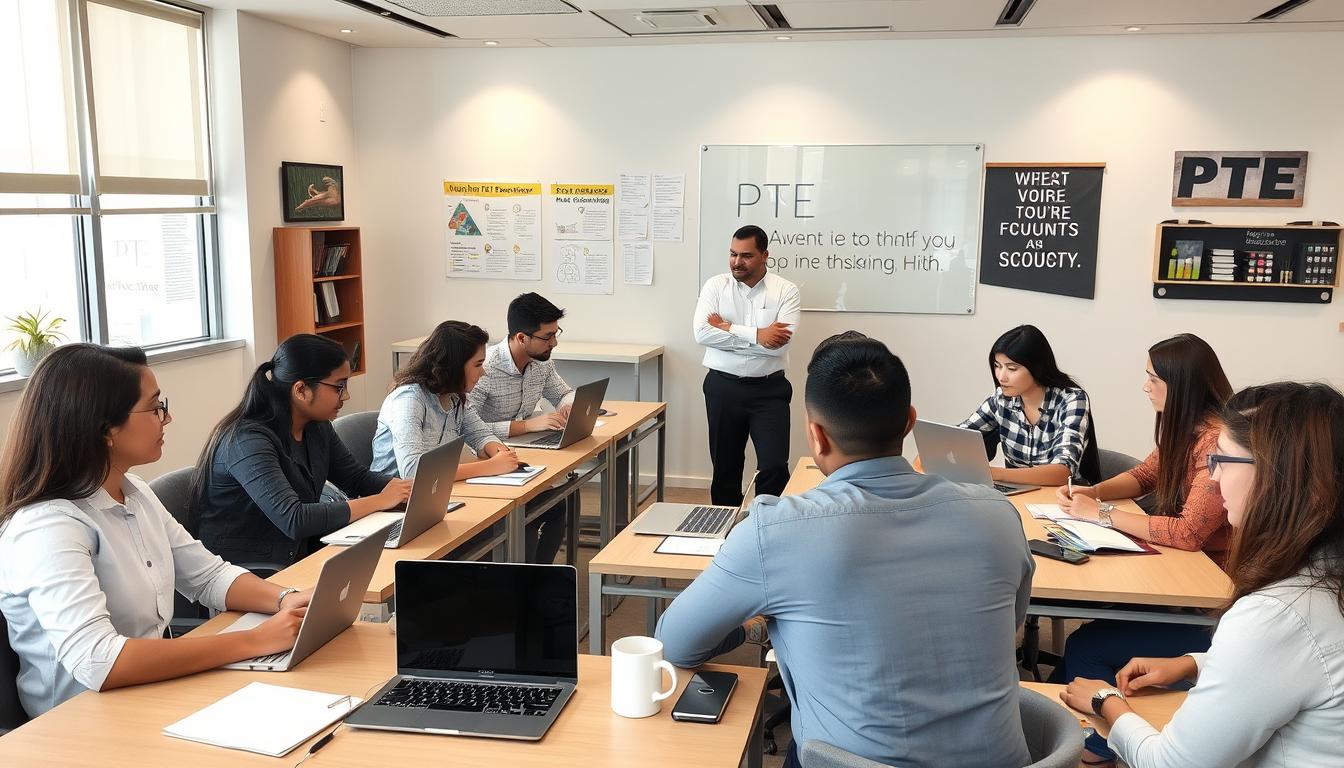
Residents of Emirates Hills who want PTE training can study at Bright Future Training Institute in Bur Dubai, close to BurJuman Metro Station, or join online live sessions from home. Both routes prepare you for the same four skills: Speaking, Writing, Reading and Listening. A course adviser can help you choose the format that suits your week.
Key takeaways
- PTE Academic is a computer-based English test, so preparation should include typing, headset use and timed practice on a screen.
- Bright Future offers PTE preparation in the classroom in Bur Dubai and as online live sessions, so you do not have to commute if your schedule is tight.
- Choose a format by looking at your weakest skill, your work pattern and how you learn best, not by the name of the area where you live.
- Course fees are not published here; ask a course adviser for current figures, and confirm exam fees, dates and rules on the official Pearson PTE website.
- You can book a free demo class before enrolling.
What does PTE training for Emirates Hills residents involve?
PTE training is structured preparation for the Pearson Test of English Academic. A good course explains the test, shows you how each question type is marked, and gives you supervised practice so that the real test feels familiar. It is not general English teaching. It is exam technique built on top of the English you already have.
People living in Emirates Hills tend to be working professionals, parents supporting a child's university plans, and residents preparing for study or migration applications abroad. Their needs differ, but the starting point is the same: understand the test, find your weak areas, then practise those areas in a planned way.
Bright Future Training Institute is a KHDA-approved training institute at the NBQ Building, Bank Street, Bur Dubai, and it runs PTE exam preparation in the classroom and as online live sessions. The institute serves learners across Dubai and the wider UAE, so living in Emirates Hills is not a barrier to joining.
What PTE Academic tests
According to the official Pearson PTE website, PTE Academic is a computer-based English test that assesses speaking, writing, reading and listening. The test is organised into three parts: Speaking and Writing together, then Reading, then Listening. Overall scores run on a scale from 10 to 90, and the score report also shows how you performed in each skill.
Pearson states that an automated system marks the test, which means there is no human examiner in the room asking you questions. Many learners find that strange at first, because you speak into a microphone and your answers are analysed by software. Training helps you get used to this, so that the format does not distract you on test day.
What good PTE training should include
Whatever institute you choose, check that the course covers the following:
- An explanation of every question type and how it is scored.
- Speaking practice with feedback on pronunciation, fluency and content.
- Writing practice with feedback on structure, grammar and vocabulary.
- Reading and Listening practice using timed tasks.
- Mock tests on a computer, followed by a review of your results.
- A clear plan for the weak areas the mock tests reveal.
If a course promises a certain score or tells you that a result is certain, treat that with caution. Nobody can honestly promise an exam score, because results depend on your own English, your practice and how you perform on the day.
How do you get from Emirates Hills to the Bur Dubai classroom?
The classroom is at Suite 404, Fourth Floor, NBQ Building, Bank Street, Bur Dubai, close to BurJuman Metro Station. Because Emirates Hills is a residential area in a different part of Dubai, plan the journey before you commit to classroom sessions, and be realistic about how often you can make it.
Here are the practical points to think through:
- Your usual route. Check the journey from home or from your workplace using a navigation app at the time of day you would travel. Traffic varies a great deal across Dubai, so test the route once before you enrol.
- Metro access. The institute is close to BurJuman Metro Station, which is helpful if you prefer not to drive or park in the city.
- Opening hours. The institute is open daily, 9:00 AM to 5:00 PM, so check that your session slot fits around work or school runs.
- A visit before enrolling. Many learners call or message first, then visit for a free demo class to see the classroom and meet the trainer.
If the journey looks like a strain, the online live option exists for exactly that reason. You can join the sessions from home or from a quiet room at work, and you keep the benefit of live teaching rather than watching recordings alone.
Classroom or online live sessions
| Question | Classroom in Bur Dubai | Online live sessions |
|---|---|---|
| Where do you study? | NBQ Building, Bank Street, Bur Dubai | From home or another quiet place |
| Is the teaching live? | Yes, with a trainer in the room | Yes, with a trainer on screen |
| Travel needed? | Yes, to Bur Dubai | No |
| Best for | Learners who focus better away from home | Learners with long commutes or busy schedules |
| Speaking practice | Face to face, with a headset on a computer for test conditions | Through your own microphone, so a good headset matters |
| Things to prepare | A travel plan and a regular slot | A stable internet connection and a quiet space |
Neither format is better in every case. The right one is the one you will actually attend regularly.
How should you prepare for each PTE skill?
The four skills are not equally difficult for everyone. A professional who writes emails all day may find Writing comfortable but feel nervous when speaking to a screen. A student who reads widely may find Reading easy but struggle to keep up with fast audio. Preparation works best when it targets the skill that holds your overall score back.
| Skill | What it asks of you | A sensible way to practise |
|---|---|---|
| Speaking | Speaking clearly into a microphone and responding within the time given | Record yourself, listen back and work on pace and clarity |
| Writing | Producing accurate, well-organised written responses | Write to a time limit, then check grammar and structure |
| Reading | Understanding written texts and answering accurately | Read varied texts and practise finding key points quickly |
| Listening | Following recorded speech and responding correctly | Listen once, take notes and check what you missed |
You can see the four skills explained in more detail in the guide to the PTE exam format.
Speaking: getting comfortable with a microphone
Many first-time candidates find the Speaking tasks the most unusual part of the test. You talk to a computer, there is no one to react to your answer, and the clock keeps moving. Practice should therefore use the same set-up you will use on the day: a headset, a quiet room and timed responses.
Ask your trainer to listen for three things: whether your answers are easy to understand, whether you speak at a steady pace, and whether you stay on the topic. Recording yourself helps, because most people hear problems in a recording that they miss while speaking.
Writing: structure before style
Writing responses are marked on more than grammar. Structure, vocabulary and staying on the task all count. A common weakness is writing a long, well-phrased answer that does not quite address what was asked. Training should teach you to read the task carefully, plan briefly, and then write to the point.
Reading and Listening: speed and attention
These skills reward steady attention. For Reading, practise skimming a text for its main idea and then locating the detail a question needs. For Listening, practise note-taking, because you cannot replay the audio. Short daily sessions often work better than one long weekly session, because attention is the skill you are building.
How do you build a study plan around work and family?
Most Emirates Hills learners are not studying full time. They are balancing jobs, children, travel and other commitments. A useful plan starts with an honest look at your week rather than an ambitious timetable you cannot keep.
- Find a baseline. Take a diagnostic or mock test early, so you know where you stand in each skill.
- Pick the weakest skill first. Spend more of your practice time there, while keeping the others ticking over.
- Fix a regular slot. A session at the same time each week is easier to protect than a changing arrangement.
- Practise on a computer. The test is taken on a computer, so keyboard and headset practice should be part of your routine.
- Review mock tests properly. The learning comes from understanding each mistake, not from collecting scores.
- Leave room before your deadline. Application and visa deadlines belong to the institutions concerned, so check them and plan backwards.
For a deeper look at timing, read the guide on how many days are needed for PTE preparation. Individual needs vary so much that the right preparation time depends on your starting level and your target, and a course adviser can talk this through with you.
What to prepare before you enrol
| Item | Why it matters |
|---|---|
| Your target score | Ask the university, employer or authority which score they require; do not rely on hearsay |
| Your deadline | Working backwards from it shows how much preparation time you realistically have |
| Your weakest skill | It tells the trainer where to focus first |
| Your preferred format | Classroom or online live sessions, depending on travel and routine |
| A computer and headset | Needed for realistic practice, especially for online sessions |
| Your questions about fees | Course fees are given by a course adviser on request |
PTE or IELTS: which test fits your plans?
Many people in Emirates Hills are not sure whether to sit PTE or IELTS. The answer depends on which test your target institution or authority accepts, so check this first with them. Both tests assess English skills, but the way they are delivered differs.
The main difference is delivery. PTE Academic is taken on a computer and marked automatically. IELTS also includes a Speaking test, which in the standard format is conducted with an examiner. IELTS preparation at Bright Future covers Listening, Reading, Writing and Speaking, in the classroom or online.
Some learners are more comfortable talking to a person, and others prefer to speak to a computer. There is no universal winner. If you are still deciding, read IELTS vs PTE explained for your career success in Dubai and then ask your target institution which score it accepts. The exam preparation category shows the other exam courses on offer.
What should you check before choosing a PTE course?
Choosing a course is easier with a short list of questions. These apply to any institute, including ours.
- Is the institute approved? Bright Future is KHDA-approved, and its certificates are approved by KHDA and recognised across the UAE.
- Are the sessions live? Live teaching lets you ask questions and get feedback while you practise.
- Can you see a demo? A free demo class shows you the teaching style before you commit.
- Is the fee clear? Ask for current fees in writing, and ask what they cover.
- How are payments handled? Options include Visa, Mastercard, Tabby and Tamara; ask a course adviser how they apply to your course.
- How is progress measured? Look for mock tests and feedback after each one.
Be careful with any provider that promises a fixed score outcome. Such promises cannot be verified, and the exam is set and marked by Pearson, not by the training institute.
What official sources should you rely on?
Exam fees, test dates, booking steps, identity requirements and scoring rules belong to Pearson. They can change, so confirm the current details on the official Pearson PTE website before you book. Requirements for visas and university admission belong to the relevant authority or institution, so confirm those with them directly. For wider guidance on the test itself, see the PTE exam structure guide and the overview of PTE test preparation in Dubai.
What happens on exam day, and how can you stay calm?
Nervousness is normal, and it usually comes from uncertainty. The best remedy is familiarity. If you have practised on a computer, with a headset, under timed conditions, the real test will feel like another practice session.
A few habits help:
- Read the official instructions for your test booking and follow them exactly.
- Arrive early, with the identification the test centre asks for.
- Move on if you are stuck; one difficult item should not cost you the next several.
- Speak at a steady pace rather than rushing, and keep going if you make a small slip.
- Rest well before the test instead of cramming at the last minute.
Your trainer can also run a full mock test in test-like conditions, then go through the results with you. That review is often the point at which learners see what to change.
What should you ask in a free demo class?
A demo class is the easiest way to judge a course before you commit. Go with a short list of questions rather than relying on first impressions.
- How are the four skills covered? Ask how time is split between Speaking, Writing, Reading and Listening, and whether weaker areas get extra attention.
- How is feedback given? Written and spoken work is hard to self-assess, so ask who reviews your answers and how quickly you hear back.
- What do mock tests look like? Ask whether practice papers are taken on a computer under timed conditions, because the real test is computer-based.
- How do classroom and online live sessions differ? Ask to see how an online session runs if you are leaning towards studying from home.
- What happens if you miss a session? Ask how missed material is handled so a busy week does not leave a gap.
- What do current fees include? Course fees are not published, so a course adviser will explain them. Official exam fees are set by Pearson and should be confirmed on the official Pearson PTE website.
Write the answers down and compare them with your own goals. If you are still unsure, a second conversation with a course adviser costs nothing.
How can you take the next step?
Start with a conversation. A course adviser can ask about your target, your deadline and your English level, then suggest classroom or online live sessions. You can also book a free demo class before enrolling, which lets you meet the trainer and see how the sessions work.
Bright Future Training Institute is at Suite 404, Fourth Floor, NBQ Building, Bank Street, Bur Dubai, Dubai, United Arab Emirates, and the institute is open daily, 9:00 AM to 5:00 PM. To plan your route, the map below shows the location.
Conclusion
PTE training works best when it fits your life. For many Emirates Hills residents that means the classroom in Bur Dubai, and for others it means online live sessions from home. Whichever you choose, look for clear explanations, regular mock tests and honest feedback.
Talk to a course adviser through the contact page, by WhatsApp or phone on +971 54 373 3394, or by email at [email protected], and ask about a free demo class.