Cooking courses in Dubai range from one-off hobby classes to structured professional training. If you want a certificate that employers can read, choose a KHDA-approved institute, check that practice happens in a real kitchen, and ask an adviser how the course fits your goal. Bright Future Training Institute in Bur Dubai offers professional cooking and baking courses.
Key takeaways
- Decide first whether you want a hobby class or career-focused training; the right choice looks very different for each.
- At Bright Future, certificates are approved by KHDA and recognised across the UAE, and you can book a free demo class before enrolling.
- Hands-on kitchen time, a clear specialisation and honest guidance on fees matter more than a long list of promises.
- Fees, start dates and timetables change, so always ask a course adviser for current details rather than relying on a blog post.
What counts as a cooking course in Dubai?
The phrase covers very different things. A search for cooking courses in Dubai returns single-evening workshops, themed classes for couples or families, cuisine-specific sessions, and longer programmes that train people to work in a kitchen. They all involve cooking, but they serve different readers.
A hobby class is built around enjoyment. You learn a dish or a cuisine, share a meal and go home with a recipe. A professional course is built around skills an employer would expect: knife work, hygiene, station organisation, consistent plating, and the ability to repeat a dish to the same standard on a busy day.
Neither is better in general. The mistake is to pay for one when you wanted the other. Someone who wants a new job in hospitality needs a structured course with a recognised certificate. Someone who wants a relaxed weekend activity does not need a full programme.
Many listing pages and directories mix both kinds together, which makes comparison hard. They often show a short description, a star rating and an "enquire" button, but say little about who the course is really for. A better approach is to sort the options yourself using the purpose of the training.
Hobby classes versus professional training
| Question | Hobby class | Professional course |
|---|---|---|
| Main goal | Enjoyment and one or two dishes | Skills and a certificate for work |
| Structure | Single session or short series | Planned sequence of practical topics |
| Certificate | Often only a participation note | KHDA-approved certificate at Bright Future |
| Practice | Following a demonstration | Repeated hands-on work in the kitchen |
| Best for | Curious beginners and social groups | Career starters, career changers and aspiring chefs |
If you are still deciding, cooking classes for beginners in Dubai explains what a first-time learner usually covers.
Why does a KHDA-approved institute matter?
KHDA is the Knowledge and Human Development Authority, the body that oversees private education and training in Dubai. When a certificate is approved by KHDA, it tells an employer or another institute that the training was delivered by a provider that operates under that oversight.
At Bright Future Training Institute, certificates are approved by KHDA and recognised across the UAE. That is a statement about the certificate, not about what happens next. Employment, visas and salaries depend on employers and on your own effort, so treat any course that claims otherwise with caution.
When you compare providers, ask three plain questions:
- Is the certificate approved by a UAE authority, and can the adviser explain how?
- Where does the practical training take place, and who supervises it?
- What exactly will I be able to do at the end, in specific kitchen tasks rather than general claims?
An institute that answers these clearly is easier to trust than one that leads with superlatives. If a provider cannot name the authority behind its certificate, treat that as a signal to keep looking.
Does a certificate replace experience?
No. A certificate shows that you completed structured training. Kitchens also value experience, attitude and reliability. The best use of a certificate is as a starting point: it helps you apply for entry-level roles and gives you a vocabulary for talking about your skills at an interview.
Think of the certificate as one part of a package. The other parts are the dishes you can cook confidently, the way you behave in a team, and your willingness to learn on the job.
What does practical kitchen training look like?
The difference between a good course and a poor one is rarely the syllabus on paper. It is how much of the time you spend with a knife, a pan or a mixing bowl in your hands.
Look for these signs of real practice:
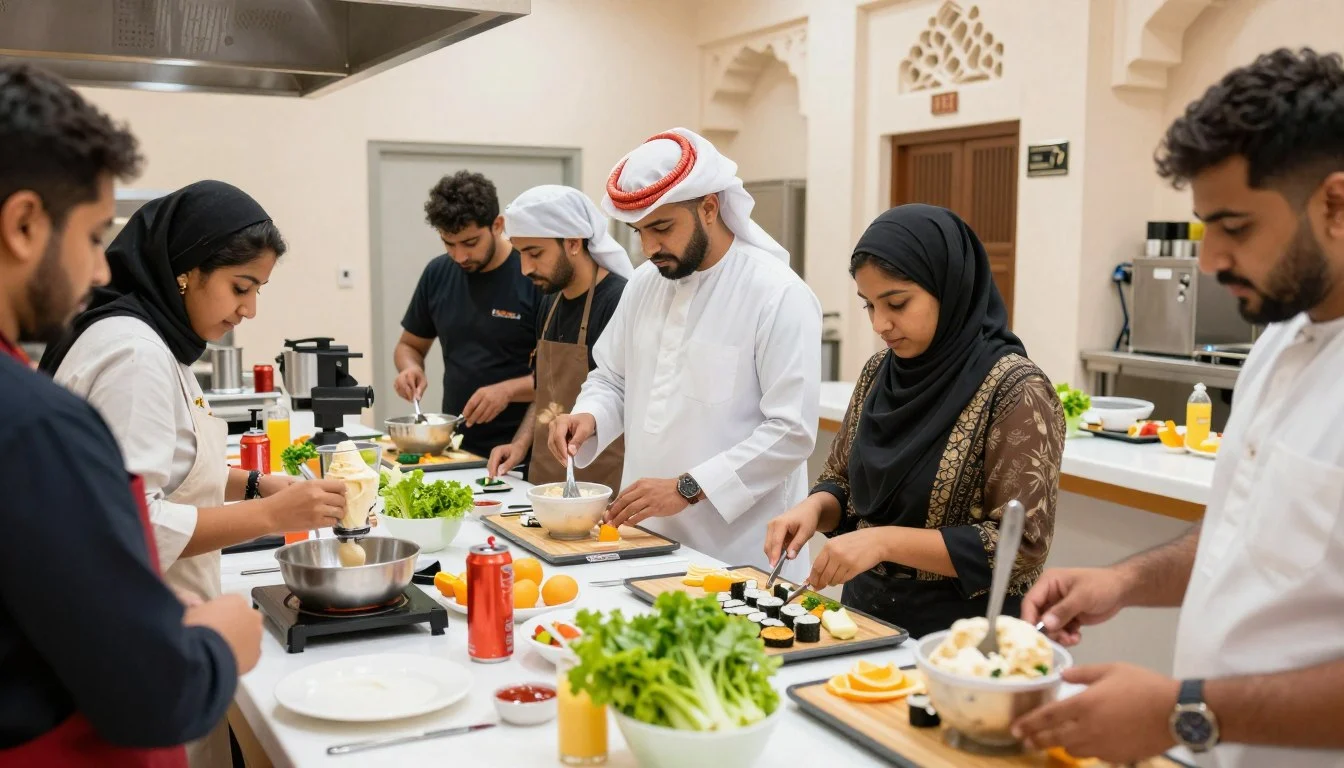
- You cook in every session instead of watching a demonstration from a distance.
- The trainer gives individual feedback on your technique, not only on the finished dish.
- You repeat core skills until they become reliable, such as cutting, seasoning, heat control and plating.
- Hygiene and safe handling are taught as habits, not as a short talk on the first day.
- The kitchen is organised the way a working kitchen is, with stations, timing and clean-down.
Skills a professional cooking course should build
Different specialisations emphasise different skills, but a solid professional course normally develops the same foundations:
- Knife skills and preparation: cutting consistently and preparing ingredients efficiently.
- Cooking methods: understanding why a technique works so you can adapt it.
- Flavour and seasoning: tasting as you go and correcting a dish.
- Presentation: plating food so it looks as good as it tastes.
- Kitchen organisation: working in order, keeping a clean station and managing your time.
- Food safety: handling, storing and serving food correctly.
These are the habits that a head chef notices in the first week of a new job. They matter more than memorising a long recipe list.
Why repetition matters more than variety
It is tempting to choose the course that promises the most dishes. In practice, a learner who cooks fewer dishes many times usually gains more than one who sees many dishes once. Repetition builds speed, consistency and confidence, and those are the qualities a kitchen team relies on.
When you visit or speak to an adviser, ask how the course balances new material with practice. A well-planned course revisits core techniques in different dishes so that skills stick.
Which specialisations can you study at Bright Future?
Cooking is a broad field, and choosing a specialisation makes your training more focused. Bright Future groups its kitchen-based programmes in the cooking and baking courses category, alongside wider hospitality training.
Culinary arts
The culinary arts programme is the broad route for people who want general professional cooking skills. It suits learners who are not yet sure which part of the kitchen they prefer and want a foundation that applies in restaurants, hotels and catering.
Baking, pastry and desserts
Baking rewards precision. Measurements, temperature and timing matter more than improvisation, which suits patient, detail-minded learners. If sweet work appeals to you, read about patisserie classes near me for a closer look at that path. The institute also offers baking, dessert, ice cream and pizza training for learners who want a narrower focus.
Sushi and international cuisines
A specialist course such as sushi making teaches a single cuisine in depth, including rice preparation, cutting and presentation. Focused courses like this suit learners who already know what they want to cook, or who want to add one distinctive skill to their profile.
Barista and beverage skills
Coffee is part of the food and beverage world, and many people combine kitchen and café skills. Barista training at Bright Future has three levels: Level 1 Basic, Level 2 Semi-Commercial and Level 3 Commercial / Professional. All three levels typically take 2 to 3 weeks. For the full picture, see barista training in Dubai.
Specialisations at a glance
| Specialisation | Best suited to | What you practise |
|---|---|---|
| Culinary arts | Learners who want broad kitchen skills | Core cooking methods, preparation and plating |
| Baking and pastry | Detail-minded, patient learners | Doughs, batters, finishing and presentation |
| Sushi | Learners drawn to a single cuisine | Rice, cutting techniques and presentation |
| Barista | Café and beverage careers | Espresso preparation and milk work, in three levels |
| Hospitality and F&B | People moving towards service or management | Front-of-house and operational skills |
How do you choose the right course for your goal?
Start with the result you want, then work backwards. The same course will feel excellent to one person and wrong to another, so spend a little time on honest self-assessment before you enquire.
If you want a new career
Career changers need a course that builds employable skills and a certificate that is easy to explain to an employer. Ask about the practical content, the supervision, and how the institute describes progression from beginner level. Be realistic: a course gives you skills, but your effort and your interview performance decide the rest.
If you already work in a kitchen
Experienced cooks often want a certificate for the skills they already use, or training in a new area such as pastry or a particular cuisine. A focused specialisation usually fits better than a broad foundation course.
If you are a student or school leaver
Young learners benefit from a general programme that keeps options open. Talk to a course adviser about which path suits your interests, and ask a parent or guardian to join the conversation if you wish.
If you are cooking for the family
If your goal is home cooking rather than employment, a more relaxed format may be enough. Parents looking for activities for children can read kids cooking classes in Dubai, which covers that audience separately.
Classroom or online: what suits cooking?
Bright Future runs classes in the classroom at the NBQ Building and as online live sessions. For a hands-on subject like cooking, the classroom has an obvious advantage: you use real equipment and the trainer can see and correct your technique.
Online live sessions still have a place. They can work well for theory, planning and discussion, and for learners who cannot travel to Bur Dubai regularly. Ask an adviser which parts of your chosen course are practical and which parts can be taught online, because the answer differs from course to course.
| Factor | Classroom | Online live session |
|---|---|---|
| Equipment | Professional kitchen equipment on site | Your own kitchen at home |
| Feedback | Trainer sees your technique directly | Trainer sees what the camera shows |
| Travel | You travel to Bur Dubai | No travel |
| Best for | Hands-on skill building | Theory and flexible learning |
How can you compare institutes fairly?
Comparing providers is difficult because they describe themselves in similar words. Use the same checklist for each one, and write the answers down so you are comparing facts, not impressions.
- Certificate: which authority approves it, and is it recognised in the UAE?
- Kitchen access: how much time is spent cooking rather than watching?
- Trainer support: do you get individual feedback?
- Clarity on cost: does the adviser explain what the fee includes?
- Flexibility: are there classroom and online options?
- Trial: can you attend a demo class before paying?
Be cautious with comparison websites that rank courses by sponsorship or by who pays for the listing. A page that shows a rating without explaining where it comes from tells you very little. A conversation with an adviser and a visit to the training environment tell you much more.
What should you ask before you enrol?
A short list of questions protects you from disappointment. Bring it to your first conversation with a course adviser.
- Which certificate will I receive, and which authority approves it?
- How much of each session is spent cooking?
- Is the training in the classroom, online, or both?
- What do I need to bring or prepare?
- What is the current fee, and what does it include?
- Which payment options are available?
- Can I book a free demo class first?
Payment options at Bright Future include Visa, Mastercard, Tabby and Tamara, and students can book a free demo class before enrolling. Fees are not published in this article because they change; the adviser will give you the current figure and explain what it covers.
How should you prepare before the first class?
Preparation is simple. You do not need prior experience for beginner-level training, but a few habits will help you learn faster.
- Write down your goal. One sentence is enough, for example "work in a hotel kitchen" or "specialise in desserts".
- List your questions. Use the checklist above.
- Check your availability. Decide whether you prefer classroom attendance or online live sessions.
- Ask about documents. The adviser will tell you what is needed for enrolment.
- Be ready to practise. Skills come from repetition, so plan time to cook between sessions if you can.
What happens after you finish?
Finishing a course is the start of the job search, not the end. Keep a simple record of the dishes you have learned to prepare, and practise them so you can describe them confidently. Be honest about your level at interviews, and show willingness to learn. Employers in hospitality notice reliability and teamwork as much as technique.
If you want to explore wider careers around food and service, ask the adviser about the hospitality and food and beverage courses that sit alongside the kitchen programmes.
Do you need experience, and what should you bring?
Many learners worry that they are too inexperienced to start. For beginner-level training, you do not need professional experience, only curiosity and a willingness to practise. Trainers expect beginners to ask basic questions, and a good class is designed so that a first-time cook can follow along.
Practical points are worth confirming with the adviser before your first session:
- Clothing and footwear: kitchens usually require closed shoes and comfortable clothing, and the institute will tell you what is expected.
- Hygiene: long hair is normally tied back and hands are washed often, as in any food environment.
- Notes: a small notebook helps you record techniques, ratios and trainer feedback.
- Dietary or health needs: tell the adviser in advance so the trainer can plan around them.
Can you combine cooking with other skills?
Yes, and many learners do. A cook who also understands coffee service, or who has studied food and beverage operations, is easier to place in a café or hotel. Others combine kitchen skills with language courses such as English or Arabic to communicate more confidently in a mixed team. An adviser can suggest a sensible order so that you are not trying to learn everything at once.
How do you reach the institute in Bur Dubai?
The institute is at Suite 404, Fourth Floor, NBQ Building, Bank Street, Bur Dubai, Dubai, United Arab Emirates. It is close to BurJuman Metro Station, which makes it easy to reach by public transport from many parts of the city. The institute is open daily, 9:00 AM to 5:00 PM.
Course advisers answer questions by phone and on WhatsApp at +971 54 373 3394, and by email at [email protected]. If you cannot visit in person, an adviser can explain the options over a call.
Talk to a course adviser
Choosing among cooking courses in Dubai is easier when you know your goal and have the right questions ready. Share your goal with a course adviser, ask about the KHDA-approved certificate, and book a free demo class to see the training environment before you commit. Start through the contact page, message +971 54 373 3394 on WhatsApp, or write to [email protected].