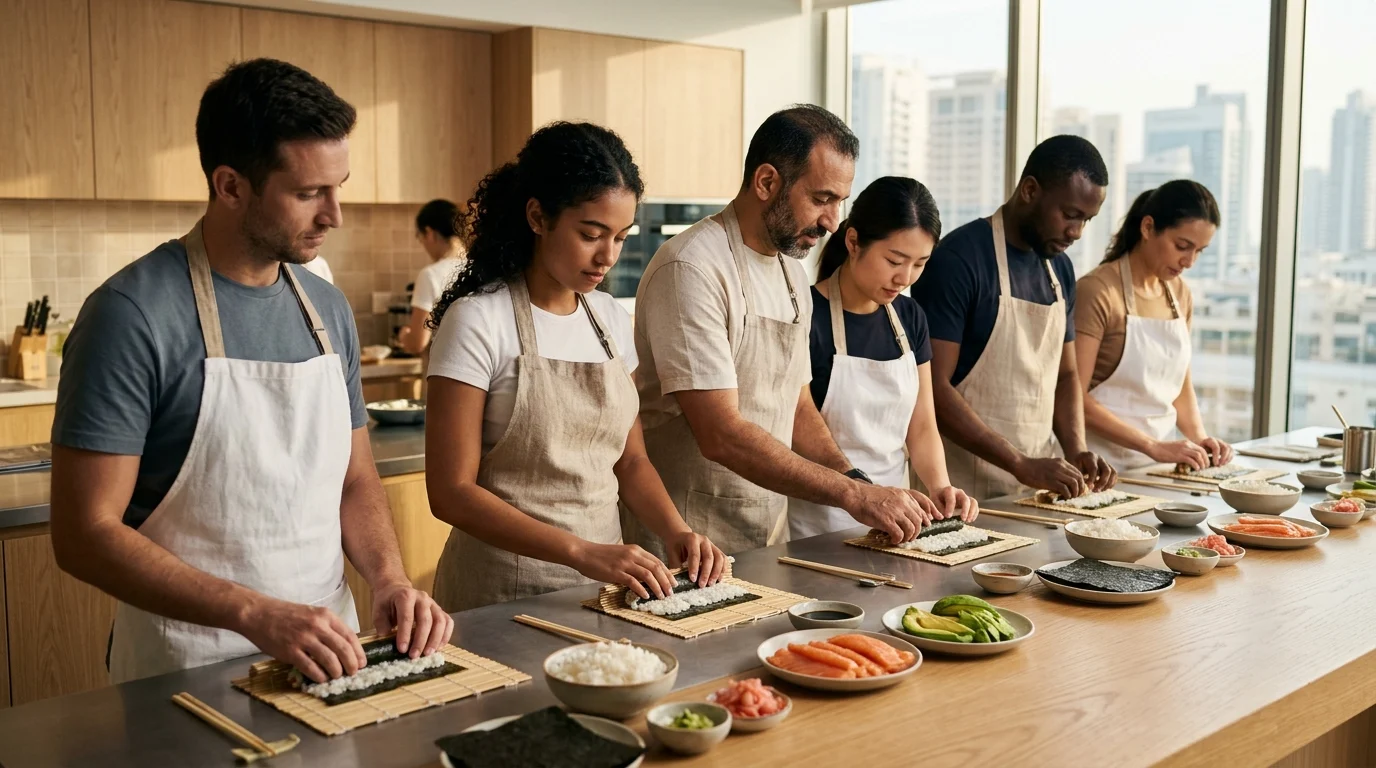
The right sushi making course in Dubai depends on your goal. A one-off workshop is a fun taster for a free evening with friends. A structured, hands-on course suits you better if you want real skills in rice, knife work, rolling and the safe handling of raw fish.
Key takeaways
- A hobby workshop gives you a quick taste of sushi, while a structured course builds practical skills step by step.
- Sushi rice is the core skill, so a good class gives it plenty of practice time and attention.
- Food safety with raw fish matters just as much as neat, tidy rolls.
- You can learn every rolling technique without raw fish by using vegetables, egg and cooked seafood.
- Classes run in the classroom in Bur Dubai or as online live sessions.
- Ask clear questions before you join, and book a free demo class if you are still unsure.
What are the two kinds of sushi classes in Dubai?
When you search for a sushi class in Dubai, you will usually find two main types. The first is a one-off hobby workshop, and the second is a structured training course with regular hands-on practice.
A hobby workshop is often a social event at a restaurant or hotel. You make a few simple rolls, eat them together and go home happy. It is a pleasant way to spend an evening with friends, family or colleagues.
A structured course goes much deeper, teaching you why each step matters, from washing the rice to slicing the fish. You also practise the same techniques again and again until they feel natural in your hands.
| Point to compare | One-off hobby workshop | Structured hands-on course |
|---|---|---|
| Main goal | Fun and a first taste | Real, lasting skills |
| Depth | A few simple rolls | Rice, rolls, nigiri, sashimi and plating |
| Food safety | Often a short mention | Taught as a core topic |
| Knife skills | Little or none | Practised with guidance |
| Certificate | Usually none | Ask what the course gives you |
| Best for | A night out or a gift | Home cooks, kitchen staff and future caterers |
If the structured route sounds right for you, see what the Sushi Making Course in Dubai covers. You can also browse other cooking and baking courses in Dubai if you would like to compare different cuisines first.
Who does a sushi training course suit?
A sushi training course is open to all skill levels, and you do not need any cooking experience to start. The course is hands-on, so you practise each technique yourself rather than only watching.
The course suits many different kinds of learners, including these groups:
- Home cooks who want to prepare sushi for family dinners, birthday parties and special occasions.
- Restaurant staff who would like to help on the sushi station or understand the dishes they serve.
- Chefs who want to add authentic Japanese dishes to their menu with proper technique.
- Culinary students who want an extra practical skill alongside their main kitchen training.
- Career changers who would like to try professional kitchen work in a supportive, hands-on setting.
- Small business planners who are thinking about a sushi catering service or a home food business.
Picture a hotel worker who sees sushi on every buffet, or a parent who wants healthy rolls for a lunch box. Both can learn side by side in the same class.
If you are new to cooking, our guide to cooking classes for beginners in Dubai explains what a first cooking class feels like.
What will you learn in a sushi making class?
A good sushi making class covers far more than rolling, from choosing ingredients to serving a finished plate. Here is a short checklist of what the course teaches:
- The foundations of Japanese cooking, the culture behind sushi and how to judge ingredient quality
- Knife skills for preparing fish and vegetables safely and neatly
- Cooking, seasoning and handling proper sushi rice
- Classic rolls, thin rolls, inside-out rolls, hand rolls, nigiri and sashimi
- Modern fusion ideas, creative rolls, garnishing and attractive presentation
- Food safety, hygiene, correct storage and temperature control
- Japanese sauces and condiments such as soy sauce, wasabi and ponzu
- Menu planning and basic business ideas for sushi catering
What do the sushi names mean?
Sushi words can sound confusing at first, so here are the main ones explained in plain English:
- Maki is a roll with seaweed on the outside and rice and filling inside.
- Hosomaki is a thin maki roll that usually holds just one simple filling.
- Uramaki is an inside-out roll, which means the rice sits on the outside.
- Temaki is a cone-shaped hand roll that you hold and eat with your fingers.
- Nigiri is a small, hand-pressed block of rice with a slice of fish on top.
- Sashimi means thin slices of raw fish served on their own, without any rice.
Which level should you start at?
The course is open to everyone, but each learner begins from a different place. Think honestly about your current skills and share them with the course adviser before you join.
| Where you are now | What to focus on first |
|---|---|
| You have never cooked | Kitchen safety, rice and simple vegetable rolls |
| You cook at home | Rice texture, rolling shape and neat cutting |
| You work in a kitchen | Speed, fish handling and clean plating |
| You are a chef adding a cuisine | Nigiri, sashimi, fusion rolls and menu ideas |
If you have never cooked
You will begin with the basics, like holding a knife correctly and keeping your workstation organised. Simple cucumber rolls are a calm and confidence-building way to begin.
If you already cook at home
You probably know how to cook ordinary rice, but sushi rice is quite different. Focus first on its texture and seasoning, and then work on rolls that stay tight when you cut them.
If you work in a kitchen or run one
You already understand hygiene, timing and working under pressure, so use the course to build specific Japanese techniques, such as slicing fish and shaping nigiri. The menu and catering topics can also help you plan new dishes for your customers.
Why is sushi rice the most important skill?
Many people think the fish is the star of sushi, but experienced chefs know the rice matters most. Good rice holds every roll together and gives each bite its balanced flavour.
Preparing sushi rice properly involves several careful steps that a trainer will guide you through:
- Washing the rice removes extra starch, which is the fine powder that makes rice gluey.
- Cooking it properly leaves each grain soft but still whole and separate.
- Seasoning means gently mixing in a rice vinegar blend for a light, sweet and sour taste.
- Cooling involves fanning and folding the rice so it cools without turning into paste.
- Covering the finished rice keeps it soft and stops it from drying out before you use it.
Rice that is too wet makes rolls fall apart, while rice that is too dry will not stick to the seaweed. A good trainer shows you how the rice should look and feel, so you learn to judge it with your own eyes and hands.
How do knife skills and food safety fit in?
Sushi uses very sharp knives and often raw fish, so skill and safety must always go together. A good course teaches both of them from the beginning.
Knife skills
You learn to hold the knife, slice in one smooth pulling motion, cut rolls cleanly and care for the blade. A sharp, well-kept knife is actually safer than a blunt one, because it needs less force.
Safe handling of raw fish
Raw fish needs extra care because cooking normally kills many harmful germs, so careful hygiene becomes your main protection. A quality course should teach these key habits:
- Keep fish cold from the moment you buy it until the moment you serve it.
- Buy fish only from trusted suppliers who sell fish that is meant for raw eating.
- Use separate chopping boards for raw fish, fresh vegetables and cooked food.
- Wash your hands, knives, tools and work surfaces often during preparation.
- Store any leftovers correctly, or throw them away if you have any doubt.
Dubai is a hot city, so cold storage matters even more here than in cooler places. Even a short drive home from the supermarket in summer can warm fish quickly, so always carry a cool bag when you shop.
If you plan to sell food, you must follow Dubai Municipality food safety rules. Check the current requirements directly with the authority before you start any kind of food business.
Can you learn sushi without eating raw fish?
Yes, and many learners do exactly that, since sushi is really about rice and rolling. You can practise every technique with popular fillings such as these:
- Cucumber is fresh and crunchy, and it works perfectly in thin rolls.
- Avocado is soft and creamy, and it tastes great in inside-out rolls.
- Cooked prawn is a safe seafood choice for both nigiri and rolls.
- Crab stick is easy to find in Dubai supermarkets and very simple to use.
- Egg cooked as a sweet Japanese-style omelette is a classic topping.
Vegetarian sushi is a smart skill for caterers, because many events in the UAE need choices for guests with different diets. Tell the course adviser what you eat, so they can explain the options available in class.
Should you choose classroom or online live sessions?
Bright Future Training Institute offers both options, so you can pick the one that fits your life. Classroom training takes place at the NBQ Building on Bank Street, Bur Dubai, close to BurJuman Metro Station. Online live sessions let you join from your own home anywhere in the UAE.
| Point to compare | Classroom in Bur Dubai | Online live sessions |
|---|---|---|
| Where you cook | The classroom in Bur Dubai | Your own kitchen at home |
| Ingredients and tools | Ask the adviser what is provided | Usually your own, so ask the adviser what to buy |
| Trainer feedback | In person, at your station | The trainer watches you on camera |
| Best for | Hands-on learners who like a group | People far from Bur Dubai or with busy days |
| What to set up | Just arrive ready | A clear camera view of your board |
The classroom suits you if you learn best by watching closely, because the trainer can correct your hand position or rolling pressure immediately.
Online learning works well if you live in another emirate or look after children at home. Set up a clean counter, good lighting and a phone or laptop on a steady stand, so the trainer can see your hands clearly.
Questions to ask before you join a sushi class
Use this checklist with any sushi course you are considering, because clear answers help you avoid surprises later.
- How much of each class is actual hands-on practice rather than watching?
- Which fish do you use in class, and how is it stored and handled?
- Are vegetarian and cooked options taught for people who avoid raw fish?
- Will I take home the sushi I make during the class?
- What exactly does the certificate say, and which authority approves it?
- Is the course taught in a classroom, online or both?
- What tools or ingredients do I need to bring or buy myself?
- Can I book a demo class before I decide, and which payment options do you accept?
At Bright Future Training Institute, certificates are approved by KHDA and recognised across the UAE. That is often what people really mean when they search for sushi certification. Ask the adviser to explain exactly what your certificate will show.
What decides the fee?
Fees depend on the class format, the level you choose and what the course includes, so ask a course adviser for current fees. Payment options include Visa, Mastercard, Tabby and Tamara.
How should you get ready for your first class?
A little planning makes your first class calm, safe and enjoyable, so work through this simple checklist:
- Tie your hair back neatly so it stays well away from the food.
- Keep your fingernails short and clean, because you will touch rice and fish directly.
- Wear closed shoes, since kitchens have sharp knives and sometimes wet floors.
- Bring an apron if the course adviser asks you to bring one.
- Eat a proper meal before you arrive, so hunger does not distract you.
- Bring a notebook and pen to write down useful tips and recipes.
- Tell the adviser about any food allergies well before the class begins.
Allergies are especially important in sushi, because fish, shellfish, sesame and soy appear in many recipes. Speak up early so the trainer can plan safe swaps for you.
How can you practise at home between classes?
Regular practice is what turns a single lesson into a real skill. You do not need a big kitchen, because a small counter and a few simple tools are enough.
- Buy a bamboo rolling mat, since it helps you make tight, even shapes.
- Start with cucumber rolls, because they are affordable, simple and safe to repeat.
- Practise your rice by making a small batch and checking its texture and taste.
- Wrap the mat in cling film for inside-out rolls, so the rice does not stick to the bamboo.
- Keep your hands damp with a small bowl of water, which stops rice sticking to your fingers.
- Film your hands while you roll, then watch the video to spot uneven pressure or messy edges.
Try to focus on one new skill at a time, such as rolling first and cutting later. Write down your questions and bring them to your next class.
Where can sushi skills be used in the UAE?
Sushi is popular across the UAE, from restaurants and hotel buffets to catering trays and home food businesses. Some learners simply cook for family and friends, while others help on a sushi station at work or plan small catering orders. Core skills like rice preparation, knife work and hygiene are useful in many different kitchens.
No course can promise you a job, because your progress depends on practice and the path you choose. If you want to explore a career, read our guide on how to become a sushi chef in the UAE. For broader kitchen skills, take a look at the chef training programme.
Choose your sushi class with confidence
The best sushi class is the one that matches your goal. A hobby workshop is great for fun, but a structured course builds real skills in rice, rolling, knives and safety.
Read what the Sushi Making Course in Dubai covers. Then talk to a course adviser or book a free demo class through the contact page. You can reach an adviser on WhatsApp or phone +971 54 373 3394, or by email at [email protected].